
Anvil
Anvil is an online IDE for building and deploying full-stack web applications with Python.
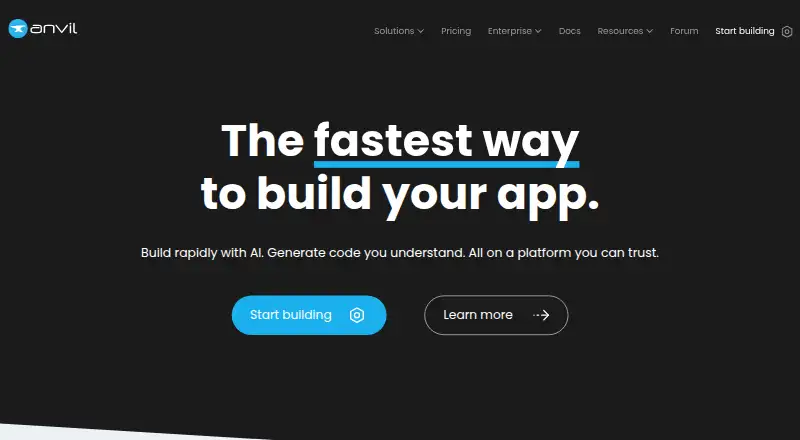
What Anvil is
Anvil is an online IDE for building and deploying full-stack web applications with Python. It combines a drag-and-drop interface designer with client-side and server-side Python, and includes Data Tables, a built-in database backed by Postgres. Apps can be published to Anvil hosting or exported to run on the open-source Anvil App Server. Developers can create HTTP APIs and connect external Python code through Uplink. Anvil also includes user authentication and support for sending and receiving email from apps.
Its documentation lists integrations with Google, Microsoft Entra ID, Facebook, Stripe, and Tableau, and says Python SDKs can connect other services. Anvil apps are responsive for phones and tablets; the FAQ describes them as Progressive Web Apps installable on Android, iPhone, and Chromebook, with offline operation. The free plan is listed as free and includes unlimited apps and cloud hosting, but limits Data Tables to 50,000 rows and 100 MB of storage. Anvil says its hosted infrastructure is in London on AWS eu-west-2. The Production plan includes private support, with responses to development questions within 24 working hours according to the FAQ.
Good
- Combines drag-and-drop UI design with Python
- Includes a Postgres-backed built-in database
- Apps can run on Anvil hosting or Anvil App Server
- Supports HTTP APIs and external Python connections
- Free plan includes unlimited apps
Watch out
- Free plan caps Data Tables at 50,000 rows
- Free plan limits Data Table storage to 100 MB
- Free plan background tasks have a 30-second timeout
- Private support is listed for Production
Who it suits
Anvil suits Python developers who want to build web apps using both visual interface design and code. Its responsive, installable apps may also suit projects intended for phone and tablet use.
Verdict
Anvil combines a visual builder, Python development, database, and deployment options for web apps. The free plan has useful core tools, but its storage, row, and background-task limits matter for larger projects.
Plans and prices
From Anvil's own pricing page, checked 15 Oct 2026.
| Plan | Price | What it gives you |
|---|---|---|
| Free | Free | unlimited apps · cloud hosting · install any library · 50,000 Data Table rows · 100 MB storage · 30-second background-task timeout · free forever |
| Hobby | $12 a month | one developer · scheduled tasks · one custom domain · no Anvil banner · 150,000 Data Table rows · 10 GB storage · monthly; $10/month when billed annually |
| Business | $89 a month | collaboration · SSO · staging environments · 1+ developers · 1,000,000 Data Table rows · 100 GB storage · monthly; $79/month when billed annually, excluding VAT |
| Enterprise | Priced on request | private deployment · on-premises or cloud · corporate authentication · fully isolated instance · contact sales |
| Production | — | private support · reserved resources · unlimited extra compute · SQL access to Data Tables · isolated database · monthly; $900+190/month when billed annually, excluding VAT |
The facts
Each one read from Anvil's own pages, with the date it was checked.
What it does
- API documentation
- The API reference documents Anvil modules, classes, functions, methods and properties.checked 15 Oct 2026
- APIs and code connections
- Anvil supports building HTTP APIs and connecting external Python code through Uplink.checked 30 Sep 2026
- Authentication and email
- Built-in services cover user authentication, API construction, and sending and receiving email.checked 15 Oct 2026
- Cloud deployment
- Apps can be published to Anvil hosting in two clicks with public URLs, private links, custom domains and multiple environments.checked 15 Oct 2026
- Community limitation
- An independent Anvil best-practices guide says separating development, testing and production is more limited on lower plans and staging environments reduce that friction on higher plans.checked 15 Oct 2026
- Cross-site request protection
- External HTTP endpoints use a separate session by default so cross-site requests do not receive the browser’s logged-in cookies.checked 15 Oct 2026
- Database
- Anvil includes Data Tables, a built-in database backed by Postgres.checked 30 Sep 2026
- Data Tables
- The built-in Data Tables database has a Python API for retrieving, updating and deleting records, while external databases can also be used from server code.checked 15 Oct 2026
- Documentation and support
- Anvil provides API reference material, tutorials, how-to guides and a community forum, with private support included in Production plans.checked 15 Oct 2026
- Enterprise deployment
- Enterprise installations run as three Docker containers and can operate on private networks or fully air-gapped environments.checked 15 Oct 2026
- GitHub integration
- Anvil can synchronize app code with GitHub and other Git remotes; private repositories require Business or higher, while public open-source repositories are available to all accounts.checked 15 Oct 2026
- Hosting
- Anvil apps can be published to Anvil hosting or exported to run on the open-source Anvil App Server.checked 30 Sep 2026
- Hosting region
- Anvil states its hosted infrastructure is in London on AWS eu-west-2.checked 30 Sep 2026
- Independent developer view
- Empiria reports that Anvil provides escape hatches to JavaScript, HTML, CSS and SQL when its Python abstractions are insufficient.checked 15 Oct 2026
- Independent technical assessment
- InfoWorld describes Anvil as combining drag-and-drop tools with Python client and server code, while noting that its generated stack includes older dependencies such as Bootstrap 3.checked 15 Oct 2026
- Infrastructure location
- Anvil says its standard infrastructure is hosted in London on AWS eu-west-2.checked 15 Oct 2026
- Integrations
- Built-in integrations include Google services, Microsoft Entra ID and Azure APIs, Facebook login, Stripe payments and Tableau extensions.checked 15 Oct 2026
- Interface
- Anvil provides a drag-and-drop UI designer and lets developers write client-side and server-side Python.checked 30 Sep 2026
Where it runs
- App Server licence
- The App Server uses an AGPL-based licence with a carve-out allowing closed-source applications; commercial non-AGPL licences are available from Anvil.checked 15 Oct 2026
The company
- Company
- Anvil identifies The Tuesday Project Ltd. as the company behind its Anvil trademarks.checked 30 Sep 2026
- Company founding and headquarters
- An independent company profile lists Anvil as founded in 2015, headquartered in Cambridge, United Kingdom, and founded by Meredydd Luff and Ian Davies.checked 15 Oct 2026
- Company legal name
- Anvil is operated by The Tuesday Project Ltd.checked 15 Oct 2026
- Company operating model
- The Company Check classifies Anvil as both SaaS and freemium and lists Anvil Platform and Anvil X as its products.checked 15 Oct 2026
- Headquarters
- Cambridge, United Kingdomchecked 28 Sep 2026
The full review of Anvil
Overview
Anvil is an online development environment for creating and deploying full-stack web apps with Python. It brings a visual interface designer, client-side and server-side Python, a built-in database and hosting options together. Developers can publish apps to Anvil’s hosting or export them to run on the open-source Anvil App Server.
The product is made by The Tuesday Project Ltd., which identifies itself as the company behind Anvil’s trademarks. Anvil says its hosted infrastructure runs on AWS in London, in the eu-west-2 region. Its scope extends beyond app code: it includes user authentication and email, and supports HTTP APIs as well as connections to external Python code through Uplink.
Anvil’s documented integrations include Google, Microsoft Entra ID, Facebook, Stripe and Tableau. Python SDKs can also connect services. The product is available across a broad set of environments, while the apps it creates are responsive and can be used on phones and tablets.
Key features
Visual design and Python development
The drag-and-drop UI designer lets developers arrange an app’s interface, then add behavior using Python on both the client and server. Anvil also lists an integrated debugger, an integrated profiler, code intelligence, and Python environment tools. Code intelligence is identified as AI-assisted.
Data and deployment
Anvil’s Data Tables are a built-in database backed by Postgres. Apps can remain on Anvil hosting or be exported for the open-source Anvil App Server, giving teams a choice between hosted and self-managed deployment. HTTP API support and Uplink provide ways to expose app functionality or connect code running outside Anvil.
The Free plan sets concrete ceilings for Data Tables: 50,000 rows and 100 MB of storage. It also limits background tasks to a 30-second timeout. Those limits matter when deciding whether a free deployment can accommodate an app’s data and workload.
Authentication, email and security
Apps can use built-in user authentication and send and receive email. Anvil says its API is designed to remove common security flaws, including injection, cross-site scripting (XSS) and cross-site request forgery (CSRF). It also states that its AI agents run in isolated sandboxes without access to a user’s infrastructure or local machine.
Mobile access and integrations
Anvil apps adapt to phone and tablet screens. According to its FAQ, they are Progressive Web Apps that can be installed on Android, iPhone and Chromebook, and can operate offline. For third-party services, Anvil documents integrations with Google, Microsoft Entra ID, Facebook, Stripe and Tableau, with Python SDKs available for connecting other services.
Pricing
Anvil describes its pricing model as freemium, and its Free plan is listed as free, billed Free forever. It includes unlimited apps, cloud hosting, the ability to install any library, one developer, 50,000 Data Table rows and 100 MB of Data Table storage.
The pricing information for paid plans is not sufficiently clear to state a single price for each plan. The Hobby plan is marked as billed annually and shows figures of 12 / 10 / 14 under Annual and 13 / 11 / 15 under Monthly, with USD, GBP and EUR selectors. It is for personal projects and one developer, and includes no Anvil banner, Scheduled Tasks, one custom domain, 150,000 Data Table rows and 10 GB of Data Table storage.
Business is marked as billed annually and displays 89 / 79 / 99 under Annual and 99 / 87 / 109 under Monthly, with the same currency selectors; VAT is excluded. Its listed features include professional use, one or more developers, app collaboration, SSO in apps, staging environments, community support and a 1,000,000 Data Table row allowance.
Production is also marked as billed annually. It displays 1050+220 / 900+190 / 1200+250 under Annual and 1150+240 / 990+210 / 1320+275 under Monthly, with currency selectors; VAT is excluded. Listed inclusions are private support, reserved resources, unlimited extra compute, SQL access to Data Tables and isolated infrastructure. Anvil says Production support responds to development questions within 24 working hours.
Enterprise pricing is by contacting sales. Its listed deployment and access options include private deployment on-premises or in the cloud, corporate authentication and full isolation.
Platforms
Anvil lists Android, iOS, Linux, macOS, Windows, web, API and self-hosted availability. The supported-platform listing also names web, iOS and Android. Its installable Progressive Web Apps provide a route to mobile use without requiring a separate native app, and the FAQ states they can work offline.
Who it's for
Anvil fits developers who want to build full-stack web apps in Python while using a visual designer for interface layout. Its built-in database, authentication, email and hosting can suit projects that need several common app components in one development environment. Uplink, HTTP APIs, documented integrations and Python SDK connections are relevant when an app needs to work with external code or services.
The free tier offers a way to start without a listed charge, but its one-developer setup, data caps and 30-second background task timeout are important constraints. Hobby is oriented toward personal projects, while Business lists collaboration, SSO and staging. Production adds private support and reserved resources; Enterprise is the option described for private, isolated deployment.
Pros and cons
- Pros: Python is used on both client and server sides; the visual designer, Postgres-backed Data Tables, hosting, authentication and email are included in the platform.
- Pros: Apps can be hosted by Anvil or exported to the open-source Anvil App Server, and external code can connect through Uplink.
- Pros: Responsive Progressive Web Apps can be installed on listed mobile devices and, according to the FAQ, operate offline.
- Cons: The Free plan has explicit limits on Data Table rows, storage and background task duration.
- Cons: Paid-plan prices are shown as sets of figures with currency selectors rather than a single unambiguous amount in the supplied pricing details.
- Cons: Production support is a paid-plan feature; the response commitment given is within 24 working hours, not an immediate service.
Alternatives
Anvil belongs in the broader Python IDEs category and also overlaps with Low-Code Development Platforms. For other Python development environments, consider Eric, Spyder, Positron, Thonny, PyCharm, PyScripter, NINJA-IDE and Pyzo.
Verdict
Anvil combines Python application code with visual UI design, data storage and deployment options, aiming to cover much of the path from interface to hosted app in one environment. Its built-in authentication, email, API support and service connections extend that scope. The main practical considerations are the Free plan’s data and task limits and the unclear paid-plan price presentation. Developers seeking a Python-centered way to build responsive full-stack web apps may find its integrated approach useful, while teams choosing a paid plan should confirm the relevant currency and billing amount before committing.
Getting started
- Visit https://anvil.works/.
- Start with the Free plan, which is free forever and includes cloud hosting.
- Build the interface with the drag-and-drop UI designer and add client-side and server-side Python.
- Use Data Tables or connect services through listed integrations, Python SDKs, HTTP APIs, or Uplink.
- Publish to Anvil hosting or export the app to run on the open-source Anvil App Server.
Limits worth knowing
The Free plan allows one developer and includes 50,000 Data Table rows, 100 MB of Data Table storage, and a 30-second background task timeout.
Questions
Is Anvil free?
Yes. Its Free plan is free and is billed free forever.
What platforms can Anvil apps use?
Anvil lists web, iOS, and Android as supported platforms. Its apps are responsive, and its FAQ describes them as installable Progressive Web Apps on Android, iPhone, and Chromebook with offline operation.
Can I host an app myself?
Yes. Apps can be exported to run on the open-source Anvil App Server. Anvil also offers private deployment on premises or in the cloud through Enterprise.
Which integrations are listed?
Documentation lists Google, Microsoft Entra ID, Facebook, Stripe, and Tableau. Python SDKs can also connect services.
What does the Free plan include?
It includes unlimited apps, cloud hosting, one developer, 50,000 Data Table rows, and 100 MB of Data Table storage.
Who makes Anvil?
Anvil identifies The Tuesday Project Ltd. as the company behind its Anvil trademarks and lists Cambridge, United Kingdom as its headquarters.
Alternatives to Anvil
- 1

Joget
Free planOpen sourceAndroidiOSWebAPI8.8Free plan - 2

ToolJet
Free planOpen sourceWebAPILinuxSelf-hosted8.3From $23 a month - 3

Windmill
Free planOpen sourceWebAPILinuxSelf-hosted8.3From $120 a month - 4

GeneXus
Free planAndroidiOSWebAPI8.2From $99 a year - 5

Budibase
Free planOpen sourceWebAPILinuxSelf-hosted8.1From $19 a month - 6
Omnis Studio
Free planAndroidiOSWebAPI8.1From $9.38 a month