
Android Emulator
Android Emulator simulates Android devices on a computer so developers can test apps across device types and Android API levels.
What Android Emulator is
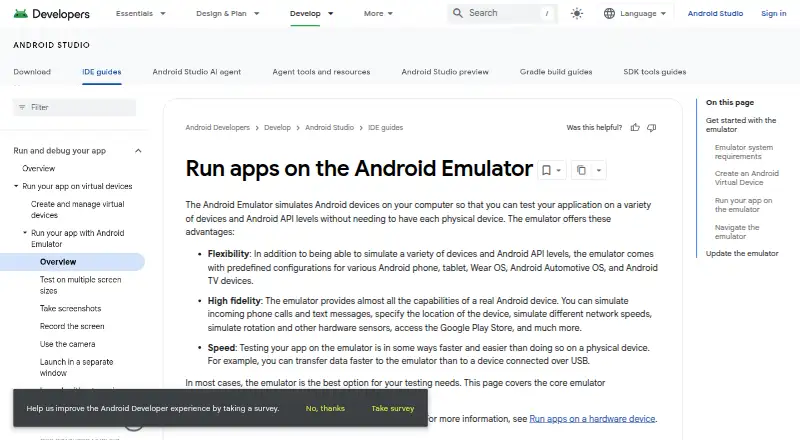
Android Emulator simulates Android devices on a computer so developers can test apps across device types and Android API levels. It comes with Android Studio and does not need a separate installation. Predefined Android Virtual Device configurations cover phones, tablets, Wear OS, Android Automotive OS, and Android TV. The emulator can simulate calls, texts, locations, network speeds, rotation, hardware sensors, and Google Play Store access. Each virtual device defines an Android version and hardware characteristics, with private storage for user data, SD card data, and related files. A first launch may take about a minute; later launches can use snapshots and start faster. Hardware acceleration can improve performance. Supported systems include 64-bit Windows 10 or newer, macOS 12 or newer, Linux, and ChromeOS. The recommended baseline is 16 GB of RAM and 16 GB of disk space, while higher API levels or larger virtual devices may need more. Android Studio on ChromeOS currently deploys apps only to connected hardware devices.
Good
- Bundled with Android Studio; no separate installation needed.
- Predefined profiles cover phones, tablets, and more.
- Simulates calls, locations, network speeds, and sensors.
- Google Play Store access is supported.
- Later launches can use snapshots.
Watch out
- 16 GB RAM and 16 GB disk are recommended.
- Higher API levels may need stronger system specifications.
- ChromeOS deployment is limited to connected hardware devices.
Who it suits
It suits developers who need to check apps across Android versions and device types without relying only on physical devices. It is also useful for Wear OS testing, with a pairing assistant included in Android Studio.
Verdict
Android Emulator brings multiple Android device configurations and simulated conditions into an Android Studio workflow. Check the system recommendations and ChromeOS limitation before choosing it for a test setup.
Plans and prices
From Android Emulator's own pricing page, checked 28 Sep 2026.
| Plan | Price | What it gives you |
|---|---|---|
| Android Emulator (bundled with Android Studio) | Free | Included with Android Studio · 16 GB RAM · 16 GB disk space |
The facts
Each one read from Android Emulator's own pages, with the date it was checked.
What it does
- Acceleration
- Hardware acceleration improves emulator performance through graphics acceleration and virtual-machine acceleration.checked 28 Sep 2026
- Capabilities
- The emulator can simulate calls, text messages, locations, network speeds, rotation, hardware sensors, and Google Play Store access.checked 28 Sep 2026
- Cloud integrations
- Android Studio integrations include Firebase Device Streaming, Firebase Crashlytics, Google Play Vitals data, and Gemini in Android Studio.checked 28 Sep 2026
- Gamepad support
- Yeschecked 19 Sep 2026
- Google Play support
- Yeschecked 19 Sep 2026
- Higher requirements
- Higher API levels or larger-screen virtual devices may require higher system specifications.checked 27 Sep 2026
- Installation
- The Android Emulator comes with Android Studio and does not need to be installed separately.checked 28 Sep 2026
- Integration availability
- Cloud service integrations require the latest stable Android Studio channel or a major version released within the previous 10 months.checked 28 Sep 2026
- Known limitations
- Android Studio on ChromeOS currently supports deploying apps only to a connected hardware device.checked 28 Sep 2026
- Minimum disk space
- At least 16 GB of disk space is recommended.checked 27 Sep 2026
- Minimum RAM
- At least 16 GB of RAM is recommended for the best experience.checked 27 Sep 2026
- Multi-instance
- Yeschecked 19 Sep 2026
- Network isolation
- Before Android Emulator version 36.5, each emulator instance operated behind its own virtual router or firewall that isolated it from the host network and other emulator instances.checked 28 Sep 2026
- Primary purpose
- Simulates Android devices on a computer for application testing.checked 27 Sep 2026
- Private storage
- Each AVD has private storage for user data, an SD card, and related data.checked 27 Sep 2026
Where it runs
- Android Studio
- The emulator comes with Android Studio and does not require separate installation.checked 27 Sep 2026
- Desktop platforms
- Windows, macOS, Linux, ChromeOSchecked 19 Sep 2026
- Device configurations
- Includes predefined configurations for phones, tablets, Wear OS, Automotive OS, and Android TV.checked 27 Sep 2026
- Device coverage
- Tests applications across a variety of devices and Android API levels.checked 27 Sep 2026
- Device profiles
- Predefined configurations cover Android phones, tablets, Wear OS, Android Automotive OS, and Android TV devices.checked 28 Sep 2026
- Device simulation
- Simulates calls, texts, location, network speeds, rotation, hardware sensors, and Google Play Store access.checked 27 Sep 2026
- Keyboard mapping
- Yeschecked 19 Sep 2026
- Physical device option
- A physical device is suggested when the computer does not meet the recommended specifications.checked 27 Sep 2026
Money
- Free plan
- Yeschecked 19 Sep 2026
The full review of Android Emulator
Overview
Android Emulator provides virtual Android devices on a computer for checking apps across device types and Android API levels. It is intended for application testing, particularly when developers need to cover more than one configuration without using a separate physical device for each. The emulator is bundled with Android Studio, so it does not require a separate installation.
Each virtual device is an Android Virtual Device (AVD), which sets its Android version and hardware characteristics. AVDs keep user data, SD card data, and cache in private storage. Predefined profiles include phones, tablets, Wear OS devices, Android Automotive OS, and Android TV.
The emulator can simulate calls, text messages, locations, network speeds, screen rotation, hardware sensors, and Google Play Store access. A mouse pointer can mimic a finger on its touchscreen. Testing and data transfer can be faster and easier than on a physical device, though the experience depends on the computer meeting the recommended specifications.
Key features
Device and condition coverage
Developers can select device profiles and Android API levels to check how an application behaves across configurations. Simulated calls, texts, location, network speeds, rotation, and sensor input help exercise scenarios that would otherwise require access to a physical device or particular conditions. Google Play support is available as well.
Repeat launches and acceleration
The first launch may take about a minute. Later launches can use a snapshot and should be faster. Hardware acceleration can improve performance through graphics and virtual-machine acceleration.
Wear OS pairing
Android Studio includes a Wear OS pairing assistant for pairing Wear OS emulators with physical or virtual phones. This helps set up a paired-device testing arrangement from within Android Studio.
Android Studio integrations
Android Studio integrations include Firebase Device Streaming, Firebase Crashlytics, Google Play Vitals data, and Gemini in Android Studio. Access to these cloud service integrations requires the latest stable Android Studio channel or a major version released within the previous 10 months. Android Studio also supports Git, GitHub, CVS, Mercurial, Subversion, and Google Cloud Source Repositories.
Pricing
Android Emulator is free and included with Android Studio. The listed plan is free, with 16 GB RAM and 16 GB disk space noted. Those memory and storage figures are recommended baselines, not a separate paid tier.
Platforms
Supported systems include 64-bit Windows 10 or higher, macOS 12 or higher, Linux, and ChromeOS. The recommended baseline is at least 16 GB of RAM and 16 GB of disk space; higher API levels or larger-screen virtual devices may need stronger system specifications. If a computer falls short of the recommended specifications, a physical device is suggested instead.
There is an important ChromeOS limitation: Android Studio currently supports deploying apps only to a connected hardware device on that platform.
Who it's for
Android Emulator is aimed at developers who need to test Android applications against multiple device profiles, API levels, or simulated conditions from a computer. It is especially relevant when a project needs phone, tablet, Wear OS, Automotive OS, or Android TV coverage. It is less suitable as the only route for ChromeOS app deployment, since that workflow currently requires a connected hardware device.
Pros and cons
- Pros: It covers varied device profiles and API levels, offers useful condition simulation, supports Google Play access, and is included with Android Studio.
- Pros: AVDs have independent private storage, repeat launches can use snapshots, and hardware acceleration can improve performance.
- Cons: The recommended baseline of 16 GB RAM and 16 GB disk space may be demanding for some computers, with higher-spec virtual devices requiring more.
- Cons: ChromeOS deployment is currently limited to connected hardware devices.
Alternatives
For other options, browse Android emulators or Emulator Software. Alternatives listed in this category include Genymotion Desktop, BlueStacks App Player, NoxPlayer, LDPlayer, MEmu Play, Cuttlefish, GameLoop, and GeeLark.
Verdict
Android Emulator is a focused development tool for testing Android apps across virtual devices and controlled conditions, rather than a substitute for every physical-device check. Its broad profile coverage, simulation controls, and Android Studio integration make it useful for development workflows, while system requirements deserve attention before relying on it. When issues arise, the official troubleshooting page lists known problems and workarounds and directs users to report bugs if no workaround succeeds.
Getting started
- Install Android Studio, which includes Android Emulator.
- Create an Android Virtual Device using a predefined device configuration.
- Choose the Android version and hardware characteristics for the virtual device.
- Launch the emulator and test the application, using its simulation controls as needed.
- For Wear OS testing, use Android Studio’s pairing assistant to pair the emulator with a phone.
Limits worth knowing
The free bundled plan lists a baseline of 16 GB RAM and 16 GB disk space. Higher API levels and larger-screen virtual devices may require higher system specifications; ChromeOS deployment is limited to connected hardware devices.
Questions
Is Android Emulator free?
Yes. Android Emulator is free and bundled with Android Studio.
Which operating systems are supported?
Supported systems are 64-bit Windows 10 or higher, macOS 12 or higher, Linux, and ChromeOS.
What device types can I emulate?
Predefined configurations cover phones, tablets, Wear OS, Android Automotive OS, and Android TV.
What can the emulator simulate?
It can simulate calls, texts, locations, network speeds, rotation, hardware sensors, and Google Play Store access.
What computer specifications are recommended?
The recommended baseline is 16 GB RAM and 16 GB disk space. Higher API levels or larger virtual devices may require more.
Can I deploy apps from Android Studio on ChromeOS?
Android Studio on ChromeOS currently supports deploying apps only to a connected hardware device.
Alternatives to Android Emulator
- 1

Genymotion Desktop
Free planLinuxmacOSWindows8.2From $49 a year - 2

BlueStacks App Player
Free planmacOSWindows7.9From $7.99 a month - 3

Appetize
Free planAndroidiOSWebAPI7.9From $59 a month - 4

QEMU
Free planOpen sourceAPILinuxmacOSSelf-hosted7.8Free plan - 5
VMOS Cloud
AndroidiOSWebAPI7.5 - 6
GeeLark
Free planLinuxmacOSWindows7.3From $3.25 a month