
AI Rule Engine
AI Rule Engine automates policy-governed decisions such as claims triage, eligibility, prior authorization, and underwriting referrals.
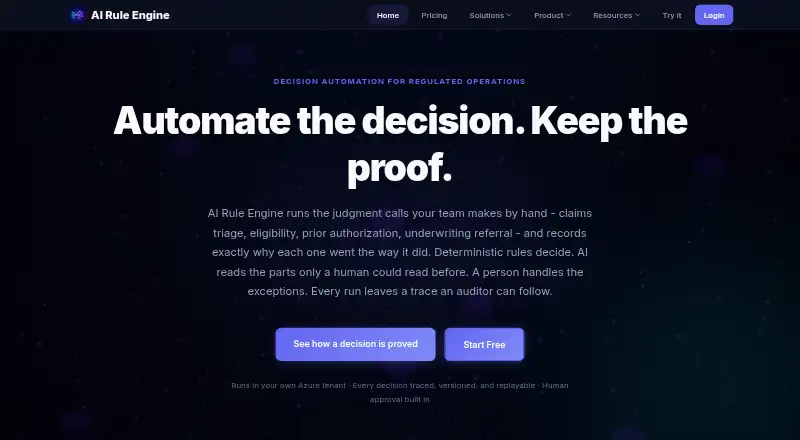
What AI Rule Engine is
AI Rule Engine automates policy-governed decisions such as claims triage, eligibility, prior authorization, and underwriting referrals. Customer-authored and approved deterministic rules decide outcomes; AI can classify, extract, or summarize unstructured input into facts. Run traces show which rules fired, their sequence, matched values, and changes to decision context. Static verification can flag rules that cannot fire, duplicates, conflicting writes, and input combinations without a matching rule, while saved tests can gate releases. The product supports API actions, marketplace extensions, durable storage actions, and external API access. Native model options include Anthropic Claude, OpenAI ChatGPT, Azure OpenAI, Google Gemini, and xAI Grok, using customer-provided keys. Every plan includes an MCP server for configured AI assistants to trigger workflows and access permitted files and run logs. Security controls include SSO, SCIM, IP allowlisting, custom roles, append-only audit events, SIEM streaming, and signed release records. The maker states it lacks SOC 2 attestation, a DPA or BAA, and an independent third-party penetration test.
Good
- Deterministic rules govern outcomes; AI can extract input facts.
- Run traces show fired rules and decision-context changes.
- Static verification flags several rule and coverage problems.
- Saved tests can gate releases.
- Every plan includes an MCP server.
Watch out
- No SOC 2 attestation is available.
- A DPA or BAA is not yet offered.
- No independent third-party penetration test has been conducted.
- Run overages are billed through credits.
Who it suits
AI Rule Engine suits regulated operations teams handling insurance claims or underwriting, and health-plan eligibility or prior authorization. Its rule traces, testing, and approval controls are relevant where teams need to review how decisions were reached.
Verdict
AI Rule Engine combines customer-controlled decision rules with AI-assisted handling of unstructured input, testing, and decision traces. Its stated security limitations are important for teams assessing regulated workloads; paid plans start at $49 a month.
Plans and prices
From AI Rule Engine's own pricing page, checked 7 Oct 2026.
| Plan | Price | What it gives you |
|---|---|---|
| Free | Free | 1 virtual environment · 200 ruleset runs/month · 2 author seats · 7-day log retention · 12-hour session window · no file storage · $0/ month |
| Pro | $49 a month | 3 virtual environments · 10,000 ruleset runs/month · 5 author seats · 30-day log retention · 72-hour session window · 5 GB file storage/environment · $49/ month |
| Team | $199 a month | 15 virtual environments · 50,000 ruleset runs/month · 15 author seats · 90-day log retention · 336-hour session window · 20 GB file storage/environment · $199/ month |
| Enterprise | $999 a month | 50 virtual environments · 500,000 ruleset runs/month · 25 author seats · up to 3 dedicated Azure hosts · unlimited log retention and file storage · live onboarding and support · $999/ month |
| Custom | Priced on request | Negotiated environment, run, and seat allowances · regional data residency · on-premises deployment · custom contract terms · Quoted annually rather than listed |
The facts
Each one read from AI Rule Engine's own pages, with the date it was checked.
What it does
- AI agents
- Every plan includes an MCP server that can let configured AI assistants trigger workflows and access permitted files and run logs.checked 7 Oct 2026
- AI providers
- Native AI model support includes Anthropic Claude, OpenAI ChatGPT, Azure OpenAI, Google Gemini, and xAI Grok, using customer-provided provider keys.checked 7 Oct 2026
- Data handling
- On dedicated Azure deployments, production run data stays in the customer's tenant, while rule authoring data and test cases remain in the maker's control plane.checked 7 Oct 2026
- Decision logic
- Deterministic rules authored and approved by the customer determine outcomes, while AI can classify, extract, or summarize unstructured input into facts.checked 7 Oct 2026
- Explainability
- Run traces record which rules fired, their order, matched condition values, and changes made to the decision context.checked 7 Oct 2026
- Hosting
- Free, Pro, Team, and Enterprise support shared hosting, and Enterprise can deploy up to three environments as dedicated hosts in the customer's Azure subscription.checked 7 Oct 2026
- Integrations
- The product supports outbound HTTP API actions, marketplace extensions, durable storage actions, and API access for external systems.checked 7 Oct 2026
- Overage
- All plans auto-bill run overage through credits, with one credit covering 100 runs; dedicated-host runs are not metered.checked 7 Oct 2026
- Purpose
- AI Rule Engine automates policy-governed operational decisions such as claims triage, eligibility, prior authorization, and underwriting referral, recording why each decision was made.checked 7 Oct 2026
- Rule testing
- Static verification identifies rules that cannot fire, duplicates, conflicting writes, and input combinations with no matching rule; saved tests can gate releases.checked 7 Oct 2026
- Security controls
- Available controls include OIDC and SAML SSO, SCIM provisioning, IP allowlisting, custom roles, append-only audit events, SIEM streaming, and RSA-SHA256 signed release records.checked 7 Oct 2026
- Security limitations
- The maker states that it has no SOC 2 attestation, does not yet offer a DPA or BAA, and has not had an independent third-party penetration test.checked 7 Oct 2026
- Support
- Enterprise includes live onboarding and support, while Premium Support is a paid add-on offering business-hours coverage and stated P1 and P2 response targets.checked 7 Oct 2026
- Use-case audience
- The maker presents the product for regulated operations teams handling insurance claims and underwriting or health-plan eligibility and prior authorization.checked 7 Oct 2026
The full review of AI Rule Engine
AI Rule Engine is a business rules platform for teams that need policy-driven operational decisions, from claims triage to eligibility and underwriting referrals. It is best suited to regulated operations groups that want auditable, testable decisions with AI helping process incoming information. Its central strength is keeping final outcomes in customer-approved rules; its security and contracting limitations can make it a poor fit for some regulated buyers.
Overview
Customer-authored rules determine outcomes, while AI can classify, extract, or summarize unstructured input into facts those rules use. That distinction is valuable when teams want AI to help interpret documents or other inputs without letting it make the final call. Run traces record the rules that fired, their order, matched values, and changes to decision context, giving operators a specific explanation of each result.
AI Rule Engine covers authoring through release and execution: it supports visual authoring, decision tables, natural-language rules, approval workflows, and API and other execution access. Static verification flags rules that cannot fire, duplicates, conflicting writes, and input combinations without a matching rule; saved tests can gate releases. These checks make policy changes more disciplined, but they do not provide independent security assurance.
Key features
Testing and integrations
Outbound HTTP API actions, marketplace extensions, durable storage actions, and external API access give teams several ways to connect decision workflows with other systems. Native model support covers Anthropic Claude, OpenAI ChatGPT, Azure OpenAI, Google Gemini, and xAI Grok, using customer-provided provider keys. Every plan also includes an MCP server that can let configured AI assistants trigger workflows and access permitted files and run logs. That breadth is useful for teams building AI-assisted workflows, though access remains bounded by configuration and permissions.
Security and deployment
Controls include OIDC and SAML single sign-on, SCIM provisioning, IP allowlisting, custom roles, append-only audit events, SIEM streaming, and RSA-SHA256 signed release records. Those are meaningful administrative and audit controls, but the maker has no SOC 2 attestation, does not yet offer a DPA or BAA, and has not had an independent third-party penetration test. Buyers with those assurance or contractual requirements should look elsewhere unless they can accept those gaps.
Free, Pro, Team, and Enterprise use shared hosting. Enterprise can deploy up to three dedicated hosts in the customer's Azure subscription; on those deployments, production run data stays in the customer tenant, while rule authoring data and test cases remain in the maker's control plane. Custom offers on-premises deployment and regional data residency. Dedicated hosting therefore gives more control over production data, not full separation of all product data.
Pricing
Pricing is freemium, with paid plans starting at $49 a month. All plans auto-bill run overage through credits, with one credit covering 100 runs; dedicated-host runs are not metered. The published plan quotas therefore matter, especially for workloads with variable volume.
- Free — free: One virtual environment, 200 ruleset runs per month, two author seats, seven-day log retention, a 12-hour session window, and no file storage. This is suitable for a small proof of concept, but the run cap and short retention leave little room for sustained operational use.
- Pro — $49 a month: Three environments, 10,000 runs per month, five author seats, 30-day log retention, a 72-hour session window, and 5 GB of file storage per environment. It is the practical entry point for a small team moving beyond evaluation, though it sharply limits authors, history, and storage compared with higher tiers.
- Team — $199 a month: Fifteen environments, 50,000 runs per month, 15 author seats, 90-day retention, a 336-hour session window, and 20 GB of file storage per environment. This suits teams managing multiple workflows and needing longer trace history, but it remains shared hosting.
- Enterprise — $999 a month: Fifty environments, 500,000 runs per month, 25 author seats, up to three dedicated Azure hosts, unlimited log retention and file storage, plus live onboarding and support. It is aimed at larger operations that need dedicated hosting and substantial capacity; the listed dedicated hosts are limited to three.
- Custom — custom pricing: Negotiated environment, run, and seat allowances, regional data residency, on-premises deployment, and custom contract terms. It is the route for requirements beyond Enterprise's fixed allowances or hosting choices.
Premium Support is a paid add-on with business-hours coverage and stated P1 and P2 response targets. The plans do not state a trial period or renewal term, so the firm differentiators are the monthly prices, quotas, seats, retention, storage, and hosting options above.
Platforms
AI Rule Engine is available through a web interface and API, with self-hosted options. Cloud deployment is also supported. Shared hosting is the standard arrangement for the listed plans; dedicated Azure hosting is an Enterprise option, while on-premises deployment is part of Custom.
Who it's for
The strongest fit is a regulated operations team handling insurance claims or underwriting, or health-plan eligibility and prior authorization, that needs customer-controlled decision logic and a record of why each outcome occurred. Teams that change policy often can benefit from static verification and saved tests as release gates. It is less suitable for organizations whose procurement requires a SOC 2 attestation, DPA, BAA, or independent penetration test.
Pros and cons
- Pro: Customer-approved rules retain authority over decisions while AI assists with unstructured input, a useful boundary for policy-sensitive workflows.
- Pro: Detailed run traces and static verification help explain decisions and catch policy defects before release.
- Pro: Multiple model providers, API actions, marketplace extensions, and an included MCP server support varied integrations and AI-assisted workflows.
- Con: No SOC 2 attestation, DPA, BAA, or independent third-party penetration test may block adoption in regulated environments.
- Con: Free is limited to 200 monthly runs and two authors, while overage is auto-billed through credits, so run volume needs active oversight.
- Con: Even dedicated Azure deployments keep rule authoring data and test cases in the maker's control plane.
Alternatives
Business Rules Management Software is the broader category to browse if AI Rule Engine's specific workflow or hosting model is not a fit. Deal Desk Software is a category option for readers comparing software in that area.
- GoRules BRMS is worth considering for teams seeking broader operating-system coverage, including Linux, macOS, and Windows, alongside API, web, and self-hosted access. Its Pro plan is $167 a month, billed $2,000 billed annually, with five users, two projects, 20 decision models per project, and one deployment environment.
- DecisionRules is another freemium API, self-hosted, and web option, with a free plan and free trial. Its Free plan is free, billed €0 billed annually, and includes 10 Business Rules & Flows, one user, one project, and 1,000 Solver API Calls.
- Nected may suit teams prioritizing a self-hosted free tier: its free plan includes unlimited rules and workflows, 1k daily invocations, and Docker, Helm charts, and Terraform scripts.
- Rulebricks offers a free Design plan with up to 10 rules and flows, 1,000 monthly rule executions, and five team members with RBAC; its plans are billed annually.
- Drools is a free Apache software option for teams comfortable with a Java-based product, with API, Linux, and self-hosted platforms.
- InRule Decisioning is a paid subscription option with access across web, mobile, desktop, API, and self-hosted platforms.
- Decisions is a paid option with a free plan and broad web, mobile, desktop, API, and self-hosted platform coverage.
- OpenL Tablets is a free option with API, web, Linux, macOS, Windows, and self-hosted platforms.
Verdict
Choose AI Rule Engine if your operations team needs customer-controlled policy decisions, clear decision traces, and checks that can gate rule releases. Its AI assistance does not take over the outcome, and its Enterprise hosting adds a dedicated Azure path. Look elsewhere if independent security assurance or a DPA or BAA is a procurement requirement, or if production-data isolation must also cover rule authoring and test cases.
Getting started
- Visit https://www.ruleengine.ai/.
- Choose the Free plan or a paid plan, starting at $49/month for Pro.
- Use the web platform, API, or self-hosted option.
- Author and approve deterministic rules, then use rule tests and verification before release.
- Connect supported APIs, extensions, storage actions, or external systems as needed.
Limits worth knowing
Free includes 200 ruleset runs per month, two author seats, one virtual environment, seven-day log retention, a 12-hour session window, and no file storage. All plans automatically bill run overage through credits, with one credit covering 100 runs; dedicated-host runs are not metered.
Questions
Is AI Rule Engine free?
Yes. The Free plan costs $0 per month and includes 200 ruleset runs monthly, two author seats, and seven-day log retention.
What do paid plans cost?
Pro costs $49/month, Team costs $199/month, and Enterprise costs $999/month. Custom pricing is quoted annually.
Which platforms does it support?
Listed platforms are API, self-hosted, and web.
Which AI providers are supported?
Native support includes Anthropic Claude, OpenAI ChatGPT, Azure OpenAI, Google Gemini, and xAI Grok, using customer-provided provider keys.
Does it support dedicated hosting?
Enterprise can deploy up to three dedicated hosts in the customer's Azure subscription. Production run data stays in the customer's tenant, while rule authoring data and test cases remain in the maker's control plane.
What security qualifications are stated?
Available controls include OIDC and SAML SSO, SCIM provisioning, IP allowlisting, custom roles, append-only audit events, SIEM streaming, and RSA-SHA256 signed release records. The maker states it has no SOC 2 attestation, DPA, or BAA, and has not had an independent third-party penetration test.
Alternatives to AI Rule Engine
- 1
Rulebricks
Free planWebAPISelf-hosted7.4From $200 a month - 2

DecisionRules
Free planWebAPISelf-hosted7.3From €291 a month - 3

GoRules BRMS
Free planWebAPILinuxmacOS7.1From $167 a month - 4

Progress Corticon
AndroidiOSWebAPI7.0 - 5
Nected
Free planWebAPISelf-hosted6.7From $399 a month - 6

ACTICO Decision Management Platform
LinuxmacOSSelf-hostedWindows6.6From €4,500 a year