
Drools
Drools is a free, open-source rule engine for building expert systems through forward- and backward-chaining inference.
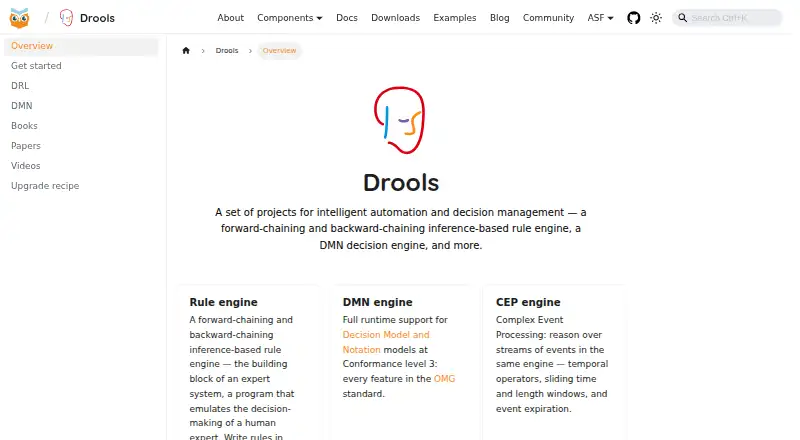
What Drools is
Drools is a free, open-source rule engine for building expert systems through forward- and backward-chaining inference. Its decision model and notation (DMN) engine supports Conformance level 3, covering the features in that standard, and can analyze decision tables for gaps, overlaps, and rule issues. The project states that the engine passes 99.9% of DMN TCK tests as of Apache KIE 10.2.0. For event processing, Drools evaluates streams with temporal operators, sliding windows, and event expiration. Developers can author rules in DRL text files alongside Java code, Excel decision tables, rule templates, or a Java executable model API. Rule units group rules with typed input-data containers, and Kogito can generate REST endpoints from them. Drools rules can also be called by a BPMN business rule task in jBPM within the same service. The software is available for API, Linux, and self-hosted use at no cost. The getting-started guide lists an IDE, JDK 21 or 17, and Maven 3.9 or later as prerequisites. Apache KIE is in incubation and has not yet been fully endorsed by the ASF.
Good
- Free Apache software
- DMN engine supports Conformance level 3
- Offers multiple rule-authoring methods
- Supports temporal event-stream processing
- DMN analysis checks decision-table gaps and overlaps
Watch out
- Getting started requires an IDE, JDK 21 or 17, and Maven 3.9 or later
- Apache KIE is still in incubation
Who it suits
Drools suits developers building expert systems, rule-driven applications, or decision models who can work with Java and the stated development prerequisites. It may also suit teams using DMN or event-stream processing.
Verdict
Drools offers rule authoring, DMN decision modeling, and event processing without a software charge. Teams should account for its development prerequisites and Apache KIE’s incubation status.
Plans and prices
From Drools's own pricing page, checked 5 Oct 2026.
| Plan | Price | What it gives you |
|---|---|---|
| Apache Drools (free) | Free | Apache software download and use at no cost · Java based |
The facts
Each one read from Drools's own pages, with the date it was checked.
What it does
- Decision modeling
- Its DMN engine provides runtime support at Conformance level 3, covering every feature in the standard.checked 5 Oct 2026
- Developer prerequisites
- The getting started guide lists an IDE, JDK 21 or 17, and Maven 3.9 or later as prerequisites.checked 5 Oct 2026
- DMN test results
- The project states that as of Apache KIE 10.2.0, its DMN engine passes 99.9% of the DMN TCK tests.checked 5 Oct 2026
- DMN validation
- The DMN engine statically analyzes decision tables to detect gaps and overlaps and check that table rules follow industry best practices.checked 5 Oct 2026
- Event processing
- Its Complex Event Processing engine reasons over event streams using temporal operators, sliding windows, and event expiration.checked 5 Oct 2026
- Integrations
- Drools rules can be called directly by a BPMN business rule task in jBPM within the same service.checked 5 Oct 2026
- Project status
- Apache KIE is undergoing incubation, and the site says incubation means it has yet to be fully endorsed by the ASF.checked 5 Oct 2026
- Purpose
- Drools is a forward-chaining and backward-chaining inference-based rule engine used to build expert systems.checked 5 Oct 2026
- Rule authoring
- Rules can also be expressed through Excel decision tables, rule templates, or a Java executable model API.checked 5 Oct 2026
- Rule language
- DRL lets developers define rules in plain text files alongside Java code and under version control.checked 5 Oct 2026
- Rule units
- Rule units organize rules with typed containers for their input data, and Kogito can generate REST endpoints from them.checked 5 Oct 2026
- Security
- The Apache Security Team coordinates handling of Apache project vulnerabilities and encourages private reports before public disclosure.checked 5 Oct 2026
- Support
- The project lists a users mailing list and Zulip chat as community contact channels.checked 5 Oct 2026
The company
- Founded
- 2001checked 28 Sep 2026
The full review of Drools
Drools is a Java-oriented inference engine for building expert systems, decision models, and event-driven rules. It best suits development teams that want business logic versioned with application code and integrated with services. Its broad rule and DMN coverage is compelling, while the required toolchain and project maturity deserve careful consideration.
Overview
Drools supports both forward- and backward-chaining inference, allowing a system to derive conclusions from known facts or work backward from a desired conclusion. That makes it more suitable for complex policy and expert-system logic than a simple collection of conditional statements. Developers can keep DRL rules in plain-text files beside Java code and under version control, which supports code review and coordinated releases.
The project extends beyond rules. Its DMN engine supports Conformance level 3, covering the full standard, and its Complex Event Processing engine evaluates event streams with temporal operators, sliding windows, and event expiration. Setup is firmly developer-oriented: the getting-started requirements include an IDE, JDK 21 or 17, and Maven 3.9 or later.
Key features
- Flexible authoring: Teams can write DRL, build Excel decision tables, use rule templates, or call the Java executable model API. This accommodates spreadsheet-led analysis and code-centric development, but governance is important when several authoring styles coexist.
- DMN modeling and validation: The engine runs every feature covered by DMN Conformance level 3. Static analysis identifies gaps and overlaps in decision tables and checks table rules against industry best practices, reducing defects before runtime. Apache KIE 10.2.0 is stated to pass 99.9% of DMN TCK tests.
- Complex event processing: Temporal operators, sliding windows, and event expiration let rules reason about sequences and timing in event streams. This is a stronger fit for streaming decisions than a rules engine limited to current-state data.
- Rule units and generated services: Rule units group rules with typed input-data containers. Kogito can generate REST endpoints from them, providing a path from organized rule logic to service interfaces.
- Process integration: jBPM can invoke Drools rules directly through a BPMN business rule task within the same service, useful when decisions are part of a larger workflow.
- Testing and authoring support: Decision tables, visual rule authoring, rule-testing tools, DMN support, and natural-language rules are included in the offering, with execution access available both through application use and authoring contexts.
Pricing
Apache Drools (free) costs free. The plan provides Apache software download and use at no cost and is Java based. It includes decision tables, visual rule authoring, rule-testing tools, DMN support, natural-language rules, and both execution-access modes. There is no free trial because the software is already free; the trade-off is that teams own the surrounding development, deployment, and operational work rather than receiving a commercial service package.
Platforms
Drools is offered through an API and runs on Linux or in a self-hosted deployment. It is therefore a natural fit for teams controlling their runtime environment, but it is not presented as a hosted, browser-first product. Community contact is provided through a users mailing list and Zulip chat. Apache’s Security Team coordinates vulnerability handling and encourages private reports before disclosure.
Who it's for
Choose Drools for Java teams building expert systems, DMN decision services, or event-processing components that need rules under source control. It is especially relevant when jBPM workflows, Kogito-generated endpoints, or self-hosted operation are part of the architecture. Look elsewhere if business users need a polished standalone authoring environment without an IDE, Java, and Maven, or if a vendor-backed hosted experience is a priority. Apache KIE is still incubating and has not yet been fully endorsed by the ASF, a governance factor for risk-sensitive adopters.
Pros and cons
Pros
- No software charge: The Apache download and use price is 0.00 USD.
- Broad decision scope: Inference, full DMN Conformance level 3, and CEP cover more than ordinary rule matching.
- Strong integration paths: DRL sits beside Java, jBPM can call rules in-process, and Kogito can expose rule units as REST endpoints.
- Multiple authoring formats: DRL, spreadsheets, templates, and the executable model support different team workflows.
Cons
- Developer-heavy setup: An IDE, JDK 21 or 17, and Maven 3.9 or later are prerequisites.
- Self-hosting responsibility: API, Linux, and self-hosted delivery leave deployment and operations to the adopting team.
- Incubation uncertainty: Apache KIE’s incubation status warrants additional governance review.
Alternatives
GoRules BRMS is a better fit when a freemium product with web and desktop platforms is preferred; its Pro plan is $167 a month billed annually, with five users and two projects.
AI Rule Engine suits teams wanting a hosted/API option with a free tier capped at 200 ruleset runs per month and two author seats.
DecisionRules is worth choosing when a freemium service and free trial matter; its free plan allows 10 Business Rules & Flows, one user, one project, and 1,000 Solver API calls.
Nected targets teams seeking a self-hosted free tier with unlimited rules and workflows, 1,000 daily invocations, and Docker, Helm, and Terraform support.
Rulebricks offers a free annual-billed Design plan limited to 10 rules and flows, 1,000 monthly executions, and five team members with RBAC.
InRule Decisioning is a paid alternative with configurable subscription components and support for mobile, web, desktop, API, and self-hosted deployments.
Decisions is a paid low-code alternative with a free plan and Foundation capabilities including a design studio and standard agentic AI tools.
OpenL Tablets is another free, self-hosted rule-table option with API, desktop, web, and Linux platform coverage.
For a wider category comparison, see Business Rules Management Software.
Verdict
Drools is a strong choice for Java-centric teams that need open-source inference, complete DMN modeling, and event processing in a self-hosted architecture. Choose it for breadth, source-controlled rules, and integration flexibility; look elsewhere for a managed product, lighter onboarding, or a project with a more established governance status.
Alternatives to Drools
- 1
Rulebricks
Free planWebAPISelf-hosted7.4From $200 a month - 2

DecisionRules
Free planWebAPISelf-hosted7.3From €291 a month - 3

GoRules BRMS
Free planWebAPILinuxmacOS7.1From $167 a month - 4

Progress Corticon
AndroidiOSWebAPI7.0 - 5

AI Rule Engine
Free planWebAPISelf-hosted6.8From $49 a month - 6
Nected
Free planWebAPISelf-hosted6.7From $399 a month