
DecisionRules
DecisionRules is a business rules engine for decisions involving dynamic pricing, credit scoring, claims, risk, fraud, and data validation.
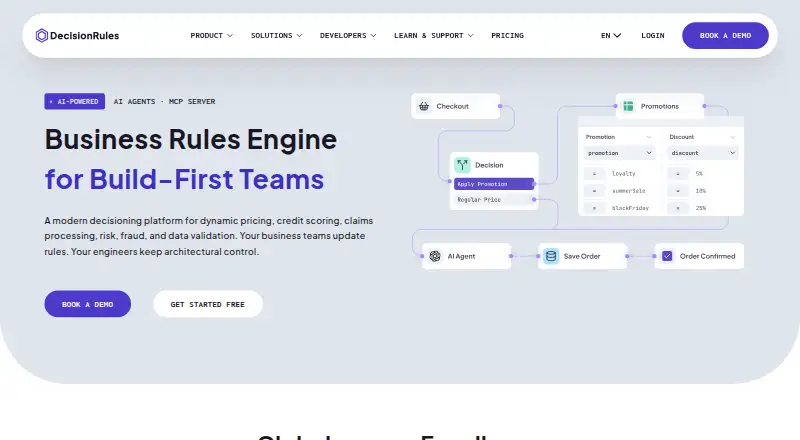
What DecisionRules is
DecisionRules is a business rules engine for decisions involving dynamic pricing, credit scoring, claims, risk, fraud, and data validation. It supports Decision Tables, Decision Trees, Decision Flows, Integration Flows, Scripting Rules, and Lookup Tables. Business analysts can define rules in a spreadsheet-like interface, while engineers use the platform to integrate and deploy them. Its AI Assistant can turn plain-language descriptions into rules, generate test data, write function expressions, and summarize rules. Integrations listed include cloud services, Kafka, REST API, Salesforce, Power BI, spreadsheets, Zapier, and n8n. Deployment choices are Public Cloud, Private Managed Cloud, and Self-Hosted; Docker images and a free 30-day local evaluation license are also offered. The Free plan is limited to 10 rules and flows, one user, one project, and 1,000 Solver API calls. Lite is €291 a month, billed €3,500 annually. A 14-day trial is listed. DecisionRules says it is ISO/IEC 27001 certified and that its SOC 2 report was independently audited by BDO.
Good
- Six supported rule types.
- Spreadsheet-like rule authoring for business analysts.
- AI Assistant creates rules from plain-language descriptions.
- Cloud, managed-cloud, and self-hosted deployment options.
- Free plan includes 1,000 Solver API calls.
Watch out
- Free plan allows only one user.
- Free plan is limited to one project.
- Free plan includes 10 rules and flows.
- Lite is billed €3,500 annually.
Who it suits
It suits teams that need configurable business decision rules, from analyst-authored tables to integrations and deployment managed by engineers. The Self-Hosted option may interest teams seeking that deployment model.
Verdict
DecisionRules brings visual rule authoring, testing-related tools, and deployment choices into one platform. Check the Free plan limits and Lite annual billing against the scale of your intended use.
Plans and prices
From DecisionRules's own pricing page, checked 14 Oct 2026.
| Plan | Price | What it gives you |
|---|---|---|
| Free | Free | 10 Business Rules & Flows · 1 User · 1 Project · 1,000 Solver API Calls · AI Assistant · Database connectors · €0 billed annually |
| Lite | €291 a month | 30 Business Rules & Flows · 1 User · 1 Project · 10,000 Solver API Calls · Management API Access · Batch processing · Live collaboration · Basic role based access · €3,500 billed annually; listed prices are based on annual billing and are approximate, exclude VAT, and final prices are defined in the Order Form |
| Premium | Priced on request | Tailored rules, projects and users · Highly scalable API usage · SSO · Customizable SLA · BI insights · Auditing · Tiered support up to 24/7 · Custom data residency · AI Rules |
The facts
Each one read from DecisionRules's own pages, with the date it was checked.
What it does
- AI Agent
- The AI Agent is a native rule type that interprets unstructured documents and returns structured output.checked 14 Oct 2026
- AI assistant
- The AI Assistant can create rules from plain-language descriptions, generate test data, write function expressions, and summarize rules.checked 30 Sep 2026
- AI Assistant
- The built-in AI Assistant can draft, test, explain and help revise decision logic using natural-language instructions.checked 14 Oct 2026
- AI data handling
- The Trust Center says customer data processed by built-in AI is not stored in the LLM provider's infrastructure or used to train its foundational models.checked 30 Sep 2026
- API
- The platform offers Solver, Rule Flow and Management APIs, with the Management API providing read and write access to rules and spaces.checked 14 Oct 2026
- API documentation
- The API documentation describes the rule solver, Rule Flow, Management API, data infrastructure and Apache Kafka solver API.checked 14 Oct 2026
- Current status
- The opened status page reports all services online and shows 99.991% uptime for Global Cloud API.checked 14 Oct 2026
- Decision Flows
- Decision Flows combine rules and scripts in a visual workflow.checked 14 Oct 2026
- Decision intelligence
- The product provides audit logs, execution statistics, a Business Intelligence API and a Power BI connector for analyzing decisions and executions.checked 14 Oct 2026
- Decision Tables
- Decision Tables express conditional business logic in a spreadsheet-like visual format.checked 14 Oct 2026
- Decision Trees
- Decision Trees model branching decisions using visual IF-THEN logic.checked 14 Oct 2026
- Deployment
- DecisionRules offers Public Cloud, Private Managed Cloud, and Self-Hosted deployment options.checked 30 Sep 2026
- Docker
- The maker offers Docker images for the client, server, and business intelligence components and a free 30-day license key for local evaluation.checked 30 Sep 2026
- Documentation
- The documentation describes application functionality with examples, supports multiple documentation versions from version 1.20.0, and includes guides for rules, APIs, deployment and integrations.checked 14 Oct 2026
- Integration Flows
- Integration Flows can handle background processes and connect directly to databases for reading and writing data.checked 14 Oct 2026
- Integrations
- Officially listed integrations include database systems, REST APIs, credit bureaus, AI models, business intelligence tools, Apache Kafka, CI/CD platforms and monitoring services.checked 14 Oct 2026
- Legal entity
- The terms identify the company as DecisionRules Services s.r.o., registered in Prague, Czechia, under ID No. 19338805.checked 14 Oct 2026
- License and open source
- The product is sold on subscription terms and is not presented as open-source software; the company separately links open-source integration and utility libraries on GitHub.checked 14 Oct 2026
The company
- Company focus
- DecisionRules says it is based in Prague and aims to make enterprise-grade decision automation accessible to teams that need it.checked 30 Sep 2026
- Company funding
- DecisionRules announced a €1.5 million raise from Jet Investment on June 23, 2026.checked 14 Oct 2026
- Company profile
- LinkedIn lists Wilmington, Delaware as headquarters, 51–200 employees and 2020 as the founding year.checked 14 Oct 2026
- Founded
- 2023checked 28 Sep 2026
- Headquarters
- Prague, Czech Republicchecked 28 Sep 2026
Money
- Free limits
- The Free plan includes 10 Business Rules & Flows, 1 user, 1 project, and 1,000 Solver API Calls.checked 30 Sep 2026
The full review of DecisionRules
DecisionRules is a business rules engine for turning business logic into rules and flows that can be integrated and deployed. It is best suited to teams where analysts and engineers share responsibility for decisions such as pricing, credit scoring, claims, risk, fraud, or data validation. Its broad rule formats and deployment choices are compelling, but the Free and Lite plans both restrict teams to one user.
Overview
DecisionRules brings tabular rules, decision flows, integrations, and execution options into one environment. That breadth is useful when a team wants decision logic managed separately from application code and needs both business and technical contributors involved. The central trade-off is collaboration at the lower tiers: even Lite is limited to one user, so it is a poor fit for a team that needs several people editing or managing rules.
Key features
The platform supports Decision Tables, Decision Trees, Decision Flows, Integration Flows, Scripting Rules, and Lookup Tables. That mix accommodates spreadsheet-like logic as well as scripted and connected workflows, making it more adaptable than a tool centered on a single rule format. Business analysts can author rules in a spreadsheet-like interface, while engineers integrate and deploy them through the same platform. Rule testing tools add a way to examine logic before relying on it.
The AI Assistant can draft rules from plain-language descriptions, generate test data, write function expressions, and summarize rules. Those capabilities can help with authoring and review, but teams remain responsible for validating the decision logic. DecisionRules says customer data processed by its built-in AI is neither stored in the LLM provider’s infrastructure nor used to train foundational models, a relevant assurance for organizations weighing AI-assisted work.
Integrations include AWS, Azure, Google Cloud, Apache Kafka, REST API, Salesforce, Power BI, Excel, Google Sheets, Zapier, and n8n. Deployment can be through Public Cloud, Private Managed Cloud, or Self-Hosted options, giving organizations a choice between cloud services and control over their own environment. Docker images cover client, server, and business intelligence components, with a free 30-day license key for local evaluation.
DecisionRules says it is ISO/IEC 27001 certified and that its SOC 2 report was independently audited by BDO. Its Trust Center describes role-based access, two-factor authentication, SSO, audit logging, backups, encryption at rest, and TLS encryption in transit. Premium includes tiered support up to 24/7; Private Managed Cloud and Self-Hosted options list 24/7 support.
Pricing
The Free plan costs €0 billed annually and includes 10 Business Rules & Flows, 1 user, 1 project, and 1,000 Solver API Calls. It is a sensible starting point for an individual evaluating the platform, but the small rule and call quotas—and single-user limit—make it restrictive for shared or expanding work.
Lite costs €291.00 per month, billed €3,500 annually. It raises the allowance to 30 Business Rules & Flows and 10,000 Solver API Calls, but retains the 1-user and 1-project limits. That makes it a larger sandbox for a solo operator, not a straightforward upgrade for a team that needs collaboration. The annual billing commitment is worth weighing against the intended scale.
Premium uses custom pricing tailored to your needs. It offers tailored rules, projects, and users, highly scalable API usage, SSO, a customizable SLA, and tiered support up to 24/7. It is the more relevant tier for organizations that have outgrown fixed caps or require enterprise support and access controls, though custom pricing means buyers should assess the cost against those needs. A 14-day trial is available for evaluation.
Platforms
DecisionRules supports API access, web use, and self-hosted deployment. That combination suits teams integrating rules into software or preferring to operate them in their own environment, while Public Cloud and Private Managed Cloud provide hosted deployment choices.
Who it's for
DecisionRules is a strong candidate for organizations that need varied decision logic, analyst-friendly authoring, and engineering-led integration or deployment in the same platform. It is especially relevant where deployment control or the described security measures matter. A solo user can start on Free or Lite, but teams needing multiple users should look beyond those tiers and evaluate Premium; users seeking only a small, inexpensive shared workspace may find the lower-plan limits decisive.
Pros and cons
- Pro: Six rule formats let teams represent decisions as tables, trees, flows, scripts, or lookups rather than forcing one structure.
- Pro: Spreadsheet-like authoring alongside engineering integration and deployment supports a shared analyst-and-engineer workflow.
- Pro: Public Cloud, Private Managed Cloud, and Self-Hosted options accommodate different deployment preferences.
- Pro: The AI Assistant can help draft rules and test data, while the stated data-handling policy addresses a key concern about using AI with customer data.
- Con: Free allows only one user, one project, and 1,000 Solver API Calls, limiting its usefulness beyond individual evaluation.
- Con: Lite still permits only one user and one project despite its €3,500 annual billing, so its higher quotas do not solve team collaboration needs.
- Con: Premium pricing is custom, so organizations needing scalable usage or broader access must evaluate a quote rather than a fixed price.
Alternatives
Business Rules Management Software is the category directory for comparing more options. Consider GoRules BRMS if a broader range of platform support or a paid plan with multiple users is more important; its Pro plan is $167.00 per month billed $2,000 annually and includes 5 users, 2 projects, and 20 decision models per project. Nected is another freemium option with API, web, and self-hosted platforms; its Self-Hosted Free Tier includes unlimited rules and workflows, 1k daily invocations, and Docker, Helm charts, and Terraform scripts.
InRule Decisioning is a paid alternative with Android, iOS, Windows, web, API, and self-hosted support. Decisions is a paid option with a free plan and support for web, mobile, API, and self-hosted use. OpenL Tablets is a free alternative supporting API, web, desktop, and self-hosted platforms. FlexRule Open is a paid option with API, web, desktop, and self-hosted support. Progress Corticon is a paid alternative with a free trial and support across web, mobile, API, Linux, and self-hosted environments. ACTICO Decision Management Platform is a paid option with a free one-month trial and support for Linux, macOS, self-hosted, and Windows environments.
Verdict
Choose DecisionRules if your organization needs flexible decision formats, a shared analyst-and-engineer workflow, and a choice of cloud or self-hosted deployment. Its main advantage is the breadth of rule authoring and deployment in one platform; its main drawback is that the fixed lower tiers are single-user, while scaling brings custom Premium pricing. For multi-user work, assess Premium before committing to Lite.
Getting started
- Visit https://www.decisionrules.io/en/.
- Choose the Free plan or begin the 14-day trial.
- Use the web platform or API, or choose a self-hosted deployment.
- For local evaluation, use the offered Docker images and free 30-day license key.
Limits worth knowing
The Free plan includes 10 Business Rules & Flows, 1 user, 1 project, and 1,000 Solver API Calls. Lite costs €291/mo and includes 30 Business Rules & Flows, 1 user, 1 project, and 10,000 Solver API Calls.
Questions
Is DecisionRules free?
Yes. Its Free plan costs nothing and includes 10 Business Rules & Flows, 1 user, 1 project, and 1,000 Solver API Calls.
How much does the Lite plan cost?
Lite is €291/mo, billed €3,500 billed annually.
Does DecisionRules offer a trial?
Yes, a 14-day trial is listed.
Which platforms and deployment options does it support?
It supports web, API, and self-hosted use. Deployment options include Public Cloud, Private Managed Cloud, and Self-Hosted.
What integrations are listed?
The catalog includes AWS, Azure, Google Cloud, Apache Kafka, REST API, Salesforce, Power BI, Excel, Google Sheets, Zapier, and n8n.
What security measures are described?
DecisionRules says it is ISO/IEC 27001 certified and its SOC 2 report was independently audited by BDO. Its Trust Center describes role-based access, two-factor authentication, SSO, audit logging, backups, encryption at rest, and TLS encryption in transit.
Alternatives to DecisionRules
- 1
Rulebricks
Free planWebAPISelf-hosted7.4From $200 a month - 2

GoRules BRMS
Free planWebAPILinuxmacOS7.1From $167 a month - 3

Progress Corticon
AndroidiOSWebAPI7.0 - 4

AI Rule Engine
Free planWebAPISelf-hosted6.8From $49 a month - 5
Nected
Free planWebAPISelf-hosted6.7From $399 a month - 6

ACTICO Decision Management Platform
LinuxmacOSSelf-hostedWindows6.6From €4,500 a year