agent-cu
agent-cu is a command-line tool for controlling desktop apps through clicks, typing, and other actions.
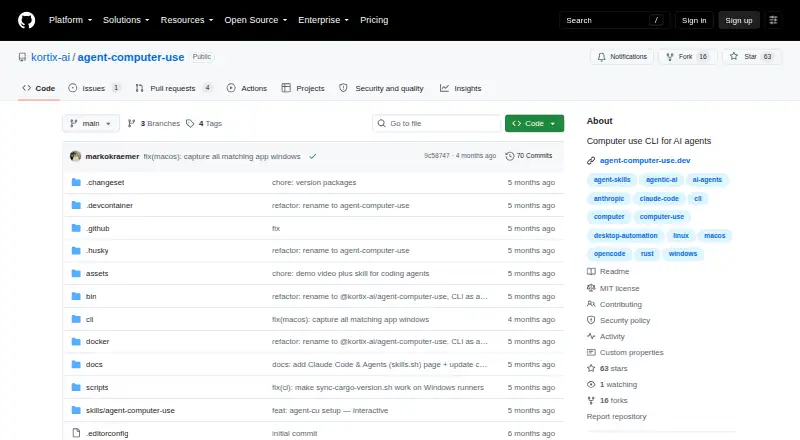
What agent-cu is
agent-cu is a command-line tool for controlling desktop apps through clicks, typing, and other actions. It reads the accessibility tree used by screen readers to find interface elements, then operates on those elements through references. Commands include snapshots, selectors, clicking, typing, scrolling, dragging, window management, and JSON output. Batched commands and reusable YAML workflows are also supported. For Electron apps such as Slack, Cursor, VS Code, Postman, Discord, and Notion, agent-cu can use CDP. The project describes integrations with Claude Code, Cursor, Codex, Copilot, OpenCode, Cline, and 40+ other agents. It runs locally, is MIT licensed, and is free. Precompiled binaries are provided for macOS Apple Silicon and Intel, Linux, and Windows, with installation instructions for npm, pnpm, yarn, and bun. The tool needs explicit operating-system accessibility permissions to read and control apps. The repository says the project is no longer maintained and recommends Cua and Cua Driver instead.
Good
- Free and MIT licensed.
- Runs locally without transmitting data over the network.
- Supports reusable YAML workflows and batched commands.
- Works with listed Electron apps through CDP.
- Precompiled binaries cover macOS, Linux, and Windows.
Watch out
- Project is no longer maintained.
- Requires explicit OS accessibility permissions.
- Does not support screen understanding.
Who it suits
agent-cu is aimed at AI agents, local models, and people who need to control desktop applications. It suits users on macOS, Linux, or Windows who can grant accessibility permissions.
Verdict
agent-cu provides local desktop control through accessibility elements, with commands for common interface actions and reusable workflows. The project is no longer maintained, so readers should note its recommendation to use Cua and Cua Driver instead.
Plans and prices
From agent-cu's own pricing page, checked 8 Oct 2026.
| Plan | Price | What it gives you |
|---|---|---|
| Open source | Free | MIT licensed · runs locally · zero per-action cost |
The facts
Each one read from agent-cu's own pages, with the date it was checked.
What it does
- Agent integrations
- The project says its skill can be used with Claude Code, Cursor, Codex, Copilot, OpenCode, Cline, and 40+ other agents.checked 8 Oct 2026
- Automation
- It supports batched commands and reusable YAML workflows.checked 8 Oct 2026
- Features
- The CLI supports snapshots, selectors, clicks, typing, scrolling, dragging, window management, and JSON output.checked 8 Oct 2026
- How it works
- It reads the accessibility tree used by screen readers to identify interface elements, then acts on them through references.checked 8 Oct 2026
- Installation
- Precompiled binaries are provided for macOS Apple Silicon and Intel, Linux, and Windows, with npm, pnpm, yarn, and bun installation instructions.checked 8 Oct 2026
- Intended users
- The README describes the tool as intended for AI agents such as Claude, Cursor, and Codex, local models, and humans.checked 8 Oct 2026
- License
- The project is released under the MIT license.checked 8 Oct 2026
- Permissions
- The tool requires explicit OS accessibility permissions to read and control apps.checked 8 Oct 2026
- Project status
- The repository says the project is no longer maintained and recommends Cua and Cua Driver instead.checked 8 Oct 2026
- Security
- The security policy says the tool does not transmit data over the network, store credentials or sensitive data, execute remote code, or bypass OS security boundaries.checked 8 Oct 2026
- Support
- The security policy asks users to email maintainers about vulnerabilities and says they will respond within 48 hours.checked 8 Oct 2026
- What it does
- agent-cu is a CLI for controlling desktop apps by clicking, typing, and reading what is on screen.checked 8 Oct 2026
Where it runs
- Electron apps
- It supports Electron apps including Slack, Cursor, VS Code, Postman, Discord, and Notion through CDP.checked 8 Oct 2026