
Adobe Fonts
Adobe Fonts is a library for adding typefaces to desktop software and supported web projects.
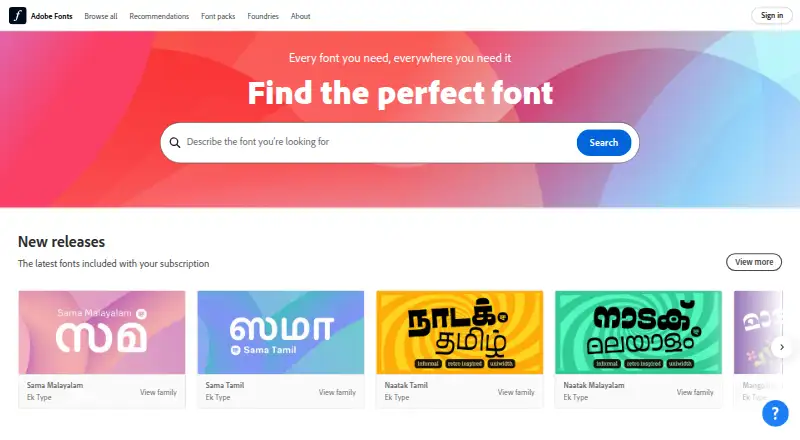
What Adobe Fonts is
Adobe Fonts is a library for adding typefaces to desktop software and supported web projects. Its catalog has more than 30,000 fonts from over 150 foundries, with access depending on subscription. Users can browse fonts and add single styles or full families. Desktop fonts are activated through the Creative Cloud desktop app for macOS or Windows and become available in desktop software. Eligible Adobe subscriptions include the service, while its free plan provides a basic library of about 5,500 fonts. For websites, Web Projects let users choose styles and weights, language subsets, OpenType features, and font-display settings, then publish with Adobe-provided embed code. Adobe states that library fonts are licensed for personal and commercial use. Web fonts must be served using that embed code; self-hosting and uploading font files to website design platforms are not allowed. The licensing excludes embedding fonts in apps or installing them on servers. Adding desktop fonts requires signing in with a named-user Adobe subscription.
Good
- Catalog includes more than 30,000 fonts.
- Free plan offers a basic library of about 5,500 fonts.
- Web Projects offer controls for styles, subsets, and features.
- Library fonts are licensed for personal and commercial use.
- Supports TTF and OTF formats.
Watch out
- Web fonts must use Adobe's embed code.
- Self-hosting font files is not allowed.
- Font licensing excludes app embedding and server installation.
- Adding desktop fonts requires a named-user Adobe subscription.
Who it suits
Adobe Fonts may suit designers and other users who need fonts in desktop software or supported web projects. Its web project controls may help site publishers select type styles and settings for their pages.
Verdict
Adobe Fonts offers a large catalog and separate workflows for desktop use and supported websites. Check the subscription and licensing requirements if you need self-hosted fonts or fonts embedded in an app.
Plans and prices
From Adobe Fonts's own pricing page, checked 29 Sep 2026.
| Plan | Price | What it gives you |
|---|---|---|
| Adobe Fonts Free | Free | Basic library (~5,500 fonts) · Available with trial subscriptions and some free, team, enterprise, and education accounts |
| Adobe Fonts Pro | — | Complete library · Licensed for authoring and editing · Desktop, web, and mobile Creative Cloud and Document Cloud apps · Third-party desktop apps using system-installed fonts · Included with Creative Cloud, Acrobat Pro and Standard, paid Adobe Express, and paid single-app desktop plans |
| Adobe Fonts Standard | — | Complete library · Licensed for authoring and editing · Use in apps granted by the subscription · Included with qualifying paid mobile-only, web-only, and plans priced at $5/month or lower |
The facts
Each one read from Adobe Fonts's own pages, with the date it was checked.
Where it runs
- Adobe app integration
- Added fonts can be used in apps including Photoshop, Illustrator, InDesign, and Adobe Express.checked 14 Oct 2026
- App and server limits
- Adobe Fonts licensing does not cover embedding fonts in mobile or desktop apps or installing them on servers; those uses require licenses from the foundry or an authorized reseller.checked 29 Sep 2026
- Browser support
- Adobe says its hosted web fonts work in browsers supporting web fonts on macOS, Windows, Chrome OS, and most mobile browsers.checked 14 Oct 2026
- Desktop app
- Desktop fonts are added through the Creative Cloud desktop app, which is available for macOS and Windows.checked 29 Sep 2026
- Linux browser support
- Adobe says web font serving should work on Linux distributions, though it has only tested Ubuntu.checked 14 Oct 2026
What it does
- API and SDK
- Adobe's opened Fonts documentation describes web-project embeds and CSS usage; it does not document a public Adobe Fonts API or SDK.checked 14 Oct 2026
- Creative Cloud integration
- Added fonts become available in desktop software through the Creative Cloud desktop app, and Adobe Fonts is included with eligible Adobe subscriptions.checked 29 Sep 2026
- Desktop activation
- Users can add individual styles or a whole font family through the Creative Cloud desktop app.checked 14 Oct 2026
- Desktop operating systems
- The Creative Cloud desktop app used to add fonts is available for macOS and Windows, and Adobe says desktop font activation is unavailable on other operating systems.checked 14 Oct 2026
- Documentation
- The Fonts User Guide covers setup, browser support, desktop and web use, licensing, app workflows, and troubleshooting.checked 14 Oct 2026
- Embed options
- Adobe offers a default link-tag embed and an @import option; JavaScript loading is used for dynamic subsetting required by East Asian web fonts.checked 14 Oct 2026
- Font discovery
- The font browser offers natural-language tags and filters for classification, x-height, width, weight, and language.checked 14 Oct 2026
- Font library
- Adobe Fonts offers more than 30,000 fonts from over 150 type foundries, with access depending on subscription level.checked 29 Sep 2026
- Font updates
- Fonts updated by a foundry are not automatically updated in desktop selections or web projects; users must update them manually.checked 14 Oct 2026
- G2 rating
- 4.5 out of 5 from 149 reviews.checked 14 Oct 2026
- Included access
- Adobe says its fonts are included with an Adobe subscription at no extra charge.checked 14 Oct 2026
- License model
- Adobe Fonts is a licensed service governed by Adobe's product-specific terms; the opened official pages do not identify an open-source license.checked 14 Oct 2026
- Limit: Adobe subscription complaints
- Trustpilot reviewers repeatedly complain about unexpected charges, difficult cancellation, early termination fees, and high prices for Adobe services.checked 14 Oct 2026
- Limit: browsing and updates
- G2 reviewers say browsing can be confusing and fonts can get stuck while updating.checked 14 Oct 2026
- Limit: sharing font files
- A G2 reviewer reports being unable to download font files to share with clients or use elsewhere, including in Figma.checked 14 Oct 2026
The company
- Company founded
- Adobe says it was founded in December 1982 by Charles Geschke and John Warnock.checked 29 Sep 2026
- Company size and founding
- Adobe's LinkedIn page lists the company as founded in 1982, headquartered in San Jose, California, and having 10,001 or more employees.checked 14 Oct 2026
- Founded
- 1982checked 23 Sep 2026
- Headquarters
- San Jose, California, USAchecked 23 Sep 2026
The full review of Adobe Fonts
Overview
Adobe Fonts is a subscription-based library for browsing typefaces and adding selected styles or full font families to desktop software and supported web projects. Its catalog contains more than 30,000 fonts from over 150 type foundries, though the collection available to an account depends on its subscription. Adobe lists TTF and OTF formats and includes variable fonts.
Fonts in the library are licensed for personal and commercial use, according to Adobe, but that permission has limits on technical use and delivery. Desktop fonts are activated through the Creative Cloud desktop app, while website use is set up through a Web Project. Adobe was founded in December 1982 by Charles Geschke and John Warnock and is headquartered in San Jose, California, USA.
Key features
Browse and add fonts
Users can browse the library and add individual styles or complete families. Access to the catalog varies by subscription tier. Adobe Fonts is included with eligible Adobe subscriptions, so it may be available as part of an existing plan rather than as a separate font purchase.
Desktop activation
Desktop fonts are added through the Creative Cloud desktop app, which is available for macOS and Windows. Once added, they become available in desktop software. This requires signing in to the desktop app with a named-user Adobe subscription; device and site-wide licenses cannot add fonts.
Web Projects
For website use, a Web Project lets users select font styles and weights, language subsets, OpenType features, and font-display settings. Adobe provides embed code to serve the web fonts. Self-hosting the fonts or uploading their files to a website design platform is not allowed under Adobe’s web-use terms.
Licensing boundaries
Adobe says its library fonts are licensed for personal and commercial use. The license does not cover embedding fonts in mobile or desktop applications, or installing them on servers; those uses require a license from the foundry or an authorized reseller. Adobe-hosted web fonts work in browsers that support web fonts, including on macOS, Windows, Chrome OS, and most mobile browsers. Adobe says Linux serving should work, but its testing is limited to Ubuntu.
Pricing
Adobe Fonts uses a subscription model and has a free plan. Plan access and the applications in which fonts may be used differ by tier.
| Plan | Price | What is included |
|---|---|---|
| Adobe Fonts Free | free | Basic library of about 5,500 fonts. Available with trial subscriptions and some free, team, enterprise, and education accounts. |
| Adobe Fonts Pro | Price not listed | Included with Creative Cloud, Acrobat Pro and Standard, paid Adobe Express, and paid single-app desktop plans. Complete library; licensed for authoring and editing; desktop, web, and mobile Creative Cloud and Document Cloud apps; and third-party desktop apps using system installation. |
| Adobe Fonts Standard | Price not listed | Included with qualifying paid mobile-only, web-only, and plans priced at $5/month or lower. Complete library; licensed for authoring and editing; use in apps granted by the subscription. |
The Pro and Standard plan prices are not listed as separate amounts. Their stated availability is tied to qualifying Adobe subscriptions, and the subscription level determines library access and permitted app use.
Platforms
Adobe lists Android, iOS, Linux, macOS, web, and Windows as platforms. The desktop font activation route depends on the Creative Cloud desktop app for macOS or Windows. Adobe-hosted web fonts can be served to compatible browsers, including most mobile browsers; Linux serving is described as supported, with testing limited to Ubuntu.
Who it's for
Adobe Fonts suits people who need a font library for desktop design work or websites and already use, or are considering, an eligible Adobe subscription. Web designers can configure Web Projects and serve selected fonts through Adobe’s embed code. Desktop users can add fonts through Creative Cloud, provided they sign in with a named-user subscription.
It is not a fit for workflows that require self-hosted web font files, font uploads to website design platforms, or font embedding in apps and servers under the Adobe Fonts license. Those uses call for a separate license from a foundry or authorized reseller.
Pros and cons
Pros
- Large catalog with more than 30,000 fonts from over 150 foundries.
- Free plan with a basic library of about 5,500 fonts.
- Desktop activation and web publishing are available through distinct Adobe workflows.
- Web Projects offer control over styles, weights, language subsets, OpenType features, and font-display settings.
- Adobe states that library fonts are licensed for personal and commercial use, subject to specified restrictions.
Cons
- Catalog access and permitted app use depend on the subscription tier.
- Desktop font activation requires a named-user Adobe subscription; device and site-wide licenses do not qualify.
- Web fonts must use Adobe’s embed code rather than self-hosting or uploads to website design platforms.
- The license does not cover embedding fonts in apps or installing them on servers.
- Linux web serving is stated to work, but Adobe tests it only on Ubuntu.
- Separate prices for the Pro and Standard tiers are not listed.
Alternatives
Readers comparing font tools can browse Font Management Software and Font Marketplaces. Other options in the directory include iFontCloud, FontBase, FontCap, MainType, Insider Font Control Suite, QuickTime Player, SandollCloud, and NexusFile.
Verdict
Adobe Fonts combines a broad font catalog with defined routes for desktop activation and website use. Its free plan provides a smaller library, while eligible subscriptions unlock the complete catalog and determine which apps can use the fonts. The main consideration is licensing: web use must go through Adobe’s embed code, and app embedding or server installation needs a separate license. For users whose work fits those terms, its value depends on the Adobe subscription they already have or choose; people needing different distribution rights should confirm licensing with a foundry or authorized reseller.
Adobe directs users to its Help Center and support contact for assistance with Adobe Fonts.
Getting started
- Open the Adobe Fonts website and browse the catalog.
- Choose individual font styles or complete families.
- For desktop software, sign in to the Creative Cloud desktop app with a named-user Adobe subscription and add fonts there.
- For a website, create a Web Project, select its font settings, and publish using Adobe’s embed code.
- Use the free basic library or access a larger catalog through an eligible subscription.
Limits worth knowing
The free plan is limited to a basic library of about 5,500 fonts. Web fonts must be served through Adobe’s embed code, and the licensing does not cover embedding fonts in apps or installing them on servers.
Questions
Is Adobe Fonts free?
Yes. Adobe Fonts Free costs nothing and includes a basic library of about 5,500 fonts.
How large is the font library?
The library contains more than 30,000 fonts from over 150 type foundries. Catalog access depends on the subscription level.
Can I use Adobe Fonts for commercial work?
Adobe states that its library fonts are licensed for personal and commercial use.
How do I use its fonts on a website?
Create a Web Project, choose the font settings, and serve the fonts using Adobe’s embed code. Self-hosting and uploading font files to a website design platform are not allowed.
Can I embed Adobe Fonts in an app or install them on a server?
Adobe Fonts licensing does not cover embedding fonts in mobile or desktop apps or installing them on servers. Those uses require licenses from the foundry or an authorized reseller.
Which subscriptions include Adobe Fonts?
The listed Pro plan is included with Creative Cloud, Acrobat Pro and Standard, paid Adobe Express, and paid single-app desktop plans. The Standard plan is included with qualifying paid mobile-only, web-only, and plans priced at $5/month or lower.
Alternatives to Adobe Fonts
- 1

FontBase
Free planWebLinuxmacOSWindows7.7From $3 a month - 2
SandollCloud
iOSWebmacOSWindows7.4From 11,000 KRW a month - 3

Launchpad
Free planWebAPILinuxSelf-hosted7.0Free plan - 4
MainType
Free planWindows6.5$49 one-time - 5
iFontCloud
iOSWebmacOSWindows6.4 - 6

Insider Font Control Suite
WebLinuxmacOSSelf-hosted6.3