
Admixer DMP
Admixer DMP is a data management platform for creating and activating targeted audiences.
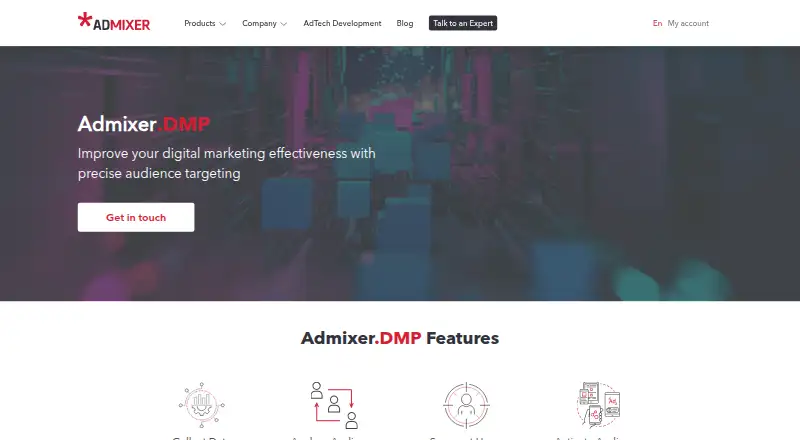
What Admixer DMP is
Admixer DMP is a data management platform for creating and activating targeted audiences. It collects data in real time from websites, mobile apps, and advertising activity, then provides insights about reached users and potential target audiences. Teams can combine first-party data, partner-provided second-party data, and built-in third-party audiences into segments. Data from CRM, CDP, and CMS systems can also be onboarded for campaign activation, and look-alike algorithms can extend target audiences. Audiences can be activated across advertising channels and platforms. The Audience API automates audience management and data transfer, while the Raw Data API provides more granular information about advertising activity. Admixer DMP is built into Admixer.DSP and Admixer.SSP and supports connections to external data sources and ad platforms. Admixer says it securely collects and stores data and complies with GDPR and CCPA; third-party verification tools can be used to check data quality. The product is available via web and API. It is paid, with pricing available on request.
Good
- Combines first-, second-, and third-party audiences.
- Supports CRM, CDP, and CMS data onboarding.
- Uses look-alike algorithms to expand audiences.
- Audience API automates management and data transfer.
- Built into Admixer.DSP and Admixer.SSP.
Watch out
- Paid product with pricing on request.
- Requires contacting Admixer to discuss needs and pricing.
Who it suits
It may suit advertisers, agencies, publishers, data providers, and technology vendors seeking to organize audience data and activate segments across advertising channels.
Verdict
Admixer DMP brings multiple audience data sources together for segmentation and activation, with APIs for management and reporting access. Prospective customers must contact Admixer for pricing.
The facts
Each one read from Admixer DMP's own pages, with the date it was checked.
What it does
- Activation
- Audiences can be activated across different channels and platforms.checked 7 Oct 2026
- Activation and automation
- Audiences can be activated across channels and platforms, with audience management and data transfer automated through the Audience API.checked 7 Oct 2026
- APIs
- Audience API automates audience management and data transfer, while Raw Data API provides more granular data about advertising activity.checked 7 Oct 2026
- Audience
- The product inquiry form lists advertisers, agencies, publishers, data providers, and technology vendors as company types.checked 7 Oct 2026
- Audience analysis
- It provides insights about reached users and target audiences.checked 7 Oct 2026
- Audience segmentation
- Users can create segments by combining audiences from different sources.checked 7 Oct 2026
- Built-in availability
- Admixer.DMP is described as built into Admixer.DSP and Admixer.SSP.checked 7 Oct 2026
- Data collection
- It collects user data in real time from websites, apps, and advertising activity.checked 7 Oct 2026
- Data onboarding
- It can onboard data from CRM, CDP, and CMS systems for campaign activation.checked 7 Oct 2026
- Data sources
- The platform supports first-party data, partner-provided second-party data, and built-in third-party audiences.checked 7 Oct 2026
- Integrations
- The DMP is built into Admixer.DSP and Admixer.SSP and supports integration with external data sources and ad platforms.checked 7 Oct 2026
- Look-alike audiences
- It can expand target audiences using look-alike algorithms.checked 7 Oct 2026
- Pricing
- The DMP page asks prospective customers to contact Admixer to learn more and shows no price.checked 7 Oct 2026
- Purpose
- Admixer.DMP is a data management platform for precise audience targeting.checked 7 Oct 2026
- Reporting access
- The Raw Data API provides access to more granular data from advertising activity.checked 7 Oct 2026
- Sales and support
- The DMP page invites prospective users to contact Admixer to discuss their needs; it does not state public pricing there.checked 7 Oct 2026
- Security and compliance
- Admixer says it securely collects and stores data and is GDPR and CCPA compliant.checked 7 Oct 2026
- Segmentation
- Users can build segments by combining users from different audiences.checked 7 Oct 2026
- Support
- The DMP page invites prospective customers to describe their challenges or opportunities through its contact form.checked 7 Oct 2026
- Verification
- The product page says third-party verification tools can be used to check data quality.checked 7 Oct 2026
The company
- Company history
- Admixer says it has helped brands, publishers, and advertising agencies since 2008.checked 7 Oct 2026
- Founded
- 2008checked 28 Sep 2026
- Headquarters
- Admixer lists its headquarters as Admixer EU GmbH in Essen, Germany.checked 7 Oct 2026
The full review of Admixer DMP
Admixer DMP is a data-management platform for advertising teams that need to turn multiple audience signals into targetable segments. It suits advertisers, agencies, publishers, data providers, and technology vendors, particularly those working with the Admixer advertising stack. The main attraction is the combination of broad data inputs, automated activation APIs, and granular reporting access; the trade-off is custom pricing and a sales-led buying process.
Overview
Admixer.DMP gathers website, mobile-app, and advertising events in real time, then analyzes reached users and target audiences. It is designed to connect data collection, audience construction, and campaign activation rather than serve as a standalone analytics store. The product has been part of Admixer's offering since the company was founded in 2008 in Essen, Germany, and is built into Admixer.DSP and Admixer.SSP.
Key features
Segmentation can combine users from different audiences, letting teams mix their own first-party data with partner-provided second-party data and built-in third-party audiences. That is a practical advantage for campaigns that need more than one source, although the resulting value depends on the quality and permissions of each source. Third-party verification tools can be used to check data quality before activation.
CRM, CDP, and CMS data can be onboarded for campaign use. This gives organizations a route from existing customer systems to advertising audiences instead of relying only on events collected by the DMP. Look-alike algorithms can then extend a seed audience for prospecting, making the platform more useful when a campaign needs scale beyond known users.
Audiences can be activated across advertising channels and platforms. The Audience API automates audience management and data transfer, which should reduce repetitive operational work for teams with recurring audience workflows. The Raw Data API supplies more granular advertising-activity data for reporting or downstream analysis. These interfaces are a strong fit for organizations with technical resources and existing data pipelines; teams wanting a mostly self-contained, no-integration workflow may gain less from them.
Admixer says it securely collects and stores data and complies with GDPR and CCPA. Those commitments address important regulatory requirements, but buyers still need to align implementation and consent practices with their own policies.
Pricing
Admixer DMP is paid software with pricing on request. Prospective customers must contact Admixer through its inquiry process to discuss their needs, so there is no public plan price, free tier, trial term, seat allowance, quota, or renewal schedule to compare. Custom commercial terms can suit organizations whose data volume and activation requirements need a tailored arrangement, but they make budgeting and quick self-service evaluation harder.
Platforms
The product is offered through web access and APIs. Its built-in position within Admixer.DSP and Admixer.SSP is most relevant to customers already using those systems, while external data-source and ad-platform integrations broaden its potential deployment.
Who it's for
Advertisers and agencies should consider it when they need unified segmentation and activation across advertising destinations. Publishers and data providers may value the ability to organize and transfer audience data, while technology vendors can use the APIs and external integrations in broader advertising workflows. It is less suitable for buyers seeking a transparent, low-commitment plan that can be purchased and tested without a sales conversation.
Pros and cons
Pros
- Multiple audience inputs: First-, second-, and built-in third-party data can be combined in one segmentation workflow.
- Activation automation: The Audience API handles audience management and transfer across channels and platforms.
- Detailed data access: The Raw Data API exposes granular advertising activity for teams that need more than summarized reporting.
- Customer-data onboarding: CRM, CDP, and CMS connections support campaign use of existing business data.
- Look-alike expansion: Algorithms can extend target audiences beyond their original users.
Cons
- Custom pricing only: Buyers cannot assess cost from a published plan or free tier.
- Technical orientation: The API-led approach is most advantageous to teams able to manage integrations and data operations.
- Ecosystem emphasis: Its built-in Admixer.DSP and Admixer.SSP placement may be less compelling for organizations committed to another advertising stack.
Alternatives
BlueData is the better starting point for smaller teams that want a freemium option, a free trial, and published entry limits such as one web user, one mobile user, 1 GB of storage, and 500 submissions per month.
Piano DMP is another paid DMP option with Android, iOS, web, and API platform coverage.
Adform DMP suits buyers prepared for dedicated pricing under a separate agreement and a standard setup of one data-import integration and one taxonomy per account.
Informatica Product 360 is a paid, no-free-plan alternative when product master-data management across cloud or self-hosted, API, web, and Windows environments is the priority; pricing varies with volume, modules, deployment, integrations, and add-ons.
Permutive is a paid alternative without a free plan or trial, supporting Android, iOS, and web.
ArcSpan AMS is a paid web-based alternative.
Audigent is a paid web-based alternative.
Diskover is a paid option with API, self-hosted, and web platforms, including an enterprise plan with unlimited seats and users; its AI connector and industry add-ons are sold separately.
Browse the wider Data Management Platforms category for more options.
Verdict
Choose Admixer DMP if your advertising organization needs to combine diverse audience data, automate activation, and access detailed campaign data through APIs, especially within the Admixer ecosystem. Look elsewhere if transparent pricing, a free trial, or a simpler non-technical workflow is essential. Its breadth and integration potential are convincing, but the custom-sales model makes a direct cost comparison impossible before a conversation with Admixer.
Alternatives to Admixer DMP
- 1
BlueData
Free planAndroidWebAPI7.8From $1,500 a year - 2
Diskover
Free planOpen sourceWebAPILinuxmacOS7.7Free plan - 3

Permutive
AndroidiOSWeb6.6 - 46.5From $1 a month
- 5

Piano DMP
AndroidiOSWebAPI6.5 - 6

Informatica Product 360
WebAPISelf-hostedWindows6.3