0G Storage
0G Storage is a decentralized storage layer for onchain applications, including AI agents, DePIN, and gaming.
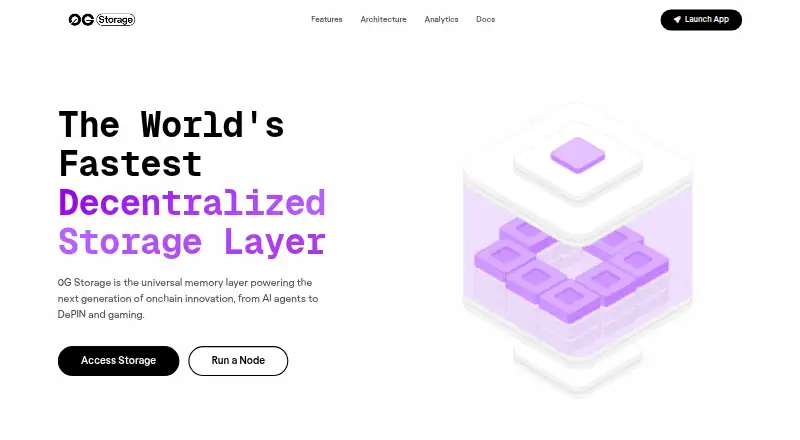
What 0G Storage is
0G Storage is a decentralized storage layer for onchain applications, including AI agents, DePIN, and gaming. Its append-only Log Layer stores unstructured data, while a mutable Key-Value Layer handles structured data. The product page claims Log Layer throughput of 50 Gbps, millisecond-level access to both data types, and sub-second access for the Key-Value Layer. Integrity and availability measures include cryptographic proofs, erasure coding, sharding, and Proof of Random Access challenges. Uploads receive on-chain Merkle-root commitments for verification, and changes to mutable data retain an immutable history. Listed workloads include datasets, media, AI model weights, sensor logs, vector embeddings, user state, and metadata. Developers can use TypeScript or Go SDKs, a CLI, or a web upload tool; the JavaScript SDK supports file transfers, RPC methods, Merkle trees, and browser environments. The service is paid from $11/mo, with API, Linux, macOS, self-hosted, and web platforms. Storage node operators can contribute capacity and earn network rewards.
Good
- Separate layers support structured and unstructured data.
- Uploads can be verified against on-chain Merkle roots.
- Offers TypeScript and Go SDKs, a CLI, and web uploads.
- Supports blockchain and Web2 integrations.
- From $11/mo.
Watch out
- Fees apply to data stored in storage nodes.
- Each mining operation is capped at 8 TB.
- Storage nodes list substantial hardware and bandwidth requirements.
Who it suits
0G Storage may suit developers and AI teams working with large datasets or onchain applications, as well as storage operators and ecosystem partners. It also supports integrations with blockchains and Web2 apps, including custom rollups and VMs.
Verdict
0G Storage offers distinct layers, verification features, and several developer interfaces for decentralized storage workloads. Consider storage fees and node requirements when assessing whether its setup fits your use case.
The facts
Each one read from 0G Storage's own pages, with the date it was checked.
What it does
- Audit history
- The site says uploads receive immutable cryptographic commitments and that mutable states retain immutable history.checked 4 Oct 2026
- Availability
- The maker says independent miners replicate data and use Proof of Random Access challenges to prove they hold and can serve it.checked 8 Oct 2026
- Composability
- The site says the storage layer can integrate with any chain, rollup, VM, or hybrid stack.checked 4 Oct 2026
- Data access
- The product page describes millisecond-level access to structured and unstructured data and sub-second access for the KV Layer.checked 4 Oct 2026
- Developer SDK
- The JavaScript SDK supports file upload and download, RPC methods, file Merkle trees, and browser environments.checked 4 Oct 2026
- Fees
- The SDK instructions say users need to pay fees to store data in storage nodes.checked 4 Oct 2026
- Integration
- The maker says 0G Storage can be used with any blockchain or Web2 app, including custom rollups and VMs.checked 8 Oct 2026
- Integrity and availability
- The site describes cryptographic proofs, erasure coding, data sharding, and PoRA challenges to support data integrity and availability.checked 4 Oct 2026
- Intended users
- The maker identifies developers and AI teams, storage node operators, and ecosystem partners as audiences.checked 8 Oct 2026
- Interfaces
- The maker offers TypeScript and Go SDKs, a CLI, and a web tool for uploads.checked 8 Oct 2026
- Node requirements
- The storage node guide lists 32 GB RAM, 8 CPU cores, a 500 GB or 1 TB SSD, and 100 Mbps upload and download bandwidth for a Storage Node.checked 4 Oct 2026
- Notable limit
- The documentation caps each mining operation's range at 8 TB and says large operators can run multiple instances.checked 8 Oct 2026
- Operator audience
- Storage node operators can contribute storage capacity and earn network rewards.checked 4 Oct 2026
- Performance claim
- The official site describes the Log Layer as capable of 50 Gbps throughput.checked 8 Oct 2026
- Pricing model
- Uploads are paid in 0G, and the documentation says the network fee is fixed and pricing is transparent and on-chain.checked 8 Oct 2026
- Purpose
- 0G Storage is a decentralized storage network designed for AI workloads, Web3 apps, and massive datasets.checked 8 Oct 2026
- Retrieval
- The documentation states that large files can be retrieved in parallel from multiple nodes and claims 200 MBPS retrieval speed even during network congestion.checked 8 Oct 2026
- Storage layers
- The Log Layer provides append-only storage for large files, while the Key-Value Layer supports mutable data and fast key-based retrieval.checked 8 Oct 2026
- Support
- The site says its contact form team will respond within 24–48 hours.checked 4 Oct 2026
- Support and community
- The maker links to Discord, Telegram, and X from its documentation site.checked 8 Oct 2026
- Supported workloads
- The site identifies datasets, media, AI model weights, sensor logs, vector embeddings, user state, and metadata as storage use cases.checked 4 Oct 2026
- Throughput claim
- The product page says the Log Layer is capable of 50 Gbps throughput.checked 4 Oct 2026
Money
- Cost claim
- The documentation lists costs 95% lower than AWS and says the savings are intended to support large datasets.checked 8 Oct 2026
The company
- Maker identity
- The 0G FAQ says 0G was co-founded in 2023 by Michael Heinrich, Ming Wu, Fan Long, and Thomas Yao.checked 4 Oct 2026
Alternatives to 0G Storage
- 1

Sia
Free planOpen sourceAndroidiOSWebAPI8.4From $7.99 a month - 2

Aleph Cloud (formerly Aleph.im)
Free planOpen sourceWebAPILinuxmacOS8.1$0.01 usage-based - 3
Datum Storage
Free planAndroidiOSWebAPI7.9From $3.99 a month - 4
Carbide Network
Free planAndroidiOSAPImacOS7.6$0.01 usage-based - 5

Peergos
Free planAndroidWebLinuxmacOS6.9Free plan - 6

Storj
WebAPILinuxmacOS6.8From $29 a month