Zstandard
Zstandard is a free, lossless compression algorithm for real-time scenarios.
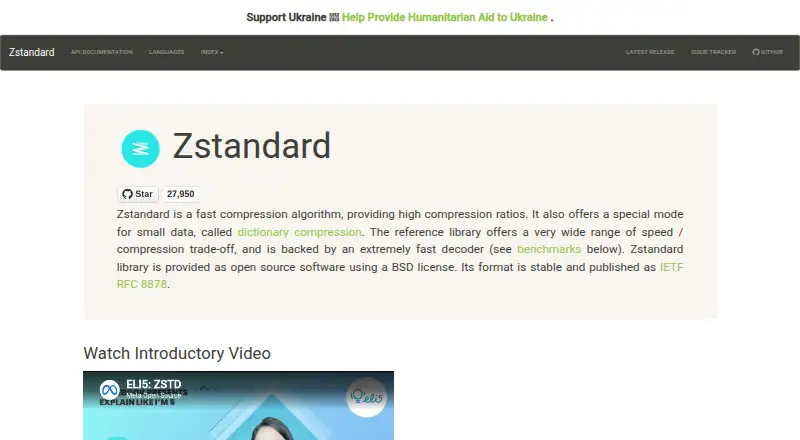
What Zstandard is
Zstandard is a free, lossless compression algorithm for real-time scenarios. It aims for zlib-level speed with better compression ratios, and users can adjust the balance between compression speed and ratio in small increments. Decompression speed stays roughly similar across those settings. For small, related data, training on sample files can create a data-specific dictionary to improve compression; the matching dictionary must be loaded for both compression and decompression, and the samples need to be correlated. The reference implementation includes a C library and command-line utility for creating and decoding .zst, .gz, .xz, and .lz4 files. The format is stable and documented in RFC 8878, and the implementation is available under BSD or GPLv2. The project documents builds or integrations through Make, CMake, Meson, Visual Studio, Buck, and Bazel, plus vcpkg and Conan installation. Community-provided language bindings and ports include Python, Rust, Java, C#, JavaScript, Go, PHP, and Swift. Zstandard supports Linux, Windows, and macOS. The project says security issues should be reported through Meta’s Bug Bounty program rather than public GitHub issues or pull requests.
Good
- Free reference library and command-line utility.
- Compression speed and ratio are adjustable.
- Supports .zst, .gz, .xz, and .lz4 files.
- Available for Linux, Windows, and macOS.
Watch out
- Archive encryption is not supported.
- Archive repair is not supported.
- Dictionary training requires correlated samples and a matching dictionary.
Who it suits
Zstandard suits developers and operators who need lossless compression and control over speed-versus-ratio trade-offs. Its dictionary mode is relevant when compressing small, correlated samples.
Verdict
Zstandard provides a configurable compression algorithm with both a C library and command-line utility. Dictionary compression can help with related small data, but requires the matching dictionary during both compression and decompression.
Plans and prices
From Zstandard's own pricing page, checked 8 Oct 2026.
| Plan | Price | What it gives you |
|---|---|---|
| Zstandard | Free | Open-source reference library and command-line utility · BSD or GPLv2 license |
The facts
Each one read from Zstandard's own pages, with the date it was checked.
What it does
- API
- The API offers simple methods first and introduces more parameters and control for advanced use.checked 8 Oct 2026
- Build and package integrations
- The project documents builds with Make, CMake, Meson, Visual Studio, Buck, and Bazel, and installation through vcpkg and Conan.checked 8 Oct 2026
- Build integrations
- The repository documents builds or integration through Make, CMake, Meson, vcpkg, Conan, Visual Studio, Buck, and Bazel.checked 8 Oct 2026
- Compression controls
- The compression speed and ratio trade-off is configurable in small increments, and decompression speed remains roughly similar across settings.checked 8 Oct 2026
- Dictionary compression
- A training mode builds a dictionary from sample files to improve compression of small, related data; a matching dictionary must be loaded for compression and decompression.checked 8 Oct 2026
- Format
- The Zstandard format is stable, documented in RFC 8878, and has multiple independent implementations.checked 8 Oct 2026
- Language bindings
- The homepage lists community-provided bindings and ports for languages including Python, Rust, Java, C#, JavaScript, Go, PHP, and Swift.checked 8 Oct 2026
- Latest listed release
- The GitHub releases page lists Zstandard v1.5.7 as the latest release.checked 8 Oct 2026
- Library and CLI
- The reference implementation provides a C library and a command-line utility that can produce and decode .zst, .gz, .xz, and .lz4 files.checked 8 Oct 2026
- License
- The reference implementation is dual-licensed under BSD or GPLv2.checked 8 Oct 2026
- Purpose
- Zstandard is a fast, lossless compression algorithm for real-time scenarios, targeting zlib-level speed with better compression ratios.checked 8 Oct 2026
- Security reporting
- The project asks reporters to submit security issues through Meta's Bug Bounty program rather than public GitHub issues or pull requests.checked 8 Oct 2026
- Security testing
- The project README says Zstandard is continuously fuzzed for security issues by Google's OSS-Fuzz program.checked 8 Oct 2026
- Small-data constraint
- Dictionary training works when a family of small samples is correlated, and the project says there is no universal dictionary.checked 8 Oct 2026
- Small-data dictionaries
- Training on sample files creates a data-specific dictionary that can improve compression of small, correlated data samples.checked 8 Oct 2026
- Speed and ratio controls
- Compression speed and ratio can be adjusted in small increments, while decompression speed remains roughly similar across settings.checked 8 Oct 2026
- Use at scale
- The project says Zstandard is deployed within Meta and other large cloud infrastructures to compress data in various formats and use cases.checked 8 Oct 2026
- Vulnerability notices
- For significant vulnerabilities not yet public, maintainers may notify selected high-exposure users before public disclosure.checked 8 Oct 2026
- Vulnerability notifications
- At its discretion, the project may notify high-profile, high-exposure users about significant undisclosed vulnerabilities before public disclosure and a fix.checked 8 Oct 2026
- What it does
- Zstandard is a fast, lossless compression algorithm for real-time compression scenarios, targeting zlib-level speed with better compression ratios.checked 8 Oct 2026
Where it runs
- Platform builds
- The project documents Windows builds and CMake Universal2 builds for Apple Silicon and Intel Macs.checked 8 Oct 2026
The full review of Zstandard
Zstandard is a free, open-source compression toolkit for developers who need fast, lossless processing in applications, services, or command-line workflows. It is particularly well suited to real-time systems and workloads built from related small samples. The main reason to choose it is fine-grained control over compression versus ratio without sacrificing broadly consistent decompression speed; the main caveat is that dictionary compression demands correlated data and a shared dictionary.
Overview
Zstandard aims for zlib-level compression speed while delivering better compression ratios. Its reference implementation combines a C library with a command-line utility, giving software teams both an embeddable API and an operational tool. The format is stable and documented in RFC 8878, which is a sound basis for long-lived storage or interchange work.
The implementation is dual-licensed under BSD or GPLv2. That gives projects two established licensing paths, but teams still need to select the one compatible with their own distribution model. The project reports deployment inside Meta and other large cloud infrastructures, indicating suitability for substantial infrastructure workloads without turning that usage into a guarantee for every deployment.
Key features
Compression speed and output ratio can be adjusted in small increments. Decompression speed remains roughly similar across those settings, so the principal tuning decision is how much CPU to spend while compressing in exchange for smaller output. This is valuable for real-time pipelines, caches, and services balancing processor time against storage or bandwidth; it is less compelling when fixed defaults are preferable to workload-specific tuning.
Dictionary training can improve compression for small, related samples by learning from representative files. The benefit is narrow: unrelated inputs do not share a useful universal dictionary, and the same trained dictionary must be available during both compression and decompression. Use it when a service controls both ends of a predictable data family, not when files arrive from unknown or changing sources.
The command-line utility creates and decodes .zst, .gz, .xz, and .lz4 files, extending its usefulness in migration and scripting workflows. The API starts with simple methods and exposes more parameters for advanced control, allowing straightforward integrations to grow more specialized over time.
Build documentation covers Make, CMake, Meson, Visual Studio, Buck, and Bazel, with package installation through vcpkg and Conan. Community bindings and ports are listed for Python, Rust, Java, C#, JavaScript, Go, PHP, and Swift. Security work includes continuous fuzzing through Google's OSS-Fuzz program; vulnerability reports are directed through Meta's Bug Bounty program, and maintainers may privately notify selected high-exposure users about significant undisclosed issues.
Pricing
| Plan | Price | Includes |
|---|---|---|
| Zstandard | free | Open-source reference library and command-line utility; BSD or GPLv2 license |
There is no paid tier or trial period. The free plan suits individual developers, commercial teams, and infrastructure operators that can work within the stated open-source licenses. It provides the core library and CLI rather than a hosted service, support package, or managed capacity.
Platforms
Zstandard supports Linux, Windows, macOS, API-based integration, and self-hosted deployments. Windows builds are documented, and macOS instructions cover Universal2 builds for both Apple Silicon and Intel processors. That range fits cross-platform applications and teams that want to run compression inside their own systems.
Who it's for
Choose Zstandard for developers embedding compression in real-time software, services that need adjustable CPU-to-size trade-offs, and systems processing families of small correlated records. It also fits teams that value a documented format, multiple build systems, and language bindings. Look elsewhere if you need archive encryption, archive repair, or a graphical archiver rather than a library-and-CLI tool.
Pros and cons
Pros
- Fine-grained compression controls let teams tune speed and ratio to a workload.
- Decompression speed stays roughly similar across compression settings.
- Stable RFC 8878 format supports durable interoperability.
- C library, CLI, build integrations, and community bindings cover varied development stacks.
- Free BSD or GPLv2 licensing avoids a purchase price.
Cons
- Dictionary gains apply only to correlated small samples.
- Compression and decompression both require the matching dictionary when one is used.
- No archive encryption or repair capability is provided.
- As a developer-focused library and CLI, it is not presented as a general graphical archive manager.
Alternatives
For a broader directory of choices, see File Compression Software. Pick B1 Archiver when you want a free archiver spanning Android, Linux, macOS, web, and Windows with no registration. Choose 7-Zip for a free archiver on Linux, macOS, and Windows. ALZip is an option for users who need a freemium archiver on Android, Linux, or Windows. PeaZip suits users seeking free open-source archiving on Linux, macOS, and Windows. PowerArchiver offers a free non-commercial tier and a paid business license for macOS and Windows. Bandizip provides a freemium choice for macOS and Windows. The Unarchiver is a free macOS-focused option. Accessibility Test Framework for Android is an alternative entry with a different purpose.
Verdict
Zstandard is the right choice for developers who need a fast, configurable compression engine with a stable format and broad integration paths. Its free reference library and CLI make adoption straightforward, and dictionary training can be highly effective for controlled families of small data. Look elsewhere if your priority is encrypted or repairable archives, or if you need a user-facing archiver instead of compression components.
Getting started
- Visit the Zstandard website
- Choose Linux, Windows, macOS, API, or self-hosted use
- Use the C library or command-line utility
- Build with Make, CMake, Meson, Visual Studio, Buck, or Bazel
- Install through vcpkg or Conan
- Train and load a matching dictionary for correlated small data
Limits worth knowing
Dictionary training only helps families of correlated small samples, and each compression or decompression operation needs the matching dictionary. The project states that no universal dictionary exists.
Questions
Is Zstandard free?
Yes. The Zstandard plan is free and includes the open-source reference library and command-line utility.
Which archive formats can its utility handle?
The command-line utility produces and decodes .zst, .gz, .xz, and .lz4 files.
What license does the reference implementation use?
It is dual-licensed under BSD or GPLv2.
Which platforms are supported?
Supported platforms include Linux, Windows, and macOS; the project also lists API and self-hosted use.
Does it provide language bindings?
The homepage lists community bindings and ports for Python, Rust, Java, C#, JavaScript, Go, PHP, and Swift.
Alternatives to Zstandard
- 1
Keka
Free planOpen sourceAndroidiOSWebAPI8.6$3.99 one-time - 2

PowerArchiver
Free planmacOSWindows6.8$22.95 one-time - 3
B1 Archiver
Free planAndroidWebLinuxmacOS6.7Free plan - 4
WinRAR
AndroidLinuxmacOSWindows6.7$6 one-time - 5

Bandizip
Free planmacOSWindows6.6$20 one-time - 6

NanaZip
Free planWindows6.5Free plan