Z3
Z3 is a theorem prover and satisfiability modulo theories (SMT) solver used in software verification and analysis.
What Z3 is
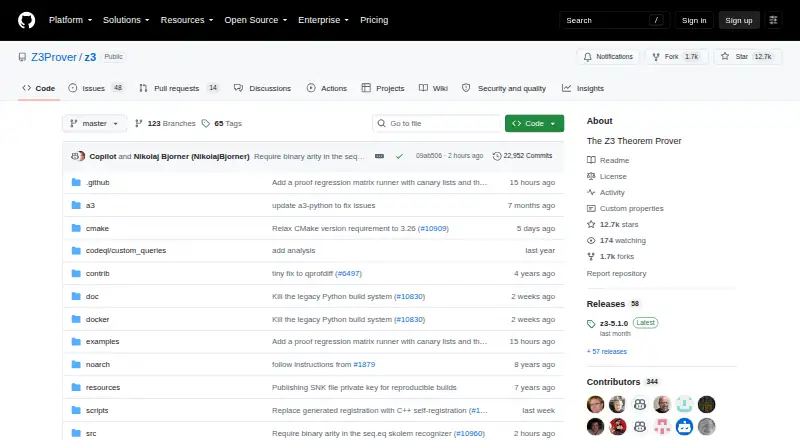
Z3 is a theorem prover and satisfiability modulo theories (SMT) solver used in software verification and analysis. Its default input format is SMT-LIB2, and it supports SMT-LIB. The project documents language bindings or APIs for C, C++, .NET, Java, Go, OCaml, Python, Julia, and JavaScript/TypeScript. Z3 can be built with CMake, vcpkg, or Bazel, and the repository links to pre-built binaries for stable and nightly releases. A project wiki also links to a page for trying it in a browser. The software is MIT licensed, with downloads and source code available at no charge. Z3 supports proof artifacts and counterexamples. Listed input languages include SMT-LIB2, C, C++, .NET, Java, Python, Rust, OCaml, Julia, JavaScript, TypeScript, Smalltalk, and Go. Python is required for builds, and additional toolchains are needed for Java, .NET, OCaml, and Julia APIs. The README says MSVC builds enable Control Flow Guard and Address Space Layout Randomization by default.
Good
- Free MIT-licensed source code and downloads.
- Supports SMT-LIB and SMT-LIB2 input.
- Offers APIs or bindings across several languages.
- Supports proof artifacts and counterexamples.
Watch out
- Python is required to build Z3.
- Some language APIs need additional toolchains.
Who it suits
Z3 suits developers and researchers working on theorem proving, software verification, or analysis who can use its documented formats and interfaces.
Verdict
Z3 provides a free theorem-proving and SMT-solving option for verification and analysis work. Building it or some language APIs requires the specified toolchains.
Plans and prices
From Z3's own pricing page, checked 2 Oct 2026.
| Plan | Price | What it gives you |
|---|---|---|
| Z3 (MIT licensed) | Free | MIT-licensed downloads and source code |
The facts
Each one read from Z3's own pages, with the date it was checked.
Where it runs
- Applications
- Z3 is used in software verification and analysis applications.checked 2 Oct 2026
- Browser use
- The project wiki links to a page for trying Z3 in a browser.checked 2 Oct 2026
- Platforms
- The project wiki lists Windows, OSX, Linux (Ubuntu and Debian), and FreeBSD as supported platforms.checked 2 Oct 2026
What it does
- Build systems
- Z3 can be built using CMake, vcpkg, or Bazel.checked 2 Oct 2026
- Dependencies
- Python is required to build Z3, and additional toolchains are needed to build Java, .NET, OCaml, and Julia APIs.checked 2 Oct 2026
- Downloads
- The repository links to pre-built binaries for stable and nightly releases.checked 2 Oct 2026
- Input
- SMTLIB2 is Z3’s default input format.checked 2 Oct 2026
- Language interfaces
- The repository documents bindings or APIs for C, C++, .NET, Java, Go, OCaml, Python, Julia, and JavaScript/TypeScript.checked 2 Oct 2026
- License
- The repository states that Z3 is licensed under the MIT license.checked 2 Oct 2026
- Purpose
- Z3 is a theorem prover and satisfiability modulo theories (SMT) solver.checked 2 Oct 2026
- Security
- The README says MSVC builds enable Control Flow Guard and Address Space Layout Randomization by default.checked 2 Oct 2026
- SMT-LIB
- Z3 supports the SMTLIB format.checked 2 Oct 2026
- Support
- The project wiki says to contact the creator of an external binding package for support issues.checked 2 Oct 2026
The full review of Z3
Overview
Z3 is a theorem prover and SMT solver for software verification and analysis. It is a strong fit for developers who need a solver across several programming environments, but it is not a general-purpose app: its value depends on having formal reasoning work to do.
Key features
SMT-LIB2 is Z3’s default input, and the solver supports SMT-LIB. That standard format gives verification workflows a clear way to express problems. Z3 also supports theorem-proving, counterexamples, and proof artifacts, useful when a team needs to reason about program behavior and examine solver results rather than receive only a yes-or-no answer.
Documented bindings or APIs cover C, C++, .NET, Java, Go, OCaml, Python, Julia, and JavaScript/TypeScript. The stated input-language range is wider, including Rust and Smalltalk as well as SMT-LIB2. That breadth helps teams working across varied stacks, but the input-language list should not be read as a promise of documented APIs for every language.
Users can build Z3 with CMake, vcpkg, or Bazel, or use pre-built binaries linked from the repository for stable and nightly releases. A wiki page offers a browser-based way to try it. Building requires Python; Java, .NET, OCaml, and Julia APIs also require additional toolchains, so compiling selected interfaces can take more setup than using a binary. For MSVC builds, Control Flow Guard and Address Space Layout Randomization are enabled by default. The project is MIT-licensed, and the wiki directs support questions about external binding packages to their creators.
Pricing
Z3 is free: the MIT-licensed downloads and source code cost nothing. There is no paid tier or free trial to weigh against it. That removes a purchasing barrier for individuals and teams, though users building from source still need to account for the required Python and any toolchains their chosen APIs need.
Platforms
Z3 is available across Android, Linux, macOS, Windows, web, API, and self-hosted environments. The variety supports use in different deployment contexts, while self-hosting suits teams that want to run the solver within their own environment. The browser page offers a way to try Z3 without making a local build the first step.
Who it's for
Z3 is best for developers, researchers, and verification teams expressing constraints or analyzing software behavior through SMT. Its multiple interfaces make it practical for projects with different language stacks, and proof artifacts and counterexamples support workflows that need inspectable results. Readers seeking a conventional end-user utility, or a tool without a formal verification use case, should look elsewhere.
Pros and cons
- Pros: SMT-LIB2 input, counterexamples, and proof artifacts support a focused verification workflow.
- Pros: Free MIT-licensed source and downloads avoid license fees, while build options and pre-built releases offer different routes to use.
- Pros: Documented APIs span several major languages, making integration possible across varied software stacks.
- Cons: Building requires Python, and four API families call for additional toolchains, adding setup work for source-build users.
- Cons: Support for external binding packages is directed to those packages' creators, which may mean looking beyond the project for binding-specific help.
Alternatives
For a broader comparison, browse Formal Verification Tools. Rocq is another free option if an interactive theorem prover and dependently typed programming language better matches the work. Choose PVS if its noncommercial plan fits, or consider its commercial plan with custom pricing; Allegro runtime use requires accepting a click-through license.
HOL4 is a free alternative for Linux, macOS, Windows, or self-hosted use. Isabelle is another free option for those platforms. If a free source-and-executables option for Linux, macOS, or Windows is the priority, consider SPIN.
UPPAAL may suit eligible students or researchers at degree-granting academic institutions through its free academic license. Alloy Analyzer is a free alternative with API access and a self-contained executable. CBMC is another free, open-source option for Linux, macOS, Windows, and self-hosted use.
Verdict
Choose Z3 if you need a free SMT solver for verification or analysis and want to integrate it through one of its documented language interfaces. Its format support and proof-related outputs are compelling for that focused job. Look elsewhere if your work calls for a different formal-methods approach or you want software that does not require solver expertise.