
Rocq
Rocq is a free interactive theorem prover and proof assistant for developing mathematical proofs, formal specifications, and programs, including proofs that …
What Rocq is
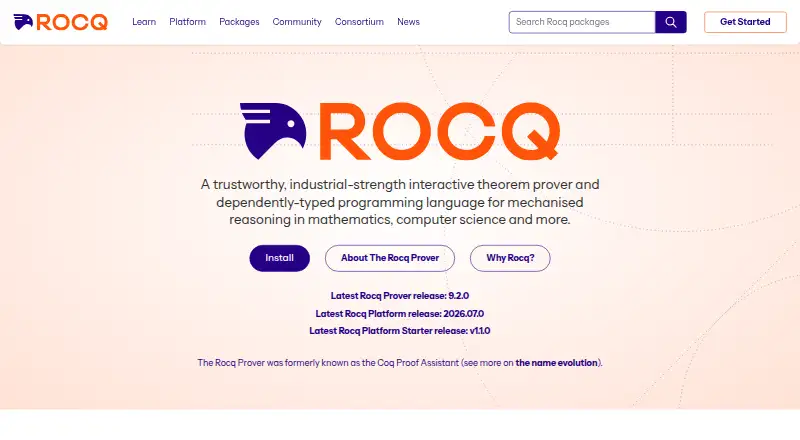
Rocq is a free interactive theorem prover and proof assistant for developing mathematical proofs, formal specifications, and programs, including proofs that programs meet specifications. Its language, Gallina, supports specification and mathematical work. A relatively small certification kernel machine-checks proofs, while interactive methods, decision and semi-decision algorithms, and a tactic language support proof development. Rocq can extract certified programs to OCaml, Haskell, or Scheme, and connect with external computer algebra systems or theorem provers. The Rocq Platform packages the prover with libraries and plugins and is intended for development and teaching in mathematics, computer science, and related areas. Installation scripts cover Windows, macOS, and many Linux distributions, but there is no Rocq Platform binary installer for Linux; scripts install Rocq and packages from source. Precompiled installers are available for Windows and macOS, and Rocq is also available as a Docker image. Editor options include the VsRocq Visual Studio Code extension, RocqIDE, Proof General, and Coqtail. Written in OCaml, Rocq is distributed under the GNU Lesser General Public Licence Version 2.1.
Good
- Machine-checks proofs with a relatively small certification kernel.
- Extracts certified programs to OCaml, Haskell, or Scheme.
- Offers extensions and integrations for several editors.
- Free and distributed under the LGPL Version 2.1.
Watch out
- No Rocq Platform binary installer is available for Linux.
- Linux installation scripts install Rocq and packages from source.
Who it suits
Rocq suits people developing or teaching formal proofs, mathematical specifications, or verified programs. It is aimed at users in mathematics, computer science, and related areas who are comfortable working with a proof assistant.
Verdict
Rocq provides proof construction and checking alongside program extraction and editor integrations. Linux users should account for the lack of a binary installer when planning installation.
Plans and prices
From Rocq's own pricing page, checked 2 Oct 2026.
| Plan | Price | What it gives you |
|---|---|---|
| Rocq Prover | Free | Interactive theorem prover and dependently typed programming language · distributed under GNU Lesser General Public Licence Version 2.1 (LGPL) |
The facts
Each one read from Rocq's own pages, with the date it was checked.
What it does
- Code of conduct
- Rocq states that its Code of Conduct covers privacy, language choices and unrelated discussions, with confidentiality maintained during reporting.checked 1 Oct 2026
- Community support
- Rocq provides Zulip chat, Discourse discussions and GitHub issue reporting for questions, announcements, bugs and feature requests.checked 1 Oct 2026
- Docker
- The Rocq Prover is available as a Docker image.checked 1 Oct 2026
- Editor integrations
- The official VsRocq extension supports Visual Studio Code; the site also documents RocqIDE, Emacs Proof General, and Vim or Neovim Coqtail.checked 2 Oct 2026
- Editors and extensions
- The official VsRocq extension supports Visual Studio Code, while Rocq LSP, VsCoq Legacy, Proof General, Coqtail and RocqIDE provide additional editor or IDE integrations.checked 1 Oct 2026
- External connections
- The Rocq Prover can connect with external computer algebra systems or theorem provers.checked 2 Oct 2026
- History
- The project started in 1984 at INRIA-Rocquencourt and more than 200 people have contributed to its development.checked 1 Oct 2026
- Implementation and license
- Rocq is written in OCaml and distributed under the GNU Lesser General Public Licence Version 2.1.checked 1 Oct 2026
- Intended users
- The Rocq Platform is intended for developing and teaching with Rocq, and the site describes Rocq as used in mathematics, computer science, and related areas.checked 2 Oct 2026
- Language
- Rocq implements Gallina, a high-level specification and mathematical language based on the Polymorphic, Cumulative Calculus of Inductive Constructions.checked 1 Oct 2026
- License
- The Rocq Prover is distributed under the GNU Lesser General Public Licence Version 2.1 (LGPL).checked 2 Oct 2026
- Privacy
- The website says it does not use cookies or collect personal data, while collecting aggregate anonymous usage data for statistics.checked 2 Oct 2026
- Program extraction
- Rocq can extract executable programs from specifications to OCaml, Haskell, or Scheme.checked 2 Oct 2026
- Proof automation
- Rocq provides interactive proof methods, decision and semi-decision algorithms, and a tactic language for defining proof methods.checked 1 Oct 2026
- Proof checking
- Rocq machine-checks proofs using a relatively small certification kernel.checked 2 Oct 2026
- Purpose
- Rocq Prover is an interactive theorem prover and proof assistant for developing mathematical proofs, formal specifications, programs and proofs that programs meet specifications.checked 1 Oct 2026
- Support
- Users can report installation trouble or extension bugs in the dedicated Rocq Zulip stream.checked 2 Oct 2026
- Supported operating systems
- Platform scripts install Rocq and its packages on macOS, Windows and many Linux distributions; precompiled installers are provided for macOS and Windows.checked 1 Oct 2026
- Supported systems
- The Rocq Platform provides installation support for Windows, macOS, and many Linux distributions.checked 2 Oct 2026
- Verification
- The site describes Rocq's well-delimited kernel and OCaml implementation as providing strong guarantees for mechanised artifacts.checked 2 Oct 2026
The company
- Founded
- 1984checked 23 Sep 2026
Where it runs
- Linux installer limit
- There is currently no Rocq Platform binary installer for Linux.checked 1 Oct 2026
- Platform distribution
- The Rocq Platform distributes the core prover together with libraries and plugins, aiming to be operating-system independent, dependable, easy to install and comprehensive.checked 1 Oct 2026
- Platform limitation
- The site says there is no longer a Rocq Platform binary installer for Linux; its scripts install Rocq and packages from sources.checked 2 Oct 2026
The full review of Rocq
Overview
Rocq is a self-hosted proof assistant for formal mathematics and software verification. It is best suited to people prepared to build and check proofs in Gallina, rather than readers looking for a general-purpose programming environment.
Its central strength is that a relatively small kernel checks proofs, while interactive methods and tactics support their construction. That makes Rocq a focused option for mechanised proofs and certified programs; the trade-off is that it is a specialist tool whose work takes place in a formal language.
Key features
- Proof construction and checking: Rocq combines interactive proof methods with decision and semi-decision algorithms, plus a tactic language for defining methods. The small certification kernel checks the resulting proofs, a useful separation for users who want machine-checked mathematical or program-verification artifacts.
- Gallina: The language supports mathematical expression and formal specifications, and is based on the Polymorphic, Cumulative Calculus of Inductive Constructions. This is a strong fit for formal work, not a casual route to ordinary application development.
- Program extraction: Certified programs can be extracted to OCaml, Haskell, or Scheme. That gives proof work a path into executable programs, though the supported extraction targets are specific.
- Connections and integrations: Rocq can connect to external computer algebra systems or theorem provers. The official VsRocq extension supports Visual Studio Code; other options include Rocq LSP, VsCoq Legacy, Proof General, Coqtail, and RocqIDE. This range helps accommodate different editor workflows.
Pricing
Rocq Prover is free: the plan costs nothing and is distributed under the GNU Lesser General Public Licence Version 2.1. There is no free trial because there is no paid plan to trial. The free release is the complete stated plan, rather than a time-limited entry tier.
Its self-hosted deployment means users install and run the prover and packages in their own environment. The Rocq Platform bundles the core prover with libraries and plugins; its scripts support macOS, Windows, and many Linux distributions. Precompiled installers are provided for macOS and Windows, but Linux users must use scripts that install from sources because there is no Rocq Platform binary installer for Linux.
Platforms
Rocq is available for Linux, macOS, and Windows, with Docker distribution and editor extensions also supported. Visual Studio Code users have the official VsRocq extension, while Proof General, Coqtail, RocqIDE, Rocq LSP, and VsCoq Legacy provide other integration choices. Linux support is real but less turnkey: installation uses source-based scripts rather than a binary Platform installer.
The Platform is intended for development and teaching, and the prover is used in mathematics, computer science, and related areas. Questions and issues can be raised through Zulip, Discourse, or GitHub.
Who it's for
Rocq suits mathematicians, computer scientists, educators, and software practitioners who need interactive theorem proving, formal specifications, or proofs that programs meet those specifications. Program extraction makes it relevant when verified work should produce code in OCaml, Haskell, or Scheme.
It is a poor fit for someone seeking a hosted verification service or a broad, conventional programming environment. Linux users who specifically need a precompiled installer should also weigh the source-based setup requirement.
Pros and cons
- Pro — small proof-checking kernel: Proofs are machine-checked by a relatively small certification kernel, supporting confidence in mechanised artifacts.
- Pro — proofs can lead to executable code: Extraction to OCaml, Haskell, and Scheme connects formal development with program output.
- Pro — broad editor options: Official Visual Studio Code support sits alongside integrations for other editors and IDEs.
- Con — Linux setup is less direct: There is no binary Platform installer, so Linux installation relies on scripts that build from sources.
- Con — specialist formal language: Gallina and interactive proof construction are tailored to mathematical and verification work, not general-purpose everyday development.
Alternatives
For other tools in the category, browse Formal Verification Tools.
- PVS is another free choice for Linux, macOS, and Windows. Its noncommercial plan is free; commercial use has a separate plan.
- Z3 may suit readers looking for a free tool with Android, API, web, and self-hosted platform options alongside desktop systems.
- ACL2 is another free option for Linux, macOS, Windows, and self-hosted use.
- Isabelle is worth considering as a free, open-source alternative for Linux, macOS, Windows, and self-hosted use.
- SPIN is a free source-and-executables option for Linux, macOS, and Windows.
- UPPAAL has a free academic license for eligible non-commercial academic use on Linux, macOS, and Windows.
- Frama-C is another free option for Linux, macOS, and Windows.
- Alloy Analyzer is a free option for Windows, macOS, and Linux.
Verdict
Choose Rocq if your priority is constructing formal proofs and checking them with a small kernel, especially when you want to extract certified programs or work through an editor integration. Its free, self-hosted release removes a pricing barrier; Linux users who want a binary installer, and anyone seeking a general-purpose or hosted tool, should look elsewhere.
Getting started
- Visit https://rocq-prover.org/.
- Choose the Rocq Platform installation route for macOS, Windows or a supported Linux distribution.
- Use a precompiled installer on macOS or Windows, or the installation scripts on Linux.
- Select an editor integration such as VsRocq for Visual Studio Code, RocqIDE, Proof General or Coqtail.
Questions
Does Rocq Prover cost anything?
Rocq Prover is free. Its listed plan is free.
Is Rocq open source?
It is distributed under the GNU Lesser General Public Licence Version 2.1 (LGPL).
Which operating systems can I use?
Rocq Platform scripts support macOS, Windows and many Linux distributions. Precompiled installers are provided for macOS and Windows, but there is no Rocq Platform binary installer for Linux.
Which editors are supported?
The official VsRocq extension supports Visual Studio Code. Other documented integrations include RocqIDE, Emacs Proof General and Vim or Neovim Coqtail.
What language does Rocq use?
Rocq implements Gallina, a high-level language for specification and mathematics. Its input languages are Gallina and Rocq vernacular.
Can Rocq produce programs?
Yes. It can extract certified programs to OCaml, Haskell or Scheme.