UPPAAL
UPPAAL is an environment for modeling, simulating, and verifying real-time systems represented as networks of timed automata.
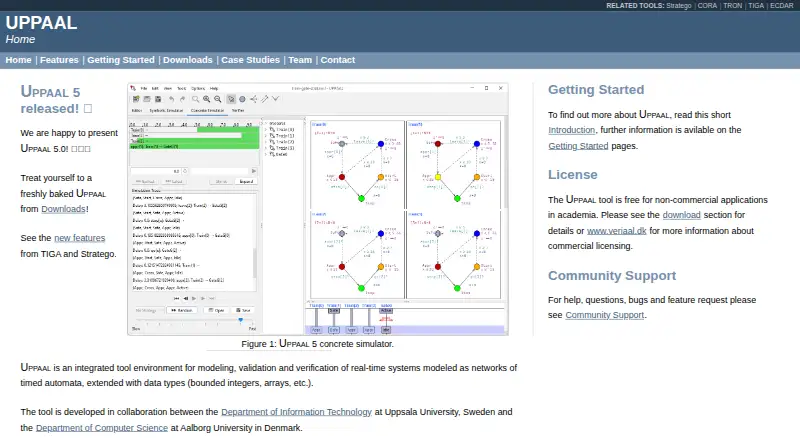
What UPPAAL is
UPPAAL is an environment for modeling, simulating, and verifying real-time systems represented as networks of timed automata. Its language supports clock and data variables, including bounded integers and arrays. The model checker uses symbolic state-space exploration to check invariant and reachability properties and can generate diagnostic traces. Statistical Model Checking can estimate probabilities and compare probabilities with values or with one another.
UPPAAL Stratego supports generating, optimizing, comparing, and examining strategies for stochastic priced timed games. The project identifies timing-critical real-time controllers and communication protocols as typical application areas. Related tools and extensions include CORA, TRON, TIGA, ECDAR, and COSHY for areas such as cost-optimal analysis, testing, timed games, refinement, and hybrid-system control. Desktop packages are available for Windows, macOS, and Linux. The graphical interface requires Java 17 or later, while the verifyta command-line utility can be used without Java. Users must register for a free academic license key, and the software needs an internet connection to retrieve it. Commercial licensing and support require contacting VeriAal.
Good
- Checks invariant and reachability properties.
- Can generate diagnostic traces.
- Statistical tools estimate and compare probabilities.
- Command-line verifyta can be used without Java.
Watch out
- The graphical interface requires Java 17 or later.
- Obtaining the academic license key requires registration and internet access.
- Academic support is community-based and may not answer every direct request.
Who it suits
UPPAAL suits researchers and students modeling or verifying timing-critical systems, particularly real-time controllers and communication protocols. Commercial, private, and other non-academic users need commercial licensing.
Verdict
UPPAAL provides modeling and verification tools for timed-automata systems, with separate statistical and strategy-analysis capabilities. Free licensing is limited to eligible non-commercial academic use; other users must contact VeriAal about commercial licensing.
Plans and prices
From UPPAAL's own pricing page, checked 3 Oct 2026.
| Plan | Price | What it gives you |
|---|---|---|
| Academic license | Free | Researchers or students at degree-granting academic institutions · Work and worker must not be contracted by a non-academic institution · Free for eligible non-commercial academic use |
| Commercial license | Priced on request | Required for company use, private use, national research agency use, and other non-academic use · Contact VeriAal for commercial licensing and support |
The facts
Each one read from UPPAAL's own pages, with the date it was checked.
What it does
- Additional tools
- The site lists related tools and extensions including CORA, TRON, TIGA, ECDAR, and COSHY for cost-optimal analysis, testing, timed games, refinement, and hybrid-system control.checked 3 Oct 2026
- Development
- UPPAAL was created through collaboration between Uppsala University and Aalborg University and is maintained by Aalborg University's Distributed, Embedded and Intelligent Systems group.checked 3 Oct 2026
- License access
- The downloads page says users must register to obtain a free academic license key and that UPPAAL needs an internet connection to fetch the license.checked 3 Oct 2026
- Modeling
- Its description language supports clock and data variables, including bounded integers and arrays, in networks of automata.checked 3 Oct 2026
- Purpose
- UPPAAL is an integrated environment for modeling, simulation, and verification of real-time systems represented as networks of timed automata.checked 3 Oct 2026
- Runtime requirement
- The graphical interface requires Java version 17 or later, while the verifyta command-line utility can be used without Java.checked 3 Oct 2026
- Statistical analysis
- The Statistical Model Checking engine can estimate probabilities, compare a probability with a value, and compare two probabilities.checked 3 Oct 2026
- Strategy analysis
- UPPAAL Stratego supports generation, optimization, comparison, and performance exploration of strategies for stochastic priced timed games.checked 3 Oct 2026
- Support
- Academic support is community-based, with documentation, discussions, mailing lists, and Stack Overflow; the team says it may be unable to answer all direct requests.checked 3 Oct 2026
- Use cases
- The site identifies real-time controllers and communication protocols with timing-critical behavior as typical application areas.checked 3 Oct 2026
- Verification
- The model checker checks invariant and reachability properties through symbolic state-space exploration and can generate diagnostic traces.checked 3 Oct 2026
Where it runs
- Desktop platforms
- The current download page provides packages for Windows, macOS, and Linux, including macOS x86_64 and Aarch64 packages.checked 3 Oct 2026
The company
- Founded
- 1995checked 28 Sep 2026