Isabelle
Isabelle is a free proof assistant for expressing mathematical formulas in a formal language and establishing them within a logical calculus.
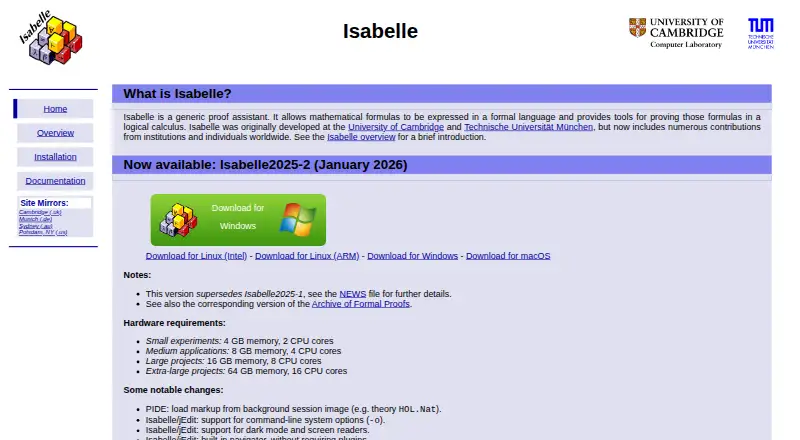
What Isabelle is
Isabelle is a free proof assistant for expressing mathematical formulas in a formal language and establishing them within a logical calculus. It is used to formalize mathematics and verify properties of hardware, software, programming languages, and protocols. Isabelle/HOL provides a higher-order logic environment for larger applications, with tools for reasoning, simplification, arithmetic, algebra, and access to external first-order provers through Sledgehammer. Proofs can be written in Isar, a structured language intended to be legible to people and computers. Isabelle/HOL can also generate SML, OCaml, Haskell, and Scala code from executable specifications. Isabelle/jEdit is the default interface, with continuous proof checking and live feedback; Isabelle2025-2 also includes Isabelle/VSCode with documentation, symbols, and Sledgehammer panels. The distribution includes a theory library, supplemented by the Archive of Formal Proofs. It runs on Linux, macOS, Windows, and self-hosted setups. The software is free, and its main code base is subject to BSD-style regulations.
Good
- Free, with a free plan.
- Supports Linux, macOS, Windows, and self-hosted deployment.
- Isar structures proofs for readers and computers.
- Generates code in four listed languages.
- Includes a theory library and proof productivity tools.
Watch out
- Windows may reject the unsigned application by default.
- macOS requires users to allow the unsigned application to open.
Who it suits
Isabelle suits people formalizing mathematical proofs or checking properties of software, hardware, programming languages, and protocols. It is also suited to large applications that need a higher-order logic theorem-proving environment.
Verdict
Isabelle combines formal proof work with verification applications and code generation. Its free distribution and broad platform support may suit users comfortable working with proof languages and theorem-proving tools.
Plans and prices
From Isabelle's own pricing page, checked 30 Sep 2026.
| Plan | Price | What it gives you |
|---|---|---|
| Isabelle | Free | Distributed for free · open-source licenses, with the main code-base subject to BSD-style regulations |
The facts
Each one read from Isabelle's own pages, with the date it was checked.
What it does
- Additional editor
- The Isabelle2025-2 release includes Isabelle/VSCode, with GUI panels for Documentation, Symbols, and Sledgehammer.checked 30 Sep 2026
- Code generation
- Isabelle/HOL can turn executable specifications into code in SML, OCaml, Haskell, and Scala.checked 30 Sep 2026
- IDE
- Isabelle/jEdit is the default user interface and Prover IDE, providing continuous proof checking with real-time feedback and semantic markup.checked 30 Sep 2026
- Isabelle/HOL
- Isabelle/HOL provides a higher-order logic theorem proving environment intended for large applications.checked 30 Sep 2026
- Libraries and examples
- The distribution includes a large theory library of formally verified mathematics, and the Archive of Formal Proofs provides additional applications from mathematics and software engineering.checked 30 Sep 2026
- Main uses
- Its main applications are formalizing mathematical proofs and formal verification, including proving properties of hardware, software, programming languages, and protocols.checked 30 Sep 2026
- Proof language
- Isar is a structured proof language whose proof text is intended to be understandable to both people and computers.checked 30 Sep 2026
- Proof tools
- Proof productivity tools include a classical reasoner, a simplifier, linear arithmetic automation, algebraic decision procedures, and access to external first-order provers through Sledgehammer.checked 30 Sep 2026
- Security design
- The overview says Isabelle follows the LCF system approach so users can write proof procedures and theory extension packages in ML without breaking system soundness.checked 30 Sep 2026
- Support
- Support is available through official documentation, the isabelle-users and isabelle-dev mailing lists, Zulip, and Q&A sites listed by the project.checked 30 Sep 2026
- What it does
- Isabelle is a generic proof assistant for expressing mathematical formulas in a formal language and proving them in a logical calculus.checked 30 Sep 2026
Where it runs
- macOS limitation
- The macOS application lacks developer signatures and certificates, so Apple rejects it by default and requires the user to allow it to open.checked 30 Sep 2026
- Platforms
- The application bundles support Linux, Windows, and macOS; the site also provides a self-contained Docker image without GUI support.checked 30 Sep 2026
- Windows limitation
- The Windows application lacks developer signatures and certificates, so Microsoft rejects it by default when first run.checked 30 Sep 2026
The full review of Isabelle
Overview
Isabelle is a theorem-proving environment for researchers and engineers who need to express claims formally and establish them with machine-checked proofs. Its breadth is a strength for work spanning mathematics and software verification, but it assumes fluency with formal logic and proof-oriented tools rather than offering a lightweight route to routine software checks.
Isabelle/HOL supplies a higher-order logic environment for larger applications. A substantial library of verified mathematics and additional work in the Archive of Formal Proofs give users material across mathematics and software engineering. Its LCF architecture also lets users extend theories and write proof procedures in ML while preserving system soundness—a meaningful safeguard when building custom proof workflows.
For a broader set of options, see Formal Verification Tools.
Key features
Proof construction and automation
Isabelle combines the structured Isar proof language with automation for classical reasoning, simplification, linear arithmetic, and algebraic decision procedures. Sledgehammer can invoke external first-order provers. This mix can reduce routine proof work while keeping arguments readable to people as well as computers; it does not remove the need to formalize the problem or guide the proof.
Its deductive verification approach supports theorem proving, counterexamples, and proof artifacts. That makes Isabelle suited to claims that need explicit proof evidence, including properties of hardware, software, programming languages, and protocols.
Editors and code generation
Isabelle/jEdit is the default Prover IDE, with continuous proof checking, real-time feedback, and semantic markup. Isabelle/VSCode is also included in the Isabelle2025-2 release, with panels for documentation, symbols, and Sledgehammer. Users can choose between the established default interface and a VS Code-based option, though both remain interfaces to a specialist proof environment.
Executable Isabelle/HOL specifications can generate code in SML, OCaml, Haskell, and Scala. This connects formal specifications to implementation languages, but code generation is not a substitute for deciding which properties matter or proving them.
Pricing
Isabelle is free: the Isabelle plan costs nothing, is distributed under open-source licenses, and has a main code base subject to BSD-style regulations. There is no free trial because the product is already free, and no paid tier or seat-based charge is part of this plan. It is a strong fit for individuals and teams prepared to manage a self-hosted toolchain; there is no lower-cost tier with reduced capabilities to weigh against it.
Platforms
Isabelle supports Linux, macOS, Windows, and self-hosted deployment. Windows and macOS users should expect an installation hurdle: the applications lack developer signatures and certificates, so Microsoft rejects the Windows application by default and Apple blocks the macOS application until the user allows it to open. Linux users avoid those particular platform warnings. Documentation, mailing lists, Zulip, and project-listed Q&A sites provide support channels.
Who it's for
Isabelle is best for people formalizing mathematics or verifying system properties who need a general theorem prover, a large-application logic environment, and the ability to develop proof extensions in ML. Its libraries, automation, and multiple editor options reward sustained work in formal methods. It is a poor fit for users seeking conventional application development, a quick automated scan, or a tool that avoids proof-language learning.
Pros and cons
- Pros: A broad proof toolkit combines structured proofs with several forms of automation, including access to external first-order provers.
- Pros: Verified mathematics libraries and the Archive of Formal Proofs provide a substantial starting point across mathematics and software engineering.
- Pros: Isabelle/HOL specifications can generate code in four functional languages, connecting executable specifications to implementation work.
- Cons: The formal language and theorem-proving model make it a specialist choice, not a low-friction checker for casual use.
- Cons: Unsigned Windows and macOS applications trigger operating-system warnings or blocks that users must resolve before opening them.
Alternatives
Choose Rocq if you want a free interactive theorem prover and dependently typed programming language across Linux, macOS, Windows, web, and extension platforms. PVS is another free option for noncommercial use; commercial users should weigh its custom pricing, and noncommercial users must accept a click-through license for the Allegro runtime.
Z3 may suit readers looking for a free MIT-licensed tool with Android, API, web, and self-hosted availability as well as desktop platforms. ACL2 is another free option with Linux, macOS, Windows, and self-hosted support. Frama-C is a free alternative for readers considering a platform co-developed by CEA LIST and academic research teams.
CBMC offers free open-source software under a 4-clause BSD license, with Linux, macOS, Windows, and self-hosted availability. Lean is a free alternative available on web, Windows, macOS, and Linux. SPIN is free, with source and executables under a BSD 3-Clause license for Linux, macOS, and Windows.
Verdict
Choose Isabelle if your work depends on formal proofs and you value a flexible higher-order logic environment, proof automation, verified libraries, and code generation without a license fee. Look elsewhere if you need a less specialized verification workflow or cannot accommodate proof-language learning and the platform-specific launch friction on Windows or macOS.