xinxin-song
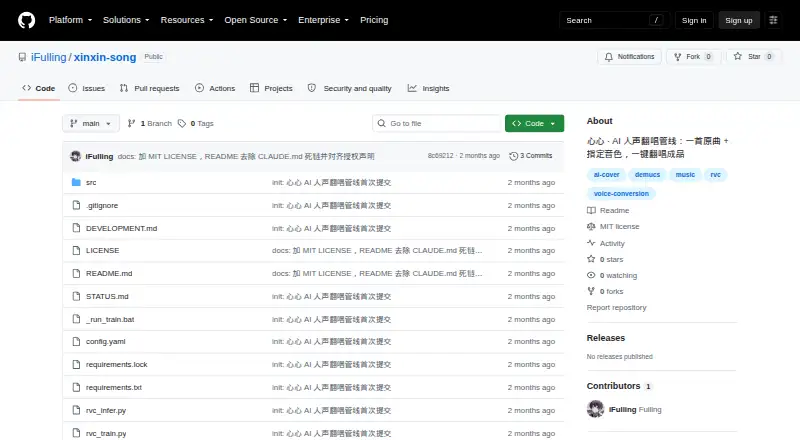
The facts below are what the maker publishes about xinxin-song, checked and dated. Our editors have not written about it yet.
The facts
Each one read from xinxin-song's own pages, with the date it was checked.
What it does
- Audio controls
- The CLI supports pitch shifting, selectable F0 methods, RVC index tuning, denoising options, and WAV or MP3 output.checked 11 Oct 2026
- Dependencies
- The setup instructions call for Python environments for the pipeline and RVC, FFmpeg, RVC models, and a trained voice model.checked 11 Oct 2026
- External audio
- Users can provide externally separated vocals and accompaniment, allowing them to skip Demucs separation.checked 11 Oct 2026
- External vocals
- Users can provide externally separated vocals to skip Demucs, with UVR5 given as an example tool for manual separation.checked 11 Oct 2026
- Hardware target
- The development document names an RTX 5070 Ti with CUDA 12.8 and PyTorch cu128 as its hardware target.checked 11 Oct 2026
- Inference only
- The V1 pipeline handles inference for one song; voice-model training is done separately with the RVC WebUI.checked 11 Oct 2026
- Integrations
- The documented pipeline uses Demucs, RVC, and ffmpeg, and accepts vocals prepared separately with UVR5.checked 11 Oct 2026
- License
- The repository says its code is released under the MIT License.checked 11 Oct 2026
- Mixing
- The documented mixing stage uses FFmpeg loudness normalization and a limiter to help manage loudness and clipping.checked 11 Oct 2026
- Output files
- By default, each song gets its own output directory containing intermediate audio, the final cover, a parameter snapshot, and a run log.checked 11 Oct 2026
- Processing
- Its pipeline separates vocals and accompaniment with Demucs, converts the vocals with RVC, then mixes the converted vocals with the accompaniment.checked 11 Oct 2026
- Purpose
- xinxin-song is a local AI vocal-cover pipeline that takes an original song and a specified voice model to produce a cover.checked 11 Oct 2026
- Requirements
- Setup requires two Python virtual environments, ffmpeg, RVC model assets, and a trained voice model; the documented RVC setup specifies Python 3.12 and CUDA 12.8.checked 11 Oct 2026
- Rights guidance
- The README says cover distribution is subject to voice and copyright rights, advises getting authorization before public sharing, and warns against impersonation.checked 11 Oct 2026
- Scope limit
- The documented V1 scope is inference for one song at a time; the development document says batch processing is not included in V1.checked 11 Oct 2026
- Security and privacy
- The maker describes the pipeline as locally deployed and documents local output files and logs; the pages opened make no security certification or compliance claim.checked 11 Oct 2026
- Voice training
- The project handles inference only; voice-model training is done separately using RVC’s WebUI.checked 11 Oct 2026
Where it runs
- Windows setup
- The documented setup uses Windows commands, including `winget` for FFmpeg and Windows virtual-environment activation paths.checked 11 Oct 2026
Alternatives to xinxin-song
- 1

BeMusic AI Cover
Free planAndroidiOSWebLinux8.2From $12 a month - 2

Revocalize AI
Free planAndroidiOSWebAPI8.1From $9 a month - 3
Media.io AI Song Cover Generator
Free planAndroidiOSWebAPI8.0From $59.90 a year - 4
Kits AI
Free planWebAPIWindows7.7From $10 a month - 5

Applio
Free planOpen sourceWebAPILinuxmacOS7.6Free plan - 6

Audjust AI Song Cover Generator
Free planWebAPI7.3From $10 a month