Wonder3D
Wonder3D reconstructs a textured 3D mesh from a single-view image.
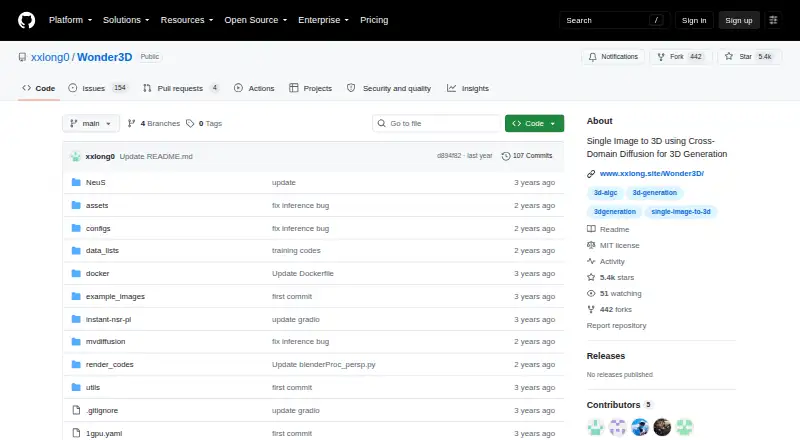
What Wonder3D is
Wonder3D reconstructs a textured 3D mesh from a single-view image. Its cross-domain diffusion process generates consistent multi-view normal maps and color images, then uses normal fusion for reconstruction. The project documents Instant-NSR and NeuS mesh extraction workflows and says reconstruction takes about 2–3 minutes. It supports image-to-3D, sketch-to-3D, and AI texturing, but not text-to-3D. The implementation is limited to six views and 256×256 generation, and resizes input images to that resolution. The README warns that occluded input can lead to worse results because six views may not show the whole object; it recommends front-facing images with fewer occlusions. Foreground segmentation can be prepared with Clipdrop or rembg. Inference requires downloaded checkpoints, including a Segment Anything Model checkpoint. The repository includes two training scripts and describes a two-stage process. Wonder3D is free to use with acknowledgement under the MIT license. Linux setup instructions are provided, with Windows users directed to a separate setup branch; local Gradio demos are also available.
Good
- Reconstructs textured meshes from single-view images
- Offers Instant-NSR and NeuS extraction workflows
- Free to use with acknowledgement under MIT
- Local Gradio demos for generation and reconstruction
Watch out
- Generation is limited to six views at 256×256
- Occluded input can produce worse reconstructions
- Inference requires downloaded model checkpoints
Who it suits
Wonder3D suits people who want to turn a single image or sketch into a textured mesh and can work with its checkpoint-based inference workflow. It may be useful for 3D asset creation, 3D printing, and related visual projects.
Verdict
Wonder3D provides a defined image-to-mesh workflow and options for extracting meshes. Its six-view resolution limit and sensitivity to occlusion are important constraints when preparing input images.
The facts
Each one read from Wonder3D's own pages, with the date it was checked.
What it does
- Contact and collaboration
- The project invites collaboration and lists [email protected] for contact.checked 7 Oct 2001
- Generation
- It generates consistent multi-view normal maps and corresponding color images using cross-domain diffusion.checked 7 Oct 2001
- Generation method
- It generates consistent multi-view normal maps and corresponding color images with a cross-domain diffusion model, then uses normal fusion for reconstruction.checked 7 Oct 2001
- Hardware
- The example pipeline moves to CUDA when available, and the repository provides a one-GPU inference configuration.checked 7 Oct 2001
- Input guidance
- The README says front-facing images with fewer occlusions generally produce better reconstructions.checked 7 Oct 2001
- Input preparation
- The README suggests using Clipdrop or rembg to segment the foreground object.checked 7 Oct 2001
- Integrations
- The documented workflow uses Hugging Face Diffusers and checkpoints, and describes using SAM and Clipdrop or rembg for foreground masks.checked 7 Oct 2001
- Intended uses
- The project page shows examples involving Houdini, 3D asset creation, 3D printing, 2D designs, and animal images.checked 7 Oct 2001
- License
- The repository states that Wonder3D is under the MIT license and free to use with acknowledgement.checked 7 Oct 2001
- Mesh extraction
- It provides Instant-NSR and NeuS-based mesh extraction workflows.checked 7 Oct 2001
- Model dependencies
- The inference instructions call for downloaded checkpoints and a Segment Anything Model checkpoint.checked 7 Oct 2001
- Multi-view attention
- The method uses multi-view cross-domain attention to exchange information across views and image modalities.checked 7 Oct 2001
- Notable limits
- The README says the implementation supports six views and 256×256 generation, and resizes input images to that resolution.checked 7 Oct 2001
- Output limits
- The current implementation supports six views and resizes input images to 256×256 for generation.checked 7 Oct 2001
- Processing time
- The project says reconstruction takes about 2–3 minutes.checked 7 Oct 2001
- Purpose
- Wonder3D reconstructs textured 3D meshes from a single-view image.checked 7 Oct 2001
- Reconstruction caveat
- The README says occluded inputs can produce worse reconstructions because six views may not cover the complete object.checked 7 Oct 2001
- Reconstruction options
- The repository documents Instant-NSR and NeuS mesh extraction; it says NeuS uses less GPU memory and favors smooth surfaces but takes longer and may produce less sharp textures.checked 7 Oct 2001
- Reconstruction speed
- The project says reconstruction takes about 2–3 minutes.checked 7 Oct 2001
- Support and collaboration
- The README invites questions and collaboration by email at [email protected].checked 7 Oct 2001
- Supported systems
- The README provides Linux setup instructions and points Windows users to a separate setup branch.checked 7 Oct 2001
The company
- Founded
- 2023checked 28 Sep 2001
Where it runs
- Local demos
- The repository provides local Gradio demos for generating normals and colors and for mesh reconstruction.checked 7 Oct 2001
- Platforms
- The README provides Linux setup, points Windows users to a separate branch, and links a Hugging Face demo.checked 7 Oct 2001
Alternatives to Wonder3D
- 1

Meshy
Free planAndroidiOSWebAPI8.3From $20 a month - 2

Tripo AI
Free planAndroidiOSWebAPI8.2From $4.58 a month - 3

Polar Cloud
Free planAndroidiOSWebAPI8.1From $6.58 a month - 4
Hunyuan3D
Free planWebAPILinuxmacOS7.5CN¥100, paid once - 5

Polycam
Free planAndroidiOSWeb7.5From $12.50 a month - 6

Hyper3D Rodin
Free planWebAPI6.9From $30 a month