whook
whook is a free, MIT-licensed, self-hostable gateway for receiving webhooks, storing them before acknowledgment, and forwarding them with retries and replay.
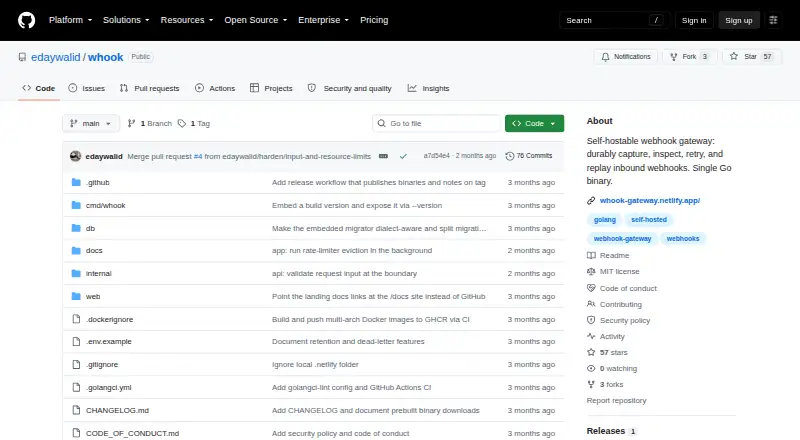
What whook is
whook is a free, MIT-licensed, self-hostable gateway for receiving webhooks, storing them before acknowledgment, and forwarding them with retries and replay. Captured events can be inspected, queried, and replayed through an API or dashboard. Failed deliveries use deterministic exponential backoff, honor Retry-After for 429 responses, and move to dead-letter state when the retry budget is exhausted. One event can be sent to multiple destinations, each with its own filter and delivery status. Optional signature verification is listed for Stripe, GitHub, Shopify, Slack, and Linear; failed verification captures the request without delivering it. SQLite is built in, while Postgres supports larger or multi-instance deployments. The dashboard shows payload details, attempt history, delivery state, replay controls, and dead-letter events. Prometheus metrics are available at GET /metrics. Prebuilt binaries support Linux, macOS, and Windows on amd64 and arm64, with a multi-architecture Docker image. Events remain indefinitely by default.
Good
- Stores requests before acknowledgment
- Automatic retries with dead-letter handling
- Replay through API or dashboard
- Multiple destinations with separate filters
- MIT licensed with no per-event pricing
Watch out
- Default inbound body limit is 1,048,576 bytes
- Events remain indefinitely unless retention is configured
- Per-source rate limiting is disabled by default
- Requires self-hosted deployment
Who it suits
It suits developers who need self-hosted webhook durability, retries, replay, routing, and inspection. Teams can choose SQLite or Postgres and deploy on listed platforms.
Verdict
whook provides durable webhook capture and controlled delivery without accounts or per-event charges. Its self-hosted model, default limits, and retention behavior matter when planning operations.
The facts
Each one read from whook's own pages, with the date it was checked.
What it does
- Access limits
- The ingest body-size limit defaults to 1,048,576 bytes, and per-source ingest rate limiting is disabled by default.checked 11 Oct 2026
- Capture and replay
- Requests are stored before acknowledgment and can be queried and replayed through the API or dashboard.checked 10 Oct 2026
- Dashboard
- The dashboard shows events, payload details, delivery state, attempt history, replay controls, and a dead-letter view.checked 11 Oct 2026
- Delivery retries
- Failed deliveries use deterministic exponential backoff, honor a 429 Retry-After header, and are dead-lettered when their retry budget is exhausted.checked 11 Oct 2026
- Deployment
- The project offers a prebuilt multi-architecture Docker image, Docker Compose setup, prebuilt binaries, and installation from Go source.checked 11 Oct 2026
- Durable capture
- Inbound requests are stored before acknowledgment and can be listed, inspected, and replayed through the API or dashboard.checked 11 Oct 2026
- Fan-out
- An event can be delivered to multiple matching destinations, each with its own filter and delivery status.checked 11 Oct 2026
- License and support
- The repository is MIT-licensed and invites issues and pull requests.checked 11 Oct 2026
- Limits
- The default maximum inbound body size is 1,048,576 bytes, and larger requests are rejected with HTTP 413.checked 10 Oct 2026
- Metrics
- The gateway exposes Prometheus metrics for ingest, delivery outcomes, and dead-letter volume at GET /metrics.checked 10 Oct 2026
- Provider verification
- Optional signature verifiers are listed for Stripe, GitHub, Shopify, Slack, and Linear; requests that fail verification are captured but not delivered.checked 10 Oct 2026
- Purpose
- whook is a self-hostable gateway that captures inbound webhooks, acknowledges them quickly, and forwards them to destinations with automatic retries.checked 11 Oct 2026
- Retention
- Captured events are kept indefinitely by default; setting WHOOK_RETENTION_AGE enables pruning, while failed events can be retained longer.checked 11 Oct 2026
- Retries
- Failed deliveries use deterministic exponential backoff, honor Retry-After for 429 responses, and are dead-lettered when the retry budget is exhausted.checked 10 Oct 2026
- Security
- When configured, an admin bearer token protects the management API, dashboard, and metrics; provider signing secrets are encrypted at rest with AES-256-GCM.checked 11 Oct 2026
- Signature integrations
- Pluggable signature verification is listed for Stripe, GitHub, Shopify, Slack, and Linear.checked 11 Oct 2026
- Storage
- SQLite is the default storage backend, and Postgres is supported for larger or multi-instance deployments.checked 11 Oct 2026
- Storage and retention
- Captured events are retained indefinitely by default; setting WHOOK_RETENTION_AGE enables pruning, while failed and dead-lettered events can be kept longer.checked 10 Oct 2026
- Support and contribution
- The repository invites issues and pull requests and links to contribution instructions.checked 10 Oct 2026
Where it runs
- Install platforms
- The maker lists prebuilt binaries for Linux, macOS, and Windows on amd64 and arm64, plus a prebuilt multi-architecture Docker image.checked 10 Oct 2026
- Supported binary platforms
- Prebuilt binaries are listed for Linux, macOS, and Windows on amd64 and arm64.checked 11 Oct 2026
Money
- License and cost
- whook is self-hostable and MIT licensed; its site says there are no accounts or per-event pricing.checked 10 Oct 2026
Alternatives to whook
- 1
Kiosk
Free planOpen sourceAndroidiOSWebExtension8.0Free plan - 2
WebhookX
Free planOpen sourceWebAPILinuxmacOS8.0From $39 a month - 3
Svix
Free planOpen sourceWebAPILinuxSelf-hosted7.8From $20 a month - 4

Hookdeck
Free planWebAPILinuxmacOS7.7From $39 a month - 5
RelayHQ
Free planWebAPILinuxmacOS7.7From $29 a month - 6
Dispatch
Free planWebAPILinuxmacOS7.6From $39 a month