Webdar
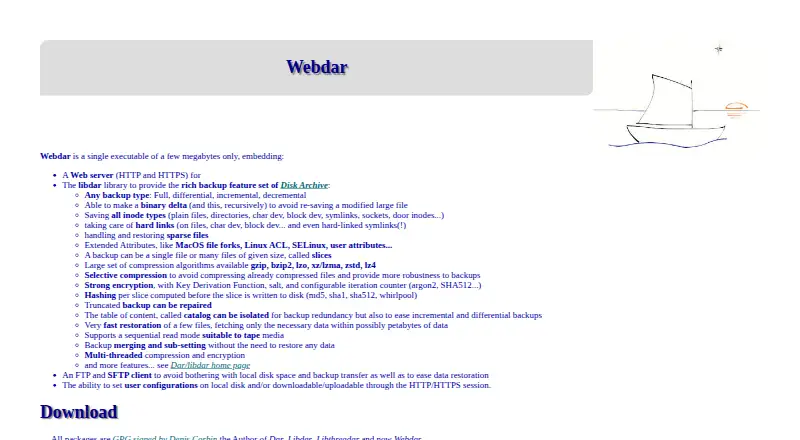
The facts below are what the maker publishes about Webdar, checked and dated. Our editors have not written about it yet.
The facts
Each one read from Webdar's own pages, with the date it was checked.
What it does
- Archive features
- It can create binary deltas, preserve inode types and hard links, handle sparse files and extended attributes, and split archives into slices.checked 12 Oct 2026
- Authentication
- When started, Webdar displays a browser login and a randomly generated password in its terminal output.checked 12 Oct 2026
- Availability
- The maker provides signed source packages and statically linked Linux binaries for x86_64 and ARM, and notes the binaries are distro independent for supported CPU types.checked 12 Oct 2026
- Backup features
- It supports binary deltas, file filtering, sliced archives, and restoration of selected files.checked 12 Oct 2026
- Backup scope
- filechecked 19 Sep 2026
- Backup types
- It supports full, differential, incremental, and decremental backups.checked 12 Oct 2026
- Compression
- Available compression algorithms include gzip, bzip2, lzo, xz/lzma, zstd, and lz4.checked 12 Oct 2026
- Computer backup
- Yeschecked 19 Sep 2026
- Configuration
- Configurations can be stored locally or uploaded and downloaded through the web session.checked 12 Oct 2026
- Encryption and integrity
- The site describes backup encryption with key derivation and per-slice hashing, and says backups are strongly ciphered by default.checked 12 Oct 2026
- Limits
- The tutorial says Webdar is ready for multiple users, but only the admin user is available at the time described.checked 12 Oct 2026
- Mobile backup
- Nochecked 19 Sep 2026
- Network security
- The tutorial recommends HTTPS for untrusted networks and warns that credentials in uploaded or downloaded configurations can be exposed without a secured connection.checked 12 Oct 2026
- Operations
- The tutorial describes backup creation, testing, comparison, listing, isolation, merging, repair, and restoration operations.checked 12 Oct 2026
- Product
- Webdar is a small single executable that combines a web server with the libdar backup library.checked 12 Oct 2026
- Purpose
- Webdar is a web interface to the libdar library for creating and restoring backups.checked 12 Oct 2026
- Ransomware protection
- Nochecked 19 Sep 2026
- Remote repositories
- Webdar includes FTP and SFTP clients for transferring backups and restoring data from remote repositories.checked 12 Oct 2026
- Restore modes
- filechecked 19 Sep 2026
- Sessions and users
- The tutorial says the admin user can run several parallel sessions, while additional user support is described as a future feature.checked 12 Oct 2026
- SFTP security
- The tutorial advises enabling checks of remote SFTP hosts against the known-host file.checked 12 Oct 2026
- Storage integrations
- Webdar includes an FTP and SFTP client for transferring and restoring backups, as well as local filesystem storage.checked 12 Oct 2026
- Support
- The project says communications and exchanges are planned through GitHub Discussions.checked 12 Oct 2026
Where it runs
- Linux downloads
- The site offers signed source packages and statically linked binaries for Linux on x86_64 and ARM; the binaries are described as distro independent.checked 12 Oct 2026
Alternatives to Webdar
- 1
UrBackup
Free planOpen sourceAndroidWebAPILinux9.4Free plan - 2

IDrive
Free planAndroidiOSWebLinux9.2From $0.25 a month - 3

Bareos
Free planOpen sourceWebAPILinuxmacOS9.1From €480 a year - 4

MSP360 Backup
Free planAndroidiOSWebAPI9.0Free plan - 5

iCloud Backup
Free planAndroidiOSWebAPI8.6From $0.99 a month - 6

Backblaze Computer Backup
AndroidiOSWebmacOS8.5From $7.88 a month