
Vooda AI
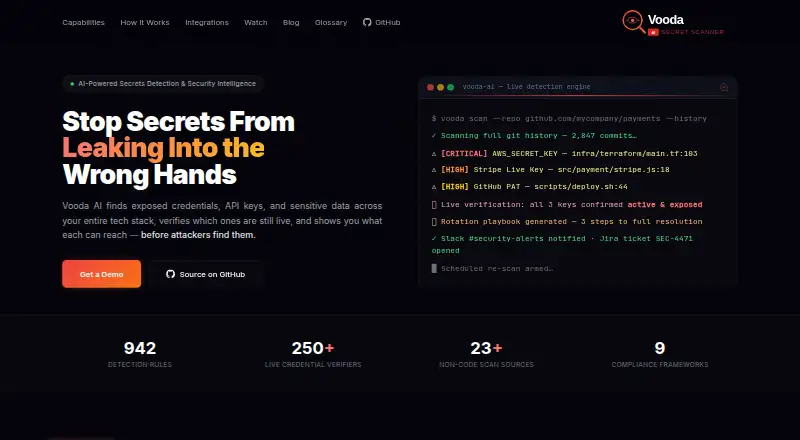
Vooda AI is a secrets detection and security intelligence platform that finds exposed credentials, API keys, and sensitive data across a technology stack.
What Vooda AI is
Vooda AI is a secrets detection and security intelligence platform that finds exposed credentials, API keys, and sensitive data across a technology stack. It checks whether credentials are still active and shows what resources they can access, including repositories, buckets, databases, and IAM policies. Detection combines 942 provider-specific rules with entropy analysis, decoding, structured-file parsing, and configuration checks. The platform scans code and more than 23 non-code sources, including collaboration tools, cloud storage, containers, Postman, and CI/CD logs. It verifies credentials against more than 250 provider APIs and uses AI confidence scores, team decisions, and suppression of known false positives to triage findings. For remediation, it creates provider-specific rotation playbooks and pre-filled pull requests. CI/CD options include GitHub and GitLab integrations, container images, pre-commit scanning, and gating. Vooda offers cloud and self-hosted deployment, including air-gapped use with a local AI model and outbound verification disabled. Its self-hosted plan costs nothing.
Good
- Checks live credentials against more than 250 provider APIs
- Scans code and 23+ non-code source types
- Offers CI/CD, pre-commit, pull-request, and push protections
- Self-hosting supports air-gapped use with a local AI model
- Free self-hosted plan has no seat limits
Watch out
- Self-hosted plan requires Docker
- Air-gapped mode disables outbound credential verification
- Enterprise access features include SSO and audit controls
Who it suits
Vooda suits security teams that need to find and verify exposed secrets across code and non-code sources. Self-hosted deployment and CI/CD protections may suit organizations with infrastructure or workflow requirements of their own.
Verdict
Vooda AI combines broad secrets discovery with credential verification and remediation tools. Its free self-hosted option supports production use, but requires Docker and air-gapped operation means giving up outbound verification.
Plans and prices
From Vooda AI's own pricing page, checked 2 Oct 2026.
| Plan | Price | What it gives you |
|---|---|---|
| Self-hosted | Free | Production use · any company size · no seat limits · requires Docker |
The facts
Each one read from Vooda AI's own pages, with the date it was checked.
What it does
- access controls
- Enterprise access features include SAML 2.0, Okta, Azure AD, Google Workspace SSO, role-based access control, and immutable audit logs.checked 1 Oct 2026
- Access controls
- The platform lists SAML 2.0, Okta, Azure AD, and Google Workspace SSO, role-based access control, and immutable audit logs.checked 2 Oct 2026
- AI triage
- AI assigns confidence scores to findings, learns from team accept and dismiss decisions, and can suppress known false positives.checked 2 Oct 2026
- blast radius
- Vooda Radar verifies active secrets, enumerates accessible repositories, buckets, databases, and IAM policies, and generates a 0–100 impact score.checked 1 Oct 2026
- CI/CD
- Vooda offers a GitHub Action, GitLab CI template, and container image for Jenkins, CircleCI, or other runners, with pre-commit and CI gate options.checked 2 Oct 2026
- CI/CD protection
- The product provides a native GitHub Action, GitLab CI template, container image, pre-commit scanning, and CI gating.checked 1 Oct 2026
- compliance
- Findings map to SOC 2, PCI-DSS 4.0, ISO 27001:2022, NIST 800-53, HIPAA, GDPR, OWASP Top 10, CWE Top 25, and CAPEC.checked 1 Oct 2026
- Compliance
- The site says findings can be mapped to SOC 2, PCI-DSS 4.0, ISO 27001:2022, NIST 800-53, HIPAA, GDPR, OWASP Top 10, CWE Top 25, and CAPEC.checked 2 Oct 2026
- Connection security
- Vooda says connection credentials are encrypted at rest and remain within the customer's tenant; it also says no agents need to be installed.checked 2 Oct 2026
- customization
- Users can write custom detectors, override severity by rule and source, and manage allowlists and suppressions.checked 1 Oct 2026
- deployment
- Vooda states that it supports on-premise deployment and requires no agents to install.checked 1 Oct 2026
- Detection
- The platform describes 942 provider-specific detection rules alongside entropy analysis, base64 decoding, structured-file parsing, and custom detectors.checked 2 Oct 2026
- detection engine
- The detection engine uses 942 provider-specific rules, Shannon-entropy analysis, base64 decoding, structured-file parsing, and configuration-assignment detection.checked 1 Oct 2026
- Integrations
- Listed integrations include GitHub, GitLab, Bitbucket, AWS S3, Slack, Jira, Jenkins, CircleCI, Microsoft Teams, ServiceNow, Notion, and Confluence.checked 2 Oct 2026
- live verification
- Vooda verifies credentials in real time against more than 250 provider APIs.checked 1 Oct 2026
- product category
- Vooda AI describes itself as an enterprise-grade secrets detection and security intelligence platform.checked 1 Oct 2026
- purpose
- Vooda AI finds exposed credentials, API keys, and sensitive data across a technology stack, verifies which credentials remain live, and shows what each can access.checked 1 Oct 2026
- Purpose
- Vooda AI detects exposed credentials, API keys, and sensitive data across code and other connected sources, verifies whether credentials are live, and maps what they can access.checked 2 Oct 2026
- remediation
- Vooda generates provider-specific rotation playbooks and opens pre-filled pull requests to remove secrets from code.checked 1 Oct 2026
- Remediation
- Vooda generates provider-specific credential rotation playbooks and pre-filled pull requests to remove secrets from code.checked 2 Oct 2026
- Scanning coverage
- The site lists scanning for full Git history and non-code sources including collaboration tools, cloud storage, containers, Postman, and CI/CD logs.checked 2 Oct 2026
- scan sources
- The platform scans 23+ non-code sources, including Slack, Teams, Confluence, Notion, Jira, cloud storage, Docker images, Postman, and CI/CD logs.checked 1 Oct 2026
- security
- The site states that connection credentials are encrypted at rest and never leave the customer tenant.checked 1 Oct 2026
The company
- Maker
- Vooda AI identifies itself as a Virantis product.checked 2 Oct 2026
The full review of Vooda AI
Overview
Vooda AI is a secrets detection and security intelligence platform for finding exposed credentials and sensitive data across code and other technology sources. It suits security teams that need to verify whether discovered credentials still work and assess their reach. The free self-hosted plan supports production use, but requires Docker; air-gapped deployments give up outbound credential verification.
Key features
Detection combines 942 provider-specific rules with entropy analysis, base64 decoding, structured-file parsing, configuration-assignment detection, and custom detectors. That breadth can help teams catch secrets in varied formats, while rule and source severity overrides, allowlists, and suppressions let them tune results to their environment.
Vooda checks credentials in real time against more than 250 provider APIs. Its AI triage scores confidence, adapts to team accept-or-dismiss decisions, and suppresses known false positives. Vooda Radar adds an impact view: it checks active secrets, enumerates accessible repositories, storage buckets, databases, and IAM policies, then assigns a 0–100 score. This connects finding a credential to understanding its potential reach; disabling outbound verification for air-gapped use removes the live-checking step.
Scanning extends beyond source code to more than 23 kinds of sources, including collaboration tools, cloud storage, Docker images, Postman, and CI/CD logs. Integrations include GitHub, GitLab, Bitbucket, AWS S3, Slack, Jira, Jenkins, CircleCI, Microsoft Teams, ServiceNow, Notion, and Confluence. A GitHub Action, GitLab CI template, and container image support CI/CD use, with pre-commit scanning, CI gates, push protection, and pull-request scanning.
For remediation, Vooda creates provider-specific rotation playbooks and pre-filled pull requests to remove secrets from code. Findings map to frameworks including SOC 2, PCI-DSS 4.0, ISO 27001:2022, NIST 800-53, HIPAA, GDPR, OWASP Top 10, CWE Top 25, and CAPEC. Enterprise access controls include SAML 2.0, SSO for Okta, Azure AD, and Google Workspace, role-based access, and immutable audit logs. Vooda says connection credentials are encrypted at rest and stay within the customer tenant, and that the product needs no agents.
Pricing
The Self-hosted plan costs nothing and is intended for production use at any company size, with no seat limits. It includes GitHub, GitLab, and Bitbucket support, CI/CD scanning, pre-commit and pull-request scanning, push protection, and custom detection rules. Docker is required, so the zero price does not remove the operational requirement to run it on customer infrastructure. Self-hosting can support air-gapped use with a local AI model, but outbound credential verification must be disabled.
Platforms
Vooda supports API, Linux, macOS, web, Windows, and self-hosted deployment. Its self-hosting guide describes running on customer infrastructure, including air-gapped operation. The product is identified as a Virantis product.
Who it's for
Vooda is a strong fit for organizations that want broad secrets coverage, live credential checks, impact assessment, and remediation workflows in one security tool. Its unlimited-seat free self-hosted plan also makes it worth considering for teams able to manage Docker and their own deployment. It is less suitable for air-gapped teams that need live credential verification, since that capability depends on outbound access.
Pros and cons
- Pro: Live checks against more than 250 provider APIs and Radar's access enumeration help teams prioritize credentials by whether they work and what they can reach.
- Pro: Scanning across code, collaboration tools, cloud storage, containers, and CI/CD logs gives teams coverage beyond repositories.
- Pro: The free production plan has no seat limits and includes CI/CD, pre-commit, pull-request, and push-protection options.
- Con: Self-hosting requires Docker, so teams must be prepared to operate the deployment themselves.
- Con: Air-gapped use disables outbound credential verification, limiting the live-checking part of the product.
Alternatives
For another broad secrets-scanning option with a free tier, consider GitGuardian; its Starter plan includes unlimited real-time scanning for up to 25 developers, with historical detections capped at 500 and API calls at 10K. HashiCorp Nomad is another freemium option, with self-managed and customizable enterprise plans. Semgrep Code offers a free edition covering code and supply chain for up to 10 repositories and 10 contributors, with 60 AI credits. Endor Labs has a no-account-required free developer plan for local scans, but without a UI, policies, or scan history.
ggshield may suit readers seeking a free CLI option; its CLI is open source, while the detection library behind GitGuardian's public API is closed source. Kingfisher is a free and open-source alternative. TruffleHog offers an open-source plan with scanning for GitHub, S3, directories, GCS, and Docker, plus 800+ detectors and CI hooks. Betterleaks is another free alternative.
Browse the Secrets Scanning Software category for more options.
Verdict
Choose Vooda AI if your team needs to find secrets across code and connected services, verify live credentials, and see their potential reach, especially if you can self-host. Its no-cost, unlimited-seat production plan is compelling, but Docker operation is a real commitment, and air-gapped users must trade away outbound verification. Teams that cannot accept either constraint should consider another secrets-scanning tool.
Getting started
- Visit https://vooda.ai/ to get started.
- Choose the self-hosted plan, listed as free.
- Use Docker to run the product on customer infrastructure.
- Connect supported VCS such as GitHub, GitLab, or Bitbucket.
- Add CI/CD scanning with the GitHub Action, GitLab CI template, or container image.
Limits worth knowing
The self-hosted plan requires Docker. For air-gapped use, the guide describes using a local AI model and disabling outbound credential verification.
Questions
Is Vooda AI free?
A free plan is listed, and the Self-hosted plan is listed as free.
Which platforms does it support?
Listed platforms are API, Linux, macOS, self-hosted, web, and Windows.
Can Vooda AI run on customer infrastructure?
Yes. Vooda supports on-premise deployment, and its self-hosted guide describes air-gapped use with a local AI model.
Which version control systems are supported?
The listed supported VCS are GitHub, GitLab, and Bitbucket.
What integrations are listed?
Integrations include GitHub, GitLab, Bitbucket, AWS S3, Slack, Jira, Jenkins, CircleCI, Microsoft Teams, ServiceNow, Notion, and Confluence.
Who makes Vooda AI?
Vooda AI identifies itself as a Virantis product.
Alternatives to Vooda AI
- 1

DeepSource
Free planWebAPILinuxmacOS8.0From $30 a month - 2

Endor Labs
Free planWebAPIExtensionLinux7.4Free plan - 3

Arnica Secrets Security
Free planWebAPISelf-hosted6.6From $300 a year - 4
GitGuardian
Free planWebAPILinuxmacOS6.6Free plan - 5
detect-secrets
Free planLinuxmacOSSelf-hostedWindows6.5Free plan - 6
ByteHide Secrets
Free planWebAPILinuxmacOS6.3Free plan