Voland
Voland is an open-source Nintendo Switch emulator project designed primarily for the browser, with native targets also listed.
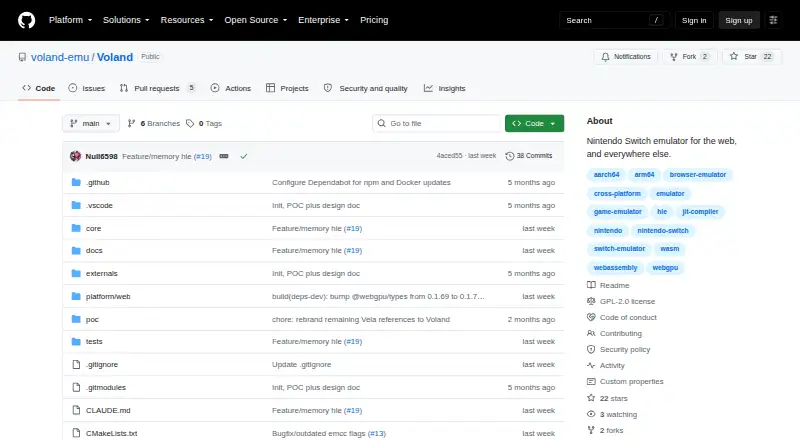
What Voland is
Voland is an open-source Nintendo Switch emulator project designed primarily for the browser, with native targets also listed. It is in early development: the repository says it does not yet execute guest code, and there are no playable games. The browser version uses a WebAssembly-compiled C core, WebGPU rendering, SharedArrayBuffer for guest RAM, and dedicated Workers for emulator subsystems. The no-op CPU backend is complete, while interpreter, dynarmic, and Ballistic backends are planned. Its architecture lists Maxwell GPU emulation and DSP emulation with an audio pipeline. Voland is released under GPL-2.0. The project does not distribute keys, firmware, or game files; users must provide their own prod.keys and NSP or XCI game files from hardware and purchases they own. The web distribution is listed as a URL or PWA. Native distribution is listed as sideloading for iOS and Android, direct downloads for macOS, Windows, and Linux, and Developer Mode for Xbox. However, GitHub Releases lists no releases.
Good
- Open-source under GPL-2.0.
- Browser-first design uses WebAssembly and WebGPU.
- Native targets are listed across desktop and mobile.
- Architecture lists GPU and DSP emulation.
Watch out
- No guest code executes yet.
- No playable games are available yet.
- Interpreter and recompiler backends are planned.
- GitHub Releases lists no releases.
Who it suits
Voland is currently for people interested in browser emulation, ARM64-to-WASM translation, compiler design, or open-source emulator engineering. It is not yet usable for playing games, according to the project status.
Verdict
Voland is an early-stage emulator project rather than a playable option at present. Its browser and native targets may interest emulator developers, but the repository reports no game execution yet.
The facts
Each one read from Voland's own pages, with the date it was checked.
Where it runs
- Browser design
- The web version is designed for the browser and uses a WASM-compiled C core, WebGPU rendering, SharedArrayBuffer for guest RAM, and a dedicated Worker per emulator subsystem.checked 3 Oct 2026
- Platforms
- The project lists web, iOS, Android, macOS, tvOS, Windows, Linux, and Xbox targets, with platform-specific distribution approaches.checked 3 Oct 2026
What it does
- CPU backends
- The README marks the no-op backend complete and lists the interpreter, dynarmic, and Ballistic backends as planned.checked 3 Oct 2026
- Development status
- The repository says Voland is in early development and that nothing executes guest code yet.checked 3 Oct 2026
- Distribution restriction
- Voland says it does not distribute keys, firmware, or game files.checked 3 Oct 2026
- Download availability
- The repository lists direct downloads for macOS, Windows, and Linux and sideloading for mobile targets; its Releases page shows no release entries.checked 3 Oct 2026
- Feature status
- The no-op CPU backend is complete, while the interpreter and recompiler backends are listed as planned.checked 3 Oct 2026
- Game requirements
- Users must provide their own prod.keys and NSP or XCI game files dumped from hardware they own.checked 3 Oct 2026
- Graphics and architecture
- The README describes a single C11 core that targets platforms through CMake, with WebGPU listed for web rendering.checked 3 Oct 2026
- Graphics and audio
- The architecture lists Maxwell GPU emulation and DSP emulation with an audio pipeline.checked 3 Oct 2026
- Integrations
- The repository identifies Ballistic as its planned primary recompiler and Ryubing as a reference for HLE service behavior.checked 3 Oct 2026
- Intended audience
- The project page invites people interested in ARM64-to-WASM translation, browser emulation, compiler design, and open-source emulator engineering to follow the project.checked 3 Oct 2026
- License
- The README says Voland is released under the GPL-2.0 license.checked 3 Oct 2026
- Native distribution
- The platform table lists sideloading for iOS and Android, direct downloads for macOS, Windows, and Linux, and Developer Mode for Xbox.checked 3 Oct 2026
- Native targets
- The README lists native targets for iOS, Android, macOS, tvOS, Windows, Linux, and Xbox.checked 3 Oct 2026
- Playable games
- The project page says there are no playable games yet.checked 3 Oct 2026
- Product
- Voland is a Nintendo Switch emulator designed primarily for the web, with planned native apps for several platforms.checked 3 Oct 2026
- Purpose
- Voland is an open-source Nintendo Switch emulator designed to run in a browser.checked 3 Oct 2026
- Release availability
- The GitHub releases page says there are no releases.checked 3 Oct 2026
- Required files
- To play, users must provide prod.keys and NSP or XCI game files from hardware and purchases they own.checked 3 Oct 2026
- Security and user files
- Voland says it does not distribute keys, firmware, or game files, and that it accepts user-prepared decrypted game files.checked 3 Oct 2026
- Web design
- The browser version is built around a WebAssembly-compiled C core, WebGPU rendering, SharedArrayBuffer guest RAM, and dedicated Workers.checked 3 Oct 2026
- Web distribution
- The platform table lists the web distribution as a URL or PWA.checked 3 Oct 2026
The company
- Maker information
- The repository identifies the owner as voland-emu but does not state a maker's legal name, headquarters, or founding date.checked 3 Oct 2026
The full review of Voland
Voland is a free, open-source Nintendo Switch emulator project centered on running in a browser, with native builds planned around the same core. It is best suited to developers and technically curious readers following WebAssembly and emulator construction. For anyone choosing software to play Switch games now, its unfinished execution layer is the overriding concern.
Overview
Voland takes a browser-first approach instead of treating the desktop as its primary destination. The project is in early development: guest code does not execute and there are no playable games. That places it firmly in the category of an engineering project to watch, not an emulator a player can depend on.
A single C11 core is intended to target multiple systems through CMake, and the code is released under GPL-2.0. The architecture is unusually explicit about its cross-platform ambitions, but the GitHub Releases page has no release entries. Consequently, the documented download and sideload routes should not be read as finished installers.
Key features
Browser-first design
The web build compiles the C core to WebAssembly, uses WebGPU for rendering, allocates guest RAM through SharedArrayBuffer, and assigns a dedicated Worker to each emulator subsystem. This is a credible foundation for research into browser emulation and ARM64-to-WASM translation, with isolation between subsystems that fits a complex emulator. It offers no practical gaming benefit yet because the guest CPU cannot run software.
Planned emulation stack
The README describes Maxwell GPU emulation and DSP emulation with an audio pipeline. The no-op CPU backend is marked complete, while interpreter, dynarmic, and Ballistic backends are planned; Ballistic is identified as the intended primary recompiler, and Ryubing is a reference for high-level service behavior. These plans show where the project is headed, not capabilities a user can access today.
User-supplied game files
A future player must provide prod.keys and NSP or XCI files dumped from hardware and purchases they own. Voland does not distribute keys, firmware, or games and accepts user-prepared decrypted files. That separation is appropriate for an open-source emulator, but it also means the project will not provide a turnkey content library.
Pricing
Voland is free and open source under the GPL-2.0 license. There are no paid tiers, seat charges, quotas, trials, or renewal terms. The cost advantage is straightforward, although free access does not change the current lack of game execution or release builds.
Platforms
The intended platform list covers web, iOS, iPadOS, tvOS, visionOS, Android, Android TV, macOS, Windows, Linux, and Xbox. The platform table describes web delivery by URL or PWA; iOS and Android use sideloading; macOS, Windows, and Linux use direct downloads; and Xbox uses Developer Mode. Those routes are useful targets for contributors and experimenters, but the absence of releases makes availability conditional on the project's development state.
Graphics APIs named by the project are WebGPU, Metal, Vulkan, and D3D12. Native targets listed in the README additionally include iOS, Android, macOS, tvOS, Windows, Linux, and Xbox, showing broad scope rather than a set of mature applications.
Who it's for
Voland fits emulator developers, compiler and systems programmers, and readers interested in browser emulation, ARM64-to-WASM translation, or open-source engineering. It may also suit contributors who want to follow a GPL-licensed C codebase with a clearly stated cross-platform architecture. It is not the right choice for someone whose immediate goal is to launch commercial Switch games, because neither guest execution nor playable titles is available.
Pros and cons
Pros
- Distinctive browser architecture: WebAssembly, WebGPU, SharedArrayBuffer, and subsystem Workers give emulator engineers a concrete technical direction to study.
- Broad intended reach: One C11 core and targets from browsers to mobile, desktop, and Xbox create a coherent cross-platform plan.
- Transparent open-source model: GPL-2.0 licensing and a policy of requiring users' own keys and game dumps keep the project's boundaries clear.
- No purchase barrier: The software is free, with no tier restrictions or recurring charges.
Cons
- No playable games: Guest code does not execute, so the emulator cannot currently fulfill a player's basic requirement.
- CPU support is mostly future work: Only the no-op backend is complete; interpreter and recompiler backends are planned.
- No release packages: With no GitHub releases, the stated download and sideload channels do not provide a conventional ready-to-install experience.
- Users must supply system files: Keys, firmware, and game files are not included, adding preparation and ownership requirements.
Alternatives
For a broader comparison, see the Nintendo Switch Emulators list.
Eden is the stronger pick for readers who want a free, open-source emulator spanning Android, Linux, macOS, web, and Windows. NeXium suits users who prefer a free MIT-licensed project on Android, Linux, or Windows, with builds and features not paywalled. Choose Ruzu for free open-source desktop packages on Windows, macOS, and Linux, or MeloNX when iPhone and iPad support is the priority. NxEmu is a free, open-source Windows option, while Citron NEO covers Android, Linux, macOS, and Windows at no cost. Hydra is a GPL-3.0 alternative for web, API, Linux, or self-hosted use, currently supported only on NixOS. Pineapple Pictures is an image viewer rather than a Switch emulator, so it belongs only in a different software search.
Verdict
Choose Voland if you want to follow or contribute to an ambitious browser-emulation codebase and value its open GPL-2.0 architecture. Look elsewhere if you need playable Switch software, because the unfinished CPU and absent releases make Voland a project for the future rather than a practical emulator today.
Alternatives to Voland
- 1

Eden
Free planOpen sourceAndroidWebAPILinux7.7Free plan - 2

GitHub CodeQL
Free planWebExtensionLinuxmacOS7.5From $30 a month - 3
Hydra
Free planOpen sourceWebAPILinuxSelf-hosted7.3Free plan - 4
Pineapple Pictures
Free planOpen sourceLinuxmacOSSelf-hostedWindows7.3Free plan - 5
Ruzu
Free planOpen sourceLinuxmacOSWindows7.2Free plan - 6
MeloNX
Free planOpen sourceiOS7.0Free plan