
ViolationFlow
ViolationFlow is a web application for self-managed HOA, condominium, and townhome associations handling violation and architectural review committee cases.
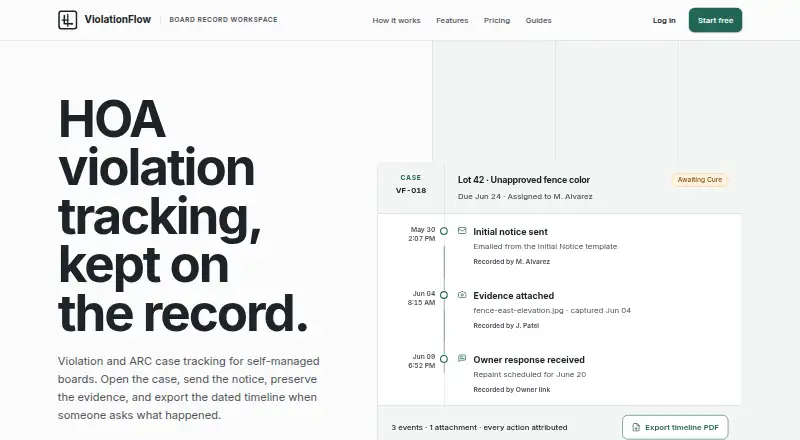
What ViolationFlow is
ViolationFlow is a web application for self-managed HOA, condominium, and townhome associations handling violation and architectural review committee cases. Each case links a lot and owner with a deadline, status, and accountable board member, while a dated timeline records attributable events. Boards can send template-based email notices, with the time, recipient, and sender saved in the record. Photo evidence keeps separate capture and upload timestamps. Configurable cure periods and fine ledgers move to the next step only after board approval. Owners can open a case and submit a response through a secure link without creating an account. CSV lot imports provide mapping, preview, and undo, and case chronologies can be exported as dated PDFs. The service includes an owner portal, photo attachments, fine tracking, and support for up to 50 units as a listed capability. ViolationFlow says workspaces are visible to invited board members and personal information is not sold. Its privacy policy names Clerk, Convex, Resend, and Dodo Payments as service providers.
Good
- Dated, attributable timelines connect cases to responsible board members
- Email notices record exact time, recipient, and sender
- Photos retain separate capture and upload timestamps
- Owners respond through secure links without accounts
- CSV import includes mapping, preview, and undo
- Fine escalations require board-member approval
Watch out
- Free plan is limited to 10 lots and five active cases
- Free plan provides one member seat
- Paid plans support up to 300 lots
- Notice templates are not legal advice
Who it suits
ViolationFlow fits self-managed HOA, condo, and townhome boards that need structured violation or ARC case records. It is useful when owners must respond without accounts and boards need approvals, notices, evidence, imports, and PDF chronologies.
Verdict
Choose ViolationFlow for a board-run association that wants a focused workflow for violations and ARC cases, including owner responses, evidence, fines, and exports. The free tier can cover a small association, while paid bands add lots and five seats. Look elsewhere if you need more than 300 lots or legal guidance instead of templates.
Plans and prices
From ViolationFlow's own pricing page, checked 9 Oct 2026.
| Plan | Price | What it gives you |
|---|---|---|
| Free | Free | 10 lots · 5 active cases · 1 member seat · full workflow |
| Starter (monthly) | $15 a month | Up to 50 lots · 5 member seats · every feature |
| Growth (monthly) | $23 a month | 51–150 lots · 5 member seats · every feature |
| Pro (monthly) | $32 a month | 151–300 lots · 5 member seats · every feature |
| Pro (annual) | — | 151–300 lots · 5 member seats · every feature · yearly |
| Growth (annual) | — | 51–150 lots · 5 member seats · every feature · yearly |
| Starter (annual) | — | Up to 50 lots · 5 member seats · every feature · yearly |
The facts
Each one read from ViolationFlow's own pages, with the date it was checked.
What it does
- Case records
- Cases are tied to a lot, owner, deadline, status, and accountable board member, with events in a dated, attributable timeline.checked 9 Oct 2026
- Escalations
- Configurable cure periods and fine ledgers advance only when a board member approves the next step.checked 9 Oct 2026
- Evidence
- Photos preserve separate capture and upload timestamps in the case record.checked 9 Oct 2026
- Exports and imports
- Boards can import lots from CSV with mapping, preview, and undo, and export a case chronology as a dated PDF.checked 9 Oct 2026
- Legal limitation
- ViolationFlow says its notice templates are not legal advice and recommends reviewing them with association counsel.checked 9 Oct 2026
- Limits
- The free plan allows 10 lots, 5 active cases, and 1 member seat; paid bands include 5 seats and support up to 300 lots.checked 9 Oct 2026
- Notices
- Boards can send template-based email notices, with the exact time, recipient, and sender recorded.checked 9 Oct 2026
- Privacy
- The privacy policy says ViolationFlow does not sell personal information and that each association workspace is visible to invited board members.checked 9 Oct 2026
- Providers
- The privacy policy names Clerk for authentication, Convex for the database, backend, and US-region file storage, Resend for transactional email, and Dodo Payments for subscriptions.checked 9 Oct 2026
- Purpose
- ViolationFlow provides violation and ARC case tracking for self-managed HOA, condo, and townhome associations.checked 9 Oct 2026
- Security
- The privacy policy describes access controls, encrypted transport, and provider security features as measures appropriate to a small SaaS product.checked 9 Oct 2026
- Support
- Users can contact [email protected], and the pricing page says subscriptions can be canceled through Manage subscription or by emailing support.checked 9 Oct 2026
The company
- Owner access
- Owners can view a case and submit a response through a secure link without creating an account.checked 9 Oct 2026
The full review of ViolationFlow
ViolationFlow is a web application for self-managed HOA, condominium, and townhome boards handling violation and architectural-review (ARC) cases. It fits volunteer teams that need a single, accountable case history and an owner response channel without forcing residents to open accounts. The focused workflow is strongest for smaller communities; boards with many lots, many reviewers, or a need for legal advice should look beyond it.
Overview
Cases are organized around a lot and owner, with a deadline, status, assigned board member, and dated timeline of attributable events. That structure gives a board a practical handoff record when enforcement work moves between volunteers, instead of relying on disconnected email threads. ViolationFlow is deliberately narrower than a full community-management suite: its value is keeping violations and ARC decisions moving through a controlled process.
Key features
Template-based email notices record the exact sending time, recipient, and sender. This creates a useful audit trail for routine communications, but the templates are not legal advice; the service recommends having association counsel review them before use.
Photos keep separate capture and upload timestamps in the case record, helping distinguish when an image was taken from when it entered the file. Boards can export a dated PDF chronology when a portable record is needed for a meeting or dispute.
Cure periods and fine ledgers are configurable, and the next escalation step advances only after a board member approves it. That approval gate reduces the risk of an unattended automatic fine, although progress can pause when the responsible volunteer does not act promptly. Owners open a secure link to view a case and submit a response without creating an account, which lowers participation friction while keeping the board’s workflow centralized.
CSV lot imports provide field mapping, a preview, and undo. Those controls make an initial roster migration safer than a blind upload. The privacy policy says personal information is not sold and that an association workspace is visible to invited board members. It describes access controls, encrypted transport, and provider security measures appropriate to a small SaaS product; authentication uses Clerk, data and US-region file storage use Convex, transactional email uses Resend, and subscriptions use Dodo Payments.
Pricing
The Free plan costs nothing and includes the full workflow for 10 lots, 5 active cases, and 1 member seat. It is a sensible starting point for a very small association, but the active-case and single-seat ceilings arrive quickly during a busy enforcement period.
Starter (monthly) is $15 a month for up to 50 lots, five member seats, and every feature. Starter (annual) is $1,794,921 a year, billed yearly, with the same lot and seat allowance. These tiers suit a small board that needs multiple reviewers and more capacity than the free plan; the annual price should be checked carefully before committing.
Growth (monthly) costs $23 a month for 51–150 lots and five seats. Growth (annual) is $2,796,920 a year, billed yearly, with the same limits. Pro (monthly) is $32 a month for 151–300 lots and five seats, while Pro (annual) is $3,798,919 a year, billed yearly. Paid bands include every feature, but none supports more than 300 lots or more than five members. Subscriptions can be canceled through Manage subscription or by emailing [email protected].
Platforms
ViolationFlow runs on the web. Its owner portal, secure response links, photo attachments, and fine tracking are available within that browser-based workflow.
Who it's for
Choose it for a self-managed association that wants board accountability, timestamped evidence, owner replies, and approval-controlled escalation in one place. The free tier can serve a tiny community; Starter is the practical entry point for a board with several active members. Communities above 300 lots, boards needing more than five seats, or organizations seeking broader property-management functions should consider another category of product.
Pros and cons
Pros
- Accountable case history: Assigned owners, deadlines, statuses, and attributed timelines clarify responsibility.
- Low-friction owner participation: Secure links allow responses without resident accounts.
- Evidence and export controls: Separate photo timestamps, notice records, and dated PDF chronologies support orderly files.
- Human approval before escalation: Cure periods and fines do not advance without a board member’s decision.
- Safer roster migration: CSV mapping, preview, and undo reduce import mistakes.
Cons
- Strict scale ceiling: Paid plans stop at 300 lots and five seats.
- Free-plan bottlenecks: Ten lots, five active cases, and one seat limit sustained use.
- Volunteer dependency: Approval gates require timely board action to keep cases moving.
- Not legal guidance: Templates still require association-counsel review.
Alternatives
For a broader directory of specialized products, see HOA Violation Management Software.
HOA Messenger is a freemium Android, iOS, and web option with unlimited HOAs and residents on its free plan, plus 90-day visibility; choose it when resident communication breadth matters more than ViolationFlow’s case-centric controls.
SpotHOA offers Android, iOS, and web access with a free tier for up to 50 active units, document storage, email volume, and dues collection, making it a better fit when payments and community records accompany violations.
CINC is a paid Android, iOS, web, and API platform for associations wanting a broader management system.
HOAResidents.com provides a web-based freemium public profile and resident tools, with a 20.00 USD monthly Pro plan per 100 homes; pick it for a resident-facing public presence.
GateWatch is a paid Android, iOS, and web product.
HOAware is a paid Android, iOS, and web service with Essentials and Complete offerings; consider it for a wider ACC and resident-communication scope.
ManageHOA is a paid Android, iOS, and web option.
Vantaca is a paid Android, iOS, and web community-management platform with customer-order pricing; choose it when an expansive managed-service platform is preferable.
Verdict
ViolationFlow is a strong match for a small, board-run association that wants disciplined violation and ARC case handling, documented owner communication, and an approval checkpoint before fines or escalation. Its inexpensive monthly entry and account-free owner portal are compelling, but the free limits, five-seat cap, 300-lot maximum, and non-legal templates define its boundaries. Choose it for focused enforcement workflow; look elsewhere for larger communities or comprehensive property management.
Getting started
- Open violationflow.homes
- Choose the Free plan or a paid monthly or annual plan
- Create an association workspace for invited board members
- Import lots from CSV with mapping and preview, or add case records
- Send notices and share secure owner response links
Limits worth knowing
Free costs nothing and includes 10 lots, five active cases, and one member seat. Monthly paid plans cover up to 50 lots for $15 a month, 51–150 lots for $23 a month, or 151–300 lots for $32 a month, each with five seats.
Questions
What does ViolationFlow track?
It tracks violation and ARC cases with lot, owner, deadline, status, accountable board member, notices, evidence, cure periods, and fine ledgers.
Is there a free plan?
Yes. The Free plan costs nothing and includes the full workflow for 10 lots, five active cases, and one member seat.
What are the paid prices?
Monthly plans are $15 a month for up to 50 lots, $23 a month for 51–150 lots, and $32 a month for 151–300 lots. Annual plans are listed at $1,794,921 a year, $2,796,920 a year, and $3,798,919 a year for those same bands.
Can owners use it without an account?
Yes. Owners can view a case and submit a response through a secure link without creating an account.
How can associations move data in and out?
Boards can import lots from CSV with mapping, preview, and undo. They can export a case chronology as a dated PDF.
What privacy and legal details apply?
ViolationFlow says it does not sell personal information and limits workspace visibility to invited board members. Its notice templates are not legal advice and should be reviewed with association counsel.
Alternatives to ViolationFlow
- 1
HOA Messenger
Free planAndroidiOSWeb8.1From $240 a year - 2
SpotHOA
Free planAndroidiOSWeb7.9From $29 a month - 3

Buildium
AndroidiOSWebAPI7.7From $62 a month - 4

Communitrak
AndroidiOSWebAPI7.5From $29 a month - 5
HOAResidents.com
Free planWeb7.3From $200 a year - 6

CommonGround
AndroidiOSWeb7.0From $59 a month