
Veeam Recovery Orchestrator
Veeam Recovery Orchestrator coordinates disaster recovery for critical applications.
What Veeam Recovery Orchestrator is
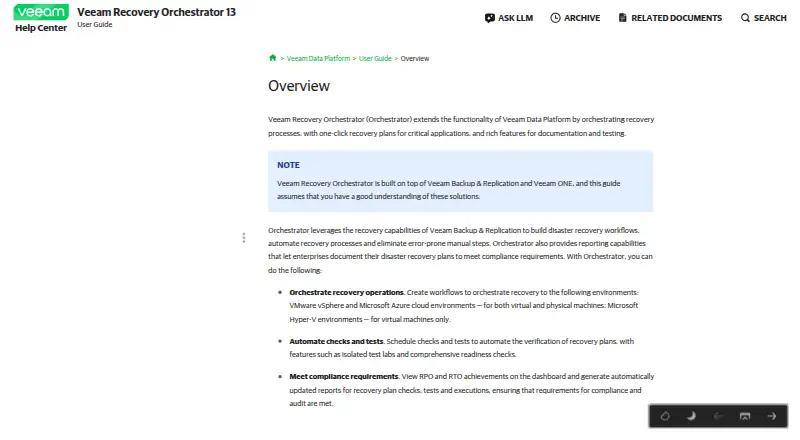
Veeam Recovery Orchestrator coordinates disaster recovery for critical applications. It uses Veeam Backup & Replication recovery capabilities to create workflows, automate recovery processes, and provide one-click recovery plans with documentation. Administrators can schedule recovery-plan checks and tests, including isolated test labs and readiness checks. Reports show recovery point and recovery time objective achievements and updated results for checks, tests, and executions. Recovery locations support VMware, Microsoft Hyper-V, storage systems, and Microsoft Azure; Orchestrator 13 can recover machines to Azure IaaS as VMs. The product is installed on a 64-bit Windows Server and accessed through a browser. It supports VMware vSphere and Hyper-V VMs, Azure VMs, and physical Windows workloads, with failover, failback, recovery runbooks, and test failover capabilities. Pricing is on request, with a 30-day trial. A Veeam Data Platform Premium license or an Advanced license with additional Orchestrator licenses is required; Foundation is unsupported.
Good
- One-click recovery plans for critical applications
- Scheduled checks, tests, isolated labs, and readiness checks
- Reports recovery point and time objectives
- Supports failover, failback, and recovery runbooks
- Recovery targets include VMware, Hyper-V, and Azure
Watch out
- Pricing is available on request
- Requires Premium or Advanced licensing with Orchestrator licenses
- Foundation licensing is unsupported
- Requires installation on a 64-bit Windows Server
Who it suits
It suits organizations coordinating and testing recovery for supported virtual and physical Windows workloads. Teams should account for its license requirements and Windows Server deployment.
Verdict
Veeam Recovery Orchestrator brings recovery workflows, testing, and reporting together for supported environments. Check licensing and deployment requirements before choosing it.
Plans and prices
From Veeam Recovery Orchestrator's own pricing page, checked 30 Sep 2026.
| Plan | Price | What it gives you |
|---|---|---|
| Evaluation license | Free | Full license · For product evaluation · Valid for 30 days from product download |
| NFR license | Free | For demonstration, training and education · Not for resale or commercial use |
| Perpetual license | — | Permanent license · Intended for enterprises · No expiration date; covers product versions issued before support expiration |
| Rental license | Priced on request | Full license · Intended for service providers · Contract end date, normally one month from the contract start date |
| Subscription license | — | Full license · Intended for enterprises · Normally 1–5 years from the license issue date |
| Veeam Recovery Orchestrator (licensed through Veeam Data Platform) | Priced on request | Veeam Data Platform Premium or Advanced with additional Orchestrator licenses · Foundation does not support Orchestrator · paid rental, subscription or perpetual licences |
The facts
Each one read from Veeam Recovery Orchestrator's own pages, with the date it was checked.
What it does
- API format
- The REST API uses HAL resource links and JSON representations, and Veeam provides a downloadable OpenAPI specification.checked 21 Oct 2026
- Automated testing
- The product can schedule recovery plan checks and tests, including isolated test labs and readiness checks.checked 21 Oct 2026
- Automation
- It uses Veeam Backup & Replication recovery capabilities to build disaster recovery workflows and automate recovery processes.checked 30 Sep 2026
- Compatibility limit
- Remote Veeam Backup & Replication servers must use Enterprise or Enterprise Plus editions for Orchestrator to deploy its agent; Essentials pack connections are unsupported.checked 30 Sep 2026
- Compliance reporting
- Dashboards show RPO and RTO achievements, and reports document plan checks, tests and executions.checked 21 Oct 2026
- Credential protection
- Credentials in the Orchestrator configuration database are encrypted, though server administrators can decrypt them.checked 30 Sep 2026
- Credential security
- Configuration database passwords are encrypted, but the guide warns that Orchestrator server administrators can decrypt them.checked 21 Oct 2026
- Database requirements
- Setup installs PostgreSQL 17 locally by default, and supported local or remote Microsoft SQL Server versions range from SQL Server 2016 through 2025.checked 21 Oct 2026
- Deployment
- Orchestrator is installed on a 64-bit Windows Server and its web UI is accessed through a browser.checked 30 Sep 2026
- Deployment limits
- The guide says installation on a Domain Controller, Windows Server Core, or a machine already running Veeam Backup & Replication or Veeam ONE is unsupported.checked 21 Oct 2026
- Installation
- The product installs with embedded components on a supported machine and can be installed unattended from the command line.checked 21 Oct 2026
- Integrations
- The documented architecture can connect NetApp and HPE storage systems, vCenter, SCVMM, Hyper-V and Azure Local clusters.checked 30 Sep 2026
- Licence model
- Orchestrator has rental, subscription and perpetual paid licences, plus evaluation and non-commercial NFR licences.checked 21 Oct 2026
- License requirements
- Orchestrator requires a Veeam Data Platform Premium license or an Advanced license with additional Orchestrator licenses; Foundation is unsupported.checked 30 Sep 2026
- Limit: usability and resource use
- TrustRadius's broader Veeam Data Platform review summary says some users report a clunky interface and high resource consumption.checked 21 Oct 2026
- Operating system
- The Orchestrator server requires a supported 64-bit Windows Server version, including Windows Server 2016, 2019, 2022 or 2025.checked 21 Oct 2026
- Praise: backup and restore reliability
- TrustRadius's broader Veeam Data Platform review summary cites reliable backup and granular restore capabilities among recurring positives.checked 21 Oct 2026
The company
- Company compliance
- Veeam's trust center lists ISO 27001, 27017, 27018, 22301 and 27701 certifications, alongside other named credentials.checked 21 Oct 2026
- Company name and founding
- The maker is Veeam, and its company page says its story began in 2006.checked 21 Oct 2026
- Company size
- Veeam's company page describes its workforce as more than 7,000 employees.checked 21 Oct 2026
- Founded
- 2006checked 28 Sep 2026
- Headquarters
- G2's Veeam seller profile lists Kirkland, Washington as the headquarters location.checked 21 Oct 2026
Where it runs
- Licensed machines
- Each machine processed by a recovery plan uses one license instance, and machines used in DataLab testing groups also consume instances.checked 30 Sep 2026
Money
- Limit: licensing cost and complexity
- G2's broader Veeam Data Platform reviews identify licensing complexity as a barrier for smaller businesses, and individual reviewers mention rising costs for larger environments.checked 21 Oct 2026
The full review of Veeam Recovery Orchestrator
Overview
Veeam Recovery Orchestrator is a disaster-recovery tool for teams managing supported virtual and physical Windows workloads. It is best suited to organizations already using Veeam Backup & Replication and able to operate a Windows Server deployment. Its strongest case is turning recovery plans into repeatable, testable workflows; licensing and per-machine consumption deserve close attention.
Key features
Orchestrator uses Veeam Backup & Replication recovery capabilities to coordinate workflows and one-click recovery plans for critical applications. Continuous replication, dependency mapping, recovery runbooks, and failover and failback orchestration make it a substantial option for planned recovery rather than a general-purpose backup product.
Teams can schedule readiness checks and recovery-plan tests, including tests in isolated labs. Reporting covers recovery point and recovery time objective achievements and updates records for checks, tests, and executions. That combination helps teams validate plans and document outcomes, although machines in DataLab testing groups also consume license instances.
Supported workloads include VMware vSphere and Microsoft Hyper-V virtual machines, Microsoft Azure virtual machines, and physical Windows machines. Recovery locations include VMware, Hyper-V, storage systems, and Azure; Orchestrator 13 can recover machines to Azure IaaS as VMs. The documented architecture can connect NetApp and HPE storage, vCenter, SCVMM, Hyper-V, and Azure Local clusters. This breadth is useful in supported environments, but does not make the product a fit for workloads outside those targets.
Pricing
Veeam describes the product as paid, with pricing on request and a 30-day trial. The free options are purpose-bound rather than ongoing commercial editions:
- NFR license: free. For demonstration, training, and education only; not for resale or commercial use.
- Evaluation license: free. A full license valid for 30 days from product download, intended for evaluation.
Commercial license prices are custom pricing. The Rental license is a full license intended for service providers; its term ends on the contract end date, normally one month from contract start. The Perpetual license is intended for enterprises, has no expiration date, and covers product versions issued before support expiration. The Subscription license is a full license intended for enterprises, normally lasting 1–5 years from issue. These models suit different procurement arrangements, but none gives a published price to compare.
Orchestrator requires a Veeam Data Platform Premium license, or an Advanced license plus additional Orchestrator licenses; Foundation is unsupported. Each machine processed by a recovery plan uses one license instance, as does each machine in a DataLab testing group. Remote Veeam Backup & Replication servers must use Enterprise or Enterprise Plus for Orchestrator to deploy its agent; Essentials connections are unsupported. Support by email and phone is offered to customers on maintenance and during the official evaluation period.
Platforms
The deployment model is on-premises: install Orchestrator on a 64-bit Windows Server and access its web UI through a browser. The platform tags also include self-hosted and web, but this is not a hosted service. For security, Veeam recommends enabling multifactor authentication, restricting inbound internet connections, and limiting outbound HTTPS to specified Veeam and Microsoft update sources. Configuration-database credentials are encrypted, though server administrators can decrypt them.
Who it's for
Choose Orchestrator if your organization already relies on Veeam Backup & Replication, needs coordinated recovery across supported workloads, and can budget for licensing each protected or test-group machine. It is less suitable for teams seeking a standalone cloud service, a Foundation-compatible deployment, or a low-cost free commercial tier.
Pros and cons
- Pro: Recovery plans combine automation, dependency mapping, failover and failback, and runbooks, supporting coordinated recovery rather than isolated machine restoration.
- Pro: Scheduled checks, isolated-lab tests, readiness checks, and recovery objective reporting help teams validate and record plans.
- Con: Every machine processed by a plan uses a license instance, including machines in DataLab testing groups, so test scope affects licensing.
- Con: Foundation and Essentials connections are unsupported, and remote servers need Enterprise or Enterprise Plus for agent deployment.
- Con: Installation requires 64-bit Windows Server and on-premises administration, which may not suit teams seeking a managed service.
Alternatives
- Acronis Cyber Disaster Recovery Cloud is worth considering if you want a paid product spanning mobile, desktop, Linux, web, and self-hosted platforms; it has a free trial but no free plan.
- Veeam Agent for Mac is a more relevant choice for macOS backup needs and has a free edition, though that edition is limited to one backup job and excludes direct object-storage backup.
- Veeam Kasten for Kubernetes is an option to consider for Kubernetes use; its free edition is capped at 5 nodes.
- Datto Endpoint Backup for Windows is another paid option for endpoint backup, with consumption-based pricing tied to storage used.
- Infrascale Backup and Disaster Recovery is an alternative paid backup and disaster-recovery product with subscriptions in 1 TB storage increments.
- Unitrends Backup is a paid alternative with tailored pricing and a free trial.
- NAKIVO Backup & Replication is another paid backup and replication option.
- Arcserve ShadowProtect is another paid option, with annual and two-year subscription choices.
Browse Disaster Recovery Software, Cloud Disaster Recovery Software, or WAN Optimization Software for category alternatives.
Verdict
Veeam Recovery Orchestrator is a strong fit for organizations built around Veeam Backup & Replication that need testable, documented recovery workflows across its supported environments. Choose it for that orchestration and validation layer; look elsewhere if your licensing edition, infrastructure, or preference for managed cloud deployment falls outside its requirements.
Getting started
- Review the product documentation at https://helpcenter.veeam.com/docs/vro/userguide/overview.html.
- Install the product on a 64-bit Windows Server.
- Access its web UI through a browser.
- Use a Veeam Data Platform Premium license or Advanced with additional Orchestrator licenses.
- Connect supported recovery targets such as VMware, Hyper-V, storage systems, or Azure.
- For evaluation, obtain the free 30-day evaluation license.
Limits worth knowing
The free evaluation license is valid for 30 days. A free NFR license is limited to demonstration, training, and education and is not for resale or commercial use; Foundation licensing is unsupported, and each machine in a recovery plan or DataLab testing group consumes a license instance.
Questions
Does Veeam Recovery Orchestrator have a free option?
Yes. A free evaluation license is valid for 30 days. A free NFR license is for demonstration, training, and education, not resale or commercial use.
Which platforms does it support?
The listed platforms are self-hosted, web, and Windows. It is installed on a 64-bit Windows Server and accessed through a browser.
What license is required?
It requires Veeam Data Platform Premium or an Advanced license with additional Orchestrator licenses. Foundation is unsupported.
Which workloads and recovery targets are supported?
Supported workloads include VMware vSphere VMs, Microsoft Hyper-V VMs, Microsoft Azure VMs, and physical Windows. Recovery locations include VMware, Hyper-V, storage systems, and Azure.
How are machines counted for licensing?
Each machine processed by a recovery plan uses one license instance. Machines in DataLab testing groups also consume instances.
Alternatives to Veeam Recovery Orchestrator
- 1

Acronis Cyber Disaster Recovery Cloud
AndroidiOSWebLinux6.8 - 2

AWS Elastic Disaster Recovery
WebAPILinuxWindows6.8From $0.03 a month - 3

JetStream DR
WebAPILinuxSelf-hosted6.7 - 4
Dbvisit Standby MultiPlatform
WebAPILinuxSelf-hosted6.6 - 5
Cohesity SiteContinuity
WebAPILinuxSelf-hosted6.4 - 6

Hystax Acura
WebAPISelf-hosted5.9