UEFI Boot Manager
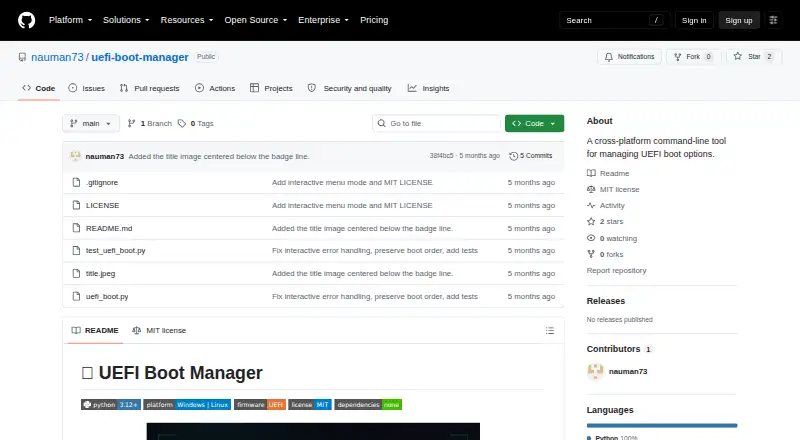
UEFI Boot Manager is a free command-line utility for managing UEFI boot options on Linux and Windows.
What UEFI Boot Manager is
UEFI Boot Manager is a free command-line utility for managing UEFI boot options on Linux and Windows. It lists boot entries with their order, active state, and IDs, then lets you change the permanent boot sequence. Entries omitted from a requested order remain at the end in their original order. The tool can also set or clear a one-time next-boot choice without changing the permanent sequence. A menu-driven interactive mode provides these operations and returns to the menu after errors. The project requires Python 3.12 or later, UEFI firmware, and no external Python dependencies. Windows uses the built-in bcdedit utility; Linux uses efibootmgr, which may need separate installation. Commands require Administrator privileges on Windows or root access on Linux. Legacy BIOS is unsupported, and unsupported operating systems produce an error. The project uses the MIT License and includes a Python script and README.
Good
- Lists boot order, status, and IDs
- Changes permanent boot sequence
- Supports one-time next-boot overrides
- Provides an interactive menu
- Has no external Python dependencies
Watch out
- Requires Python 3.12 or later
- Needs Administrator or root privileges
- Linux may require efibootmgr installation
- Does not support legacy BIOS
Who it suits
This tool suits Linux or Windows administrators who need command-line control over UEFI boot entries. It is intended for systems using UEFI firmware rather than legacy BIOS.
Verdict
UEFI Boot Manager offers focused boot-entry listing and editing for UEFI systems. Its preserved ordering behavior and one-time override are useful, but platform, firmware, and privilege requirements apply.
The facts
Each one read from UEFI Boot Manager's own pages, with the date it was checked.
What it does
- Compatibility limit
- The README reports an error on unsupported operating systems and states that the tool requires UEFI rather than legacy BIOS.checked 8 Oct 2026
- Distribution
- The repository lists a Python script and README, and its Releases and Packages sections show no listed items.checked 8 Oct 2026
- Interactive mode
- Its menu-driven interactive mode supports the listed boot-entry operations and returns to the menu after errors.checked 8 Oct 2026
- License
- The project is licensed under the MIT License.checked 8 Oct 2026
- Limits
- The README says the tool does not support legacy BIOS and reports unsupported operating systems as an error.checked 8 Oct 2026
- List entries
- It lists UEFI boot entries with their order, active status, and IDs.checked 8 Oct 2026
- One-time boot
- It can set or clear a one-time next-boot override without changing the permanent order.checked 8 Oct 2026
- Privileges
- Commands require elevated privileges: Administrator on Windows or root on Linux.checked 8 Oct 2026
- Purpose
- UEFI Boot Manager is a cross-platform command-line tool for managing UEFI boot options.checked 8 Oct 2026
- Reorder boots
- It can change the permanent boot sequence, appending unspecified entries at the end in their original order.checked 8 Oct 2026
- Reorder entries
- It can change the permanent boot sequence, appending unspecified entries in their original order.checked 8 Oct 2026
- Requirements
- The project requires Python 3.12 or later, UEFI firmware, and no external Python dependencies.checked 8 Oct 2026
- Safety behavior
- When changing boot order, entries omitted from the requested order are preserved at the end.checked 8 Oct 2026
- Security controls
- The README describes safe reordering that preserves unspecified entries at the end of the boot order.checked 8 Oct 2026
- Testing
- The README says its mock-based test suite contains 62 unit tests covering parsers, interactive mode, and error handling.checked 8 Oct 2026
- Warranty
- The MIT license provides the software “as is” without warranty, including implied warranties of merchantability, fitness, and noninfringement.checked 8 Oct 2026
Where it runs
- Linux backend
- On Linux it uses efibootmgr, which may need to be installed separately.checked 8 Oct 2026
- Platform backends
- Windows uses the built-in bcdedit tool, while Linux uses efibootmgr, which may need to be installed separately.checked 8 Oct 2026
- Windows backend
- On Windows it uses the built-in bcdedit tool.checked 8 Oct 2026
Alternatives to UEFI Boot Manager
- 1

GitHub CodeQL
Free planWebExtensionLinuxmacOS7.5From $30 a month - 2
Avidemux
Free planOpen sourceWebLinuxmacOSWindows7.3Free plan - 3
Boot-US
Free planLinuxWindows7.3Free plan - 4
rEFInd
Free planOpen sourceLinuxmacOSSelf-hostedWindows7.1Free plan - 5

Launchpad
Free planWebAPILinuxSelf-hosted7.0Free plan - 6
EasyBCD
Free planWindows6.5$39.99 one-time