twinify
twinify is an open-source package for creating synthetic twins of sensitive tabular datasets while applying differential privacy.
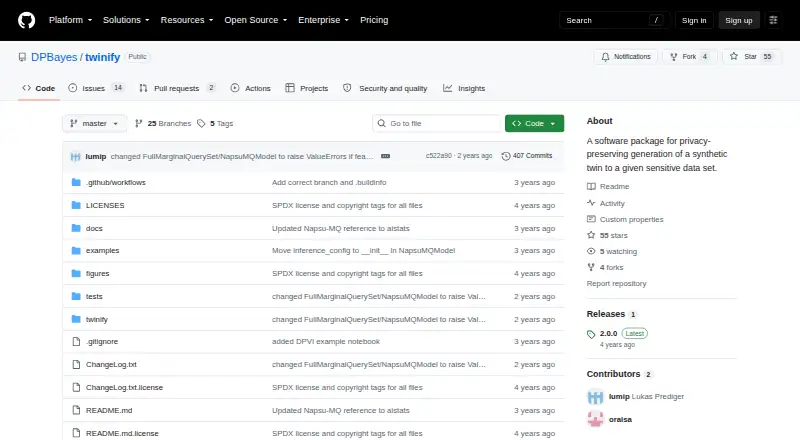
What twinify is
twinify is an open-source package for creating synthetic twins of sensitive tabular datasets while applying differential privacy. It learns probabilistic models with ε and δ settings, where smaller values indicate stronger privacy. The package provides NAPSU-MQ and differentially private variational inference (DPVI). DPVI can automatically model categorical, continuous, or mixed data, or use models written with NumPyro. NAPSU-MQ is intended for fully categorical datasets. Automatic modeling can represent missing-value probabilities when missingness is independent across features. You can use twinify as a Python library or as a command-line tool that reads CSV files. Its implementation uses NumPyro, JAX, and d3p. A stable release can be installed from PyPI with pip, while a development version can come from a cloned repository. The code is licensed under Apache License 2.0 and is available for API or self-hosted use.
Good
- Open-source Apache License 2.0 code
- Supports categorical, continuous, and mixed data
- Offers library and CSV command-line use
- Configurable ε and δ privacy parameters
- Handles missing values in automatic modeling
Watch out
- NAPSU-MQ supports only fully categorical data
- NAPSU-MQ may run long on many dimensions
- DPVI uses an approximate posterior
- DPVI omits extra differential-privacy uncertainty
Who it suits
twinify suits scientific research users working with sensitive tabular data who need configurable differential-privacy parameters. It is also suited to Python users who prefer a library or CSV command-line workflow.
Verdict
twinify combines two inference methods with configurable privacy controls and multiple ways to work with tabular data. Its method-specific limits matter when choosing between categorical-only NAPSU-MQ and broader but approximate DPVI.
The facts
Each one read from twinify's own pages, with the date it was checked.
What it does
- Data types
- DPVI can handle categorical, continuous, or mixed data; NAPSU-MQ is currently suitable only for fully categorical data.checked 4 Oct 2026
- DPVI limitation
- DPVI supports categorical, continuous, and mixed data, but produces an approximate posterior and does not explicitly capture the additional uncertainty due to differential privacy.checked 5 Oct 2026
- Inference methods
- It implements NAPSU-MQ and differentially private variational inference (DPVI).checked 4 Oct 2026
- Installation
- The stable version is installed with pip from PyPI, and the development version can be installed from the cloned GitHub repository.checked 5 Oct 2026
- Integrations
- The implementation relies on NumPyro for modeling and inference, JAX for CPU and GPU kernels, and d3p for differentially private training routines.checked 5 Oct 2026
- Intended audience
- The package metadata classifies twinify for scientific research audiences.checked 4 Oct 2026
- License
- The codebase is licensed under Apache License 2.0.checked 5 Oct 2026
- Limitations
- NAPSU-MQ may run for a long time on datasets with many feature dimensions, while DPVI approximates the true posterior and does not explicitly capture additional uncertainty due to differential privacy.checked 4 Oct 2026
- Maintainer organization
- The DPBayes GitHub organization describes itself as providing differential privacy software from the Finnish Center for Artificial Intelligence FCAI.checked 4 Oct 2026
- Methods
- It implements NAPSU-MQ and differentially private variational inference (DPVI).checked 5 Oct 2026
- Missing values
- Automatic modeling handles missing values by assuming they are missing at random, independently of whether other feature values are missing.checked 5 Oct 2026
- Modeling
- DPVI automatic modeling builds mixture models from user-specified feature distributions; users can also supply NumPyro models.checked 5 Oct 2026
- NAPSU-MQ limitation
- NAPSU-MQ currently supports only fully categorical data and may run for a long time on datasets with many feature dimensions.checked 5 Oct 2026
- Privacy controls
- Users can set ε and δ privacy parameters, with smaller values indicating stronger privacy.checked 5 Oct 2026
- Privacy method
- It learns probabilistic models under differential privacy, with ε and δ parameters for setting the privacy level.checked 4 Oct 2026
- Purpose
- twinify generates privacy-preserving synthetic twins of sensitive tabular datasets.checked 5 Oct 2026
- Usage
- It can be used as a Python library or a command-line tool that operates on CSV datasets.checked 5 Oct 2026
- Ways to use it
- The package can be used as a Python library or as a command-line tool that reads CSV datasets.checked 4 Oct 2026
The company
- Maker
- The DPBayes GitHub organization describes itself as differential privacy software from the Finnish Center for Artificial Intelligence (FCAI).checked 5 Oct 2026
- Maker details
- The opened maker page does not state a headquarters or founding year.checked 5 Oct 2026
Alternatives to twinify
- 1

FakerForge
Free planWebAPILinuxmacOS7.8From $10 a month - 2

Synth Studio
Free planOpen sourceWebAPILinuxmacOS7.5Free plan - 3
Synthehol Dataset
Free planWebAPISelf-hosted7.3From $3,990 a year - 4
SimpleTest
Free planWebAPIExtensionSelf-hosted7.2From $750 a month - 5
SynthEngyne
Free plan7.1Free plan - 6

Tonic Fabricate
Free planWebAPISelf-hosted6.8$29 usage-based