
Tuta Mail
Tuta Mail is an encrypted email service with apps for Android, iOS, Windows, macOS, and Linux, plus browser access.
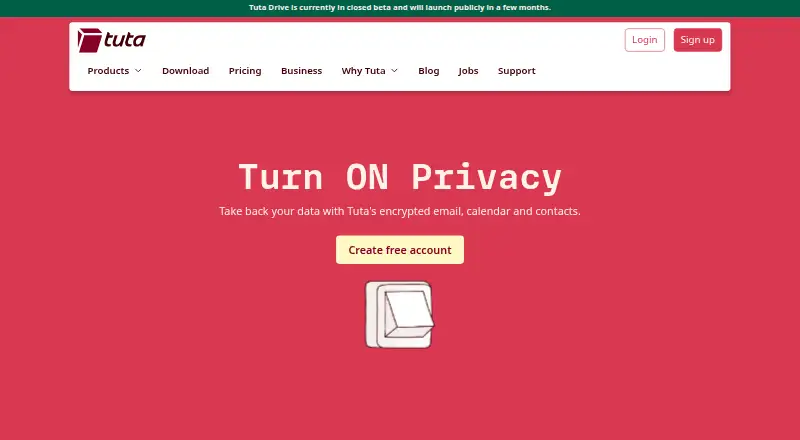
What Tuta Mail is
Tuta Mail is an encrypted email service with apps for Android, iOS, Windows, macOS, and Linux, plus browser access. It includes an encrypted calendar and supports offline use; full offline support is listed among paid-plan benefits. The free plan provides 1 GB of storage, one calendar, and three labels. Paid plans add custom email domains and more storage: Revolutionary includes 20 GB and 15 aliases, while Legend includes 500 GB and 30 aliases. Revolutionary costs €3 a month and Legend costs €8 a month, both billed annually. Paid plans support calendar sharing and event invitations, and desktop clients can import EML or MBOX files. Tuta says its clients are open source and auditable, and that data is stored on its servers in Germany in ISO 27001 certified data centers. It uses post-quantum cryptography. Mail protocol support is listed as none. Family multi-user support can be activated through support on paid plans; priority email support replies within one business day.
Good
- Apps for Android, iOS, Windows, macOS, and Linux
- Free plan includes 1 GB of storage
- Includes an encrypted calendar
- Paid plans support custom email domains
- Desktop clients import EML or MBOX files
Watch out
- Mail protocol support is listed as none
- Free plan includes 1 GB of storage
- Custom domains require a paid plan
- Full offline support is listed among paid-plan benefits
Who it suits
Tuta Mail suits people seeking encrypted email and calendar access across desktop and mobile platforms. Its paid plans may suit users who need custom domains, additional storage, or family features.
Verdict
Tuta Mail offers encrypted email and calendar features across mobile and desktop platforms. Compare the free plan’s storage and calendar limits with the paid plans, especially if you need custom domains or more storage.
Plans and prices
From Tuta Mail's own pricing page, checked 27 Sep 2026.
| Plan | Price | What it gives you |
|---|---|---|
| Free | Free | Forever free plan. · 1 GB storage · One calendar · Three labels · End-to-end encryption · billed annually |
| Revolutionary | €3 a month | Supports custom domains, 15 aliases, and optional family multi-user support. · 20 GB storage · 15 extra email addresses · Three custom domains · Unlimited calendars · Offline support · billed annually |
| Legend | €8 a month | Supports custom domains, 30 aliases, and optional family multi-user support. · 500 GB storage · 30 extra email addresses · 10 custom domains · Unlimited calendars · Priority email support · billed annually |
The facts
Each one read from Tuta Mail's own pages, with the date it was checked.
What it does
- Alias limits
- Revolutionary includes 15 aliases and Legend includes 30 aliases.checked 27 Sep 2026
- Business customers
- Tuta says more than 10,000 businesses have chosen it to safeguard their data.checked 27 Sep 2026
- Calendar sharing
- Calendar sharing and event invitations are supported on paid plans.checked 27 Sep 2026
- Custom domain
- Yeschecked 19 Sep 2026
- Custom domains
- Paid plans support custom email domains.checked 27 Sep 2026
- Data certification
- Data is stored on Tuta servers in ISO 27001 certified data centers in Germany.checked 27 Sep 2026
- Email aliases
- 15checked 19 Sep 2026
- Email import
- Desktop clients can import EML or MBOX files.checked 27 Sep 2026
- Encrypted calendar
- Tuta calendars and their notifications are encrypted.checked 27 Sep 2026
- End-to-end encryption
- Tuta encrypts mailbox data end to end and says it has zero access to the mailbox.checked 27 Sep 2026
- External invitations
- Calendar invitations to external users can optionally be encrypted with a shared password.checked 27 Sep 2026
- Family option
- Family multi-user support can be activated through support on paid plans.checked 27 Sep 2026
- Family pricing
- Revolutionary family members cost €3 per user per month; shared mailboxes cost €3 per month.checked 27 Sep 2026
- Legend family pricing
- Legend family members cost €8 per user per month; shared mailboxes cost €8 per month.checked 27 Sep 2026
- Mailbox storage
- 20checked 19 Sep 2026
- Mail protocol support
- nonechecked 19 Sep 2026
- Offline support
- Tuta supports offline use and lists full offline support among paid-plan benefits.checked 27 Sep 2026
- Open source clients
- All Tuta clients are fully open source and auditable by security experts.checked 27 Sep 2026
- Paid storage
- Revolutionary includes 20 GB and Legend includes 500 GB.checked 27 Sep 2026
- Quantum-safe encryption
- Tuta uses quantum-resistant or post-quantum cryptography.checked 27 Sep 2026
The company
- Founded
- 2011checked 23 Sep 2026
- Headquarters
- Hanover, Germanychecked 23 Sep 2026
Money
- Free plan
- Yeschecked 19 Sep 2026
- Free storage
- The free plan includes 1 GB of storage.checked 27 Sep 2026
The full review of Tuta Mail
Tuta Mail is an encrypted email service with a calendar, apps for major desktop and mobile platforms, and browser access. It suits people who want privacy features across devices and can accept a limited free plan. Its paid tiers add substantial storage and custom-domain support, but the free tier’s 1 GB and single calendar are tight for long-term use.
Overview
Tuta combines end-to-end encrypted email with an encrypted calendar. Its clients are open source and auditable, and it uses quantum-resistant cryptography. Data is stored in ISO 27001-certified data centers in Germany; Tuta is based in Hanover and was founded in 2011.
The main trade-off is that Tuta supports no mail protocols. That makes its own apps and browser access the route to the service, rather than a conventional mail client using a supported protocol. For privacy-focused users comfortable with that constraint, the combination of encryption and broad platform coverage is compelling.
Key features
Encrypted mail and calendar
End-to-end encryption is central to Tuta’s email service, and the calendar is encrypted too. Free users get one calendar; paid plans allow unlimited calendars. Paid users can share calendars and send event invitations, including invitations to external users encrypted with a shared password. These capabilities make the paid plans more suitable for coordinating across people, while the free calendar is better for a basic personal schedule.
Storage and account management
The free plan’s 1 GB is enough to try the service, but it leaves little room for a growing mailbox. Revolutionary raises storage to 20 GB, while Legend provides 500 GB. Desktop clients can import EML and MBOX files, which helps when moving existing messages. Paid plans support custom email domains; Revolutionary includes three custom domains and 15 extra email addresses, while Legend includes 10 domains and 30 extra addresses.
Security and access
All Tuta clients are fully open source, allowing security experts to audit them. The service also uses quantum-resistant cryptography. Apps are available for Android, iOS, Windows, macOS and Linux, alongside browser access. Offline use is supported, with full offline support presented as a paid-plan benefit.
Pricing
Tuta is freemium, with prices billed annually. The free plan is a lasting option rather than a time-limited trial.
| Plan | Price | What it includes |
|---|---|---|
| Free | free | 1 GB storage, one calendar, three labels and end-to-end encryption. |
| Revolutionary | €3 a month | 20 GB storage, 15 extra email addresses, three custom domains, unlimited calendars and offline support. |
| Legend | €8 a month | 500 GB storage, 30 extra email addresses, 10 custom domains, unlimited calendars and priority email support. |
Free is for someone who wants to try encrypted email or keep a small mailbox; its 1 GB, single calendar and three labels are clear constraints. Revolutionary is the practical step up for an individual who needs a custom domain, more room and multiple calendars. Legend suits users who need much more storage, more domains and priority email support; its premium over Revolutionary is most persuasive when those higher limits matter.
Paid plans can add family multi-user support through support. Revolutionary family members cost €3 per user per month, and shared mailboxes cost €3 per month. On Legend, family members cost €8 per user per month and shared mailboxes cost €8 per month. Priority email support replies within one business day. The plan details do not define a seat quota, so family costs are per user rather than a stated bundle.
Platforms
Tuta offers apps for Android, iOS, Windows, macOS and Linux, plus browser access. That breadth makes it a viable choice for people moving between phones and computers. The lack of mail protocol support is the corresponding limitation: readers who require access through a separate protocol-compatible mail client should look elsewhere.
Who it's for
Tuta is a strong fit for individuals and families who prioritize encrypted email and calendars, want open-source clients, and are willing to use Tuta’s apps or browser. Revolutionary is the clearest fit for a personal custom-domain mailbox; Legend is better for large storage needs, several domains or priority support. The free plan is best treated as an entry point or a small-scale account, not a roomy mailbox.
It is a weaker fit for anyone who depends on mail protocols or needs more than 1 GB without paying. Businesses may find the domain and family options useful, though the stated family add-ons are not a substitute for a specified business seat plan.
Pros and cons
Pros
- End-to-end encrypted email and an encrypted calendar: privacy protections extend beyond mail to scheduling.
- Open-source clients and quantum-resistant cryptography: users get auditable apps and a forward-looking encryption approach.
- Broad device coverage: apps span Android, iOS and all three major desktop operating systems, with browser access as well.
- Useful paid storage and domain options: Revolutionary offers 20 GB and three custom domains; Legend scales to 500 GB and 10 domains.
- Migration and sharing tools: desktop EML/MBOX import and paid calendar sharing support moving in and coordinating around the account.
Cons
- No mail protocol support: users cannot rely on conventional protocol access through their preferred mail client.
- The free plan is constrained: 1 GB and one calendar limit its usefulness as a primary account over time.
- Several useful capabilities require a paid plan: custom domains, unlimited calendars, calendar sharing and full offline support sit beyond the free tier.
- Family pricing is per user: multi-user support must be activated through support, and member and shared-mailbox charges add up separately.
Alternatives
Proton Mail is worth considering if its free plan’s 1 GB storage and one email address suit your needs; it also has apps across web, desktop and mobile platforms.
Aster Mail is an alternative for readers prioritizing a free, open-source service with 10 GB encrypted storage, five aliases and one custom domain.
eclipso Mail Europe offers a free plan with 4 GB storage, one address and no aliases, a different set of limits for a no-cost account.
Mailfence may suit readers who want web access and mobile apps, with its free plan splitting 1 GB between email and document storage.
Mailo is an option for readers who value IMAP4 and EAS access; its free tier includes 1 GB email storage and five aliases.
mail.de offers free plans with no contract period, including FreeMail Zero with 500 MB storage, a 25-email daily limit and 60 MB attachment size.
mailbox is a paid alternative if protocol access is important: its Light plan is €1 a month billed annually and includes 2 GB storage, three aliases, calendar and address book, and IMAP and POP3 access.
SecureMyEmail is another freemium option, with its free plan covering one email address.
For broader comparisons, see Email providers, Secure Email Providers and Private Email Services.
Verdict
Choose Tuta Mail if encrypted mail and calendar, auditable clients and coverage across desktop and mobile matter more than protocol flexibility. Revolutionary is the sensible paid choice for a custom domain and room to grow; Legend earns its higher price for users who genuinely need 500 GB, more domains or priority support. Look elsewhere if you need a conventional mail protocol or expect the free plan to handle a large mailbox.
Getting started
- Visit https://tuta.com/.
- Choose the Free plan or a paid plan.
- Use the browser service or install an app for Android, iOS, Windows, macOS, or Linux.
- For desktop email import, use a client to import EML or MBOX files.
Limits worth knowing
The Free plan includes 1 GB of storage, one calendar, and three labels. Revolutionary includes 20 GB and 15 aliases; Legend includes 500 GB and 30 aliases.
Questions
Is Tuta Mail free?
Yes. The Free plan is free and includes 1 GB of storage, one calendar, and three labels.
What do the paid plans cost?
Revolutionary costs €3 per user per month and Legend costs €8 per user per month, both billed annually.
Which platforms can I use?
Apps are available for Android, iOS, Windows, macOS, and Linux, with browser access as well.
Is Tuta Mail open source?
Tuta says all its clients are fully open source and auditable by security experts.
Does Tuta Mail support custom domains?
Yes. Paid plans support custom email domains: Revolutionary includes three and Legend includes 10.
Can I add family members?
Family multi-user support can be activated through support on paid plans. Family members cost €3 per user per month on Revolutionary or €8 per user per month on Legend.
Alternatives to Tuta Mail
- 1

Aster Mail
Free planOpen sourceAndroidiOSWebLinux9.2From $2.42 a month - 2

Mailfence
Free planAndroidiOSWebAPI8.9From $2.50 a month - 3

Disroot Email
Free planOpen sourceAndroidiOSWebExtension8.9Free plan - 4

eclipso Mail Europe
Free planAndroidiOSWebmacOS8.7From €1.49 a month - 5
SecureMyEmail
Free planAndroidiOSWebmacOS8.7From $29.99 a year - 6

Neir
Free planOpen sourceAndroidiOSWebAPI8.7From $51 a year