
Disroot Email
Disroot Email provides email accounts accessible through its webmail or desktop and mobile email clients.
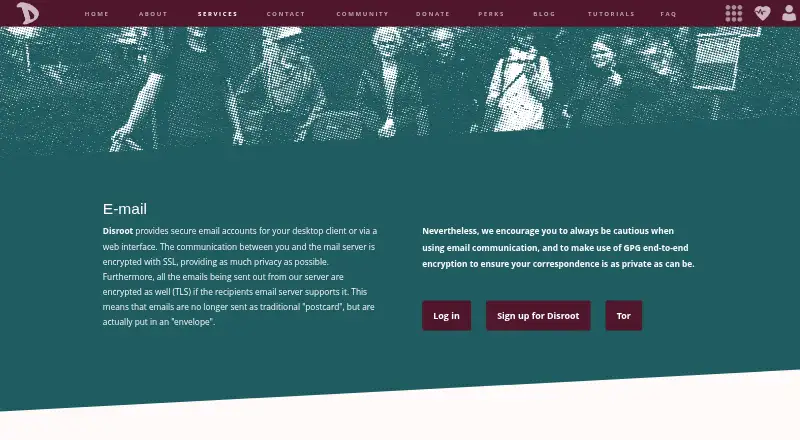
What Disroot Email is
Disroot Email provides email accounts accessible through its webmail or desktop and mobile email clients. The Roundcube-based webmail includes threaded messages, filters, folders, attachment previews, and MIME and HTML support. Users can connect with IMAP over SSL, SMTP with STARTTLS, SMTPS with TLS, or POP over SSL; suggested clients include Thunderbird, Evolution, KMail, ClawsMail, Mailpile, K-9 Mail, FairEmail, and iOS Mail. The free email plan offers a 1 GB mailbox and supports attachments up to 64 MB. Plus addressing creates sub-addresses that deliver to the original mailbox and can help filter or track spam. Users may link their own domain for sending and receiving email as a lifetime feature tied to a donation amount they choose; Disroot does not sell domains. Mail-server connections use SSL, and outgoing messages use TLS when the recipient’s server supports it. Messages are stored unencrypted on Disroot’s servers unless users encrypt them themselves. The service says data is held on its own servers in a Netherlands data center, while email logs that may include account and address details are retained for 48 hours and not backed up. Disroot, founded in 2015 and based in Amsterdam, is volunteer-maintained and serves people seeking open, decentralized and federated services that respect freedom and privacy.
Good
- Free email plan includes a 1 GB mailbox.
- Supports IMAP, SMTP, SMTPS and POP connections.
- Roundcube webmail includes filters, folders and attachment previews.
- Plus addressing routes sub-addresses to the original mailbox.
- Custom domain linking is offered as a lifetime donation feature.
Watch out
- Email is stored unencrypted unless users encrypt it themselves.
- The free email plan limits attachments to 64 MB.
- Outgoing TLS depends on the recipient’s mail server supporting it.
Who it suits
Disroot Email suits people looking for a free mailbox with webmail and support for a range of desktop and mobile clients. It may also suit users who want plus addressing or the option to send and receive mail on a custom domain through a lifetime donation feature.
Verdict
Choose Disroot Email if you want a free mailbox with webmail, common mail protocols and broad client compatibility. Consider its unencrypted server storage unless you encrypt messages yourself, and note the 64 MB attachment limit on the free email plan.
Plans and prices
From Disroot Email's own pricing page, checked 15 Sep 2026.
| Plan | Price | What it gives you |
|---|---|---|
| Free | — | 1 GB mailbox storage · Webmail access · IMAP, SMTP, SMTPS and POP support · Optional PGP encryption with Mailvelope |
| Free email | Free | 1 GB mailbox · 64 MB attachments |
| Free mailbox | Free | 1 GB mailbox · 64 MB attachments · webmail and IMAP/SMTP/POP access |
| Extra mailbox storage | €0.15 a month | Up to 10 GB mailbox storage described by reviewer · EU VAT may apply · per GB per month |
| Custom domain linking | — | Use your own domain to send and receive email · Disroot does not sell domains · Lifetime feature; donation amount is user-decided |
| Extra storage | — | Extra storage can be allocated between mail, cloud, and CryptPad · Prices per year; EU transactions add 21% VAT |
The facts
Each one read from Disroot Email's own pages, with the date it was checked.
Where it runs
- Android app scope
- The Android app is a launcher for services such as Etherpad, Ethercalc, PrivateBin, Upload, Poll and Searx rather than a native email client.checked 14 Oct 2026
- Android requirement
- F-Droid lists Disroot app version 2.2.3 as requiring Android 6.0 or newer.checked 14 Oct 2026
- App license
- The community Disroot Android app is published under GNU LGPL v3.0-only with source code and reproducible-build metadata linked by F-Droid.checked 14 Oct 2026
What it does
- API availability
- The product pages document IMAP, SMTP, POP and webmail but do not describe a public email REST API or SDK.checked 14 Oct 2026
- Attachment limit
- The service limits individual attachments to 64 MB.checked 14 Oct 2026
- Catch-all domains
- A 2022 service update says linked custom domains can receive mail sent to addresses that were not explicitly created.checked 14 Oct 2026
- Client compatibility
- Suggested clients include Thunderbird, Evolution, KMail, ClawsMail, Mailpile, K-9 Mail, FairEmail, and iOS Mail.checked 7 Oct 2026
- Client integrations
- The official page lists Thunderbird, Evolution, KMail, Claws Mail, Mailpile, K-9 Mail, FairEmail and Apple Mail as usable clients.checked 14 Oct 2026
- Custom domain
- Yeschecked 15 Sep 2026
- Custom domains
- Users who make a qualifying contribution can link a domain for sending and receiving mail; the feature is described as lifetime with no fixed subscription price.checked 14 Oct 2026
- Data practices
- Disroot says it does not sell data, run advertising profiles or request phone numbers and home addresses for service operation.checked 14 Oct 2026
- Documentation
- Disroot links users to a separate Howto site for configuring email clients and publishes a public platform changelog.checked 14 Oct 2026
- Email storage privacy
- Unless users encrypt their messages themselves, emails are stored unencrypted on Disroot servers.checked 7 Oct 2026
- End-to-end encryption
- Disroot recommends GPG for end-to-end email encryption and says Mailvelope can provide PGP encryption with webmail in Chrome, Edge, and Firefox.checked 7 Oct 2026
- IMAP
- IMAP access uses disroot.org on SSL port 993 with normal-password authentication.checked 14 Oct 2026
- Independent editorial score
- ProPrivacy gave Disroot an overall score of 3 out of 5 in its editorial review.checked 14 Oct 2026
- Intended audience
- Disroot describes its project as serving people seeking open, decentralized, federated services that respect freedom and privacy.checked 7 Oct 2026
- Limit: server-side plaintext
- ProPrivacy notes that email is not end-to-end encrypted by default and requires users to configure OpenPGP for message confidentiality.checked 14 Oct 2026
- Limit: signup friction
- AlternativeTo's review summary reports complex or restrictive registration, including periods when registration was closed.checked 14 Oct 2026
- Limit: small mailbox
- ProPrivacy identifies the 1 GB mailbox as a significant limitation compared with larger mainstream quotas.checked 14 Oct 2026
The company
- Company structure
- The project describes itself as community-supported and volunteer-maintained rather than an investor-funded commercial SaaS company.checked 14 Oct 2026
- Founded
- 2015checked 28 Sep 2026
- Headquarters
- Amsterdam, Netherlandschecked 28 Sep 2026
Money
- Free plan
- Yeschecked 15 Sep 2026
The full review of Disroot Email
Disroot Email is a community-maintained mailbox that combines Roundcube webmail with standard protocols for desktop and mobile clients. It suits people who value open, decentralized services and want control over their mail software. The main trade-off is clear: you get broad compatibility and a free account, but only 1 GB of storage and no end-to-end encryption by default.
Overview
Disroot provides email through a browser or through compatible desktop and mobile applications. Its servers are in a data center in the Netherlands, and the project has operated from Amsterdam since 2015. Volunteers maintain the service and rely on community support, an approach that appeals to users who prefer community-run infrastructure over a conventional commercial provider.
Connections to the mail server use SSL. Outgoing messages use TLS when the recipient's mail server supports it, protecting traffic in transit rather than the contents stored on the server. Unless you encrypt messages yourself, Disroot stores email unencrypted. Server logs can contain usernames, IP addresses, and sender and recipient addresses; those logs are retained for 48 hours and are not backed up.
Key features
- Roundcube webmail: Threaded messages, filters, folders, attachment previews, and MIME and HTML support cover normal reading, sorting, and message display in a browser.
- Standard protocols: IMAP over SSL on port 993, SMTP with STARTTLS on port 587, SMTPS with TLS on port 465, and POP over SSL on port 995 let you choose how mail is synchronized and sent. This is useful if you do not want to be tied to one proprietary app.
- Client choice: Suggested software includes Thunderbird, Evolution, KMail, ClawsMail, Mailpile, K-9 Mail, FairEmail, and iOS Mail. Disroot also provides setup instructions for configuring clients.
- Optional encryption: Mailvelope can add PGP encryption, but encryption is optional and requires you to manage it. Disroot therefore does not provide private-by-default storage.
- Plus addressing: Adding a plus sign to your address creates sub-addresses that still deliver to the original mailbox, helping with filtering and spam tracking.
- Custom domains: Linking your own domain enables sending and receiving with that domain. It is offered as a lifetime perk in return for a donation of your choice; Disroot does not sell domains.
Pricing
Disroot's core email plan is free. The Free plan includes a 1 GB mailbox, webmail, IMAP, SMTP, SMTPS and POP support, plus optional PGP encryption with Mailvelope. The separate Free email listing is also free and sets the same 1 GB mailbox with a 64 MB attachment limit. That small quota suits light personal use, but regular attachment-heavy correspondence or long-term archiving will require additional capacity.
Extra storage has custom pricing and is billed per year. It can be allocated among mail, cloud, and CryptPad; EU transactions add 21% VAT. Custom domain linking has no set price or subscription: it is a lifetime feature tied to a user-decided donation. Because the donation is not a fixed fee, it is best for users who already own a domain and want a one-time contribution rather than another recurring bill.
Platforms
Disroot lists Android, iOS, Linux, macOS, Windows, web access, and an extension. The protocol support matters more than a dedicated app ecosystem: you can use Roundcube or select a compatible client on the operating system you prefer.
Who it's for
Choose Disroot if you want a free, standards-based mailbox, already use software such as Thunderbird or K-9 Mail, or support open and decentralized services. It is also a practical option for someone who wants to attach an existing domain through a lifetime donation.
Look elsewhere if you need end-to-end encryption without configuring it yourself, substantially more than 1 GB, or a larger attachment allowance. Users who are unwilling to manage PGP should treat server-side storage as unencrypted.
Pros and cons
Pros
- Broad protocol support: IMAP, SMTP, SMTPS, and POP work with many established clients instead of forcing one interface.
- Useful browser tools: Roundcube's threads, filters, folders, previews, and MIME/HTML handling cover everyday inbox management.
- Community-oriented operation: Volunteer maintenance and Dutch-hosted infrastructure fit users seeking decentralized services.
- Flexible domain option: A user-chosen lifetime donation can unlock mail on your own domain.
Cons
- Unencrypted server storage by default: You must encrypt messages yourself for stronger privacy.
- Small free allowance: The 1 GB mailbox and 64 MB attachment cap are restrictive for heavy mail use.
- Short-lived server logs still contain metadata: Usernames, IP addresses, and message routing addresses are retained for 48 hours.
Alternatives
For a broader comparison, see Secure Email Providers, Private Email Services, and Email providers.
- Aster Mail is a better fit if you want open-source software, 10 GB of encrypted storage, aliases, and one custom domain on its free plan.
- Proton Mail suits readers who prefer a freemium service with encrypted storage and a 1 GB free tier across major platforms.
- eclipso Mail Europe is worth choosing when 4 GB of free storage and a 0.00 EUR plan are more useful than Disroot's 1 GB quota.
- PrivMail is for users willing to pay $12.95 a month for a 5 GB mailbox and a @priv-mail.com address.
- Neir offers a free 10 MB mailbox with webmail encrypted to your key and random aliases for users who prioritize key-based privacy over capacity.
- NevTan Mail is an alternative free email service.
- Tuta Mail is the stronger choice for a free plan with end-to-end encryption, 1 GB storage, and a calendar.
- QeyeT provides a free preview with mail, chat, calendar, meetings, and web and Android access.
Verdict
Disroot Email is a sensible choice for privacy-minded users who want a free, flexible mailbox and are comfortable encrypting sensitive messages themselves. Its protocol breadth, client compatibility, and optional custom-domain donation are genuine strengths. The 1 GB quota, 64 MB attachment limit, and unencrypted server storage make it the wrong choice for users who need generous capacity or built-in end-to-end privacy.
Getting started
- Visit the Disroot Email website.
- Choose the free email plan.
- Use Disroot webmail or configure a compatible email client.
- Consult Disroot’s setup instructions for client configuration help.
- For custom-domain sending and receiving, link your domain through the lifetime donation feature.
Limits worth knowing
The free email plan includes a 1 GB mailbox and attachments up to 64 MB. Custom domain linking is a lifetime feature tied to a user-decided donation; Disroot does not sell domains.
Questions
Is Disroot Email free?
Yes. The free email plan is listed as free and includes a 1 GB mailbox and 64 MB attachments.
Which platforms and clients can I use?
Platforms include Android, iOS, Linux, macOS, web, Windows and an extension. Suggested clients include Thunderbird, Evolution, KMail, ClawsMail, Mailpile, K-9 Mail, FairEmail and iOS Mail.
Does it support custom domains?
Yes. Custom domain linking lets users send and receive email with their own domain as a lifetime feature tied to a donation amount they choose. Disroot does not sell domains.
Are messages end-to-end encrypted?
End-to-end encryption is listed as no. Emails remain unencrypted on Disroot’s servers unless users encrypt them themselves.
Who maintains Disroot Email?
Disroot says the service is maintained by volunteers and relies on community support. The maker is based in Amsterdam, Netherlands.
Alternatives to Disroot Email
- 1

Aster Mail
Free planOpen sourceAndroidiOSWebLinux8.5From $2.42 a month - 2

Mailfence
Free planAndroidiOSWebAPI8.2From $2.50 a month - 3
PreVeil
Free planAndroidiOSWebExtension8.1From $25 a month - 4

Tuta Mail
Free planAndroidiOSLinuxmacOS8.1From €3 a month - 5

eclipso Mail Europe
Free planAndroidiOSWebAPI8.0From €1.49 a month - 6

Mailo
Free planAndroidiOSWeb7.8From €1.50 a month