Tributary
Tributary is an open-source, browser-based remote recording studio that captures each participant locally and creates separate synchronized tracks alongside …
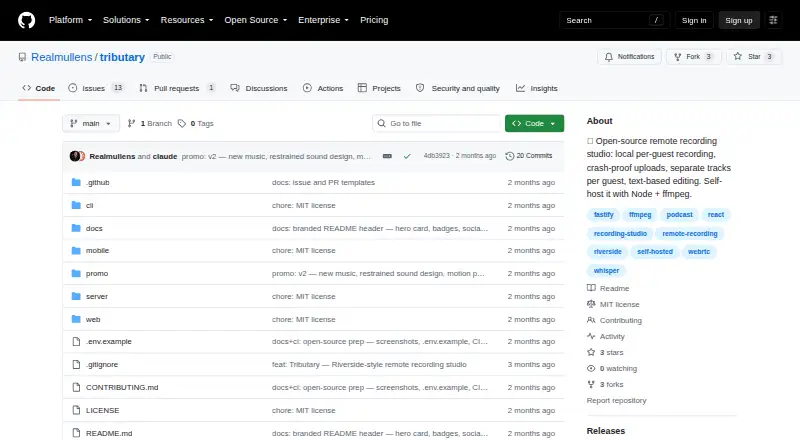
What Tributary is
Tributary is an open-source, browser-based remote recording studio that captures each participant locally and creates separate synchronized tracks alongside mixed audio and video exports. Hosts create studios and sessions, while guests join through invite links without accounts. Recordings are saved in IndexedDB chunks before upload, with retry and recovery support for interruptions and crashed tabs. The editor includes trimming, cuts, transcript-based word editing, and social clip formats. Per-track transcription uses whisper.cpp and supports TXT, SRT, and VTT downloads with speaker labels. Tributary streams to RTMP destinations such as YouTube, Twitch, or custom endpoints, and exports XML timelines for Premiere Pro or DaVinci Resolve. Its CLI exposes transcripts, timestamps, cuts, clips, downloads, and enhancement as JSON commands, without shipping an LLM dependency. Self-hosting requires Node 20 or newer, pnpm, and ffmpeg/ffprobe; production remote guests require HTTPS. Mesh WebRTC is described as suitable for about six participants, with LiveKit SFU for larger rooms. The project is MIT-licensed.
Good
- Guests join without accounts
- Local recordings with recovery support
- Separate synchronized tracks
- Transcript-based editing
- RTMP and XML exports
Watch out
- Self-hosting requires several dependencies
- Mesh mode suits about six participants
- Production guests require HTTPS
- Mobile app is not yet polished
Who it suits
Tributary suits podcasters, interviewers, and production teams wanting local participant recordings, separate tracks, transcription, and browser editing. It also fits developers comfortable with self-hosting and command-line workflows.
Verdict
Tributary provides a free, open-source browser studio with local capture, editing, transcription, and production exports. Its deployment requirements and stated room-size limits matter when planning larger or hosted sessions.
Plans and prices
From Tributary's own pricing page, checked 9 Oct 2026.
| Plan | Price | What it gives you |
|---|---|---|
| Tributary | Free | Open-source · self-hosted |
The facts
Each one read from Tributary's own pages, with the date it was checked.
What it does
- AI tooling
- The Tributary CLI exposes transcripts, word timestamps, cuts, clips, downloads, and enhancement as JSON commands, and the project says no LLM dependency ships with it.checked 9 Oct 2026
- Editing and exports
- The editor supports trimming, cuts, transcript-based word editing, social clip formats, and mixed audio and video exports.checked 9 Oct 2026
- Guest access
- Hosts create studios and sessions, while guests can join with an invite link without an account.checked 9 Oct 2026
- Integrations
- It can stream to RTMP destinations such as YouTube, Twitch, or custom endpoints, and export XML timelines for Premiere Pro or DaVinci Resolve.checked 9 Oct 2026
- Mobile status
- The project describes its mobile app as an early Expo shell and says it is not yet a polished native app.checked 9 Oct 2026
- Purpose
- Tributary is an open-source, browser-based remote recording studio that records each participant locally and produces separate synchronized tracks and mixed exports.checked 9 Oct 2026
- Recording
- Each participant’s recording is saved in chunks to IndexedDB before upload, with retry and recovery support for interruptions and crashed tabs.checked 9 Oct 2026
- Room size
- Mesh WebRTC is described as suitable for about six participants; LiveKit SFU mode is available for larger rooms.checked 9 Oct 2026
- Security and connectivity
- The deployment guide says TURN relaying may be needed for guests behind symmetric NATs or strict corporate firewalls, while recording remains locally captured and uploaded over HTTPS.checked 9 Oct 2026
- Self-hosting requirements
- The project’s quick start requires Node 20 or newer, pnpm, and ffmpeg/ffprobe; production use with remote guests requires HTTPS.checked 9 Oct 2026
- Storage and scaling
- The documented architecture stores media on local disk and uses an in-process job queue, with S3 and an external queue identified as scaling alternatives.checked 9 Oct 2026
- Support and licensing
- The GitHub repository links to contribution instructions and identifies the project as MIT-licensed.checked 9 Oct 2026
- Transcription
- Per-track transcription uses whisper.cpp and supports TXT, SRT, and VTT downloads with speaker labels.checked 9 Oct 2026
The company
- Maker
- The repository is owned by GitHub user Realmullens.checked 9 Oct 2026
Alternatives to Tributary
- 1

Cozyla Calendar
Free planAndroidiOSmacOS7.8Free plan - 2

Cozi
Free planAndroidiOSWeb7.6From $39 a year - 3

Equal House
Free planAndroidiOSAPI7.6From £29.90 a year - 4

FamilyWall
Free planAndroidiOSWeb7.6From $44.99 a year - 5

TimeTree
Free planAndroidiOSWeb7.6From $44.99 a year - 6

Ahenora
Free planAndroidiOSWeb7.3From €1.99 a month