
Tolgee
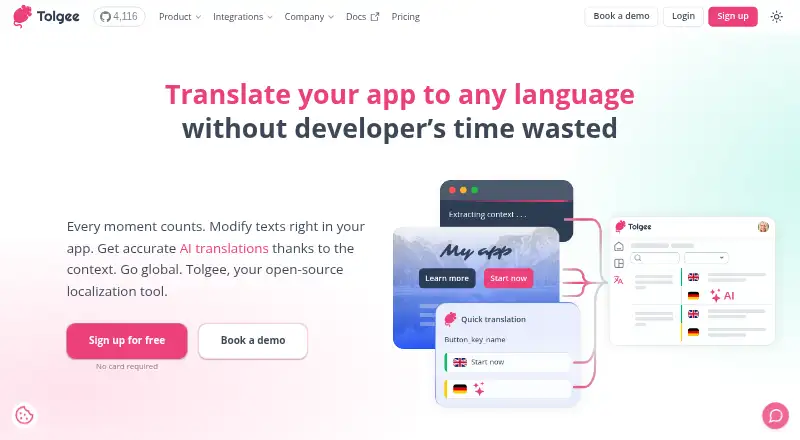
Tolgee is an open-source translation management and localization platform for applications, designed to let teams translate without modifying code.
What Tolgee is
Tolgee is an open-source translation management and localization platform for applications, designed to let teams translate without modifying code. Its in-context editor lets translators work inside an application, and its AI Translator uses context from native JavaScript SDKs, including in-context dialogs. The platform is designed for web applications and can also be used with mobile and desktop applications. Integrations include React, Angular, Vue, Svelte, Next.js, i18next, Flutter, Slack, Figma, Unreal Engine and a REST API. Supported file formats include JSON, XLIFF, gettext PO, Apple strings, Android XML, Flutter ARB, CSV and XLSX. Tolgee offers translation memory, glossary management, context screenshots, role permissions and a plugin for in-game delivery. It states that it is ISO 27001 certified and complies with the EU General Data Protection Regulation. Its SaaS encrypts stored data with AES-256 and network traffic with HTTPS/TLS.
Good
- In-context editing keeps translation work inside the application.
- Supports a broad range of integrations and file formats.
- Free plan includes 30,000 words and three seats.
- Self-hosted customers retain control of their infrastructure.
Watch out
- Free plan is limited to three seats.
- Free plan is limited to 30,000 words.
Who it suits
Tolgee suits development and localization teams working across web, mobile or desktop applications. It may also fit teams that need in-context editing, translation memory or self-hosting.
Verdict
Tolgee brings application translation workflows together with in-context editing, integrations and both SaaS and self-hosted options. Check the free plan's word and seat limits against your team's needs.
Plans and prices
From Tolgee's own pricing page, checked 30 Sep 2026.
| Plan | Price | What it gives you |
|---|---|---|
| Free | Free | 30 000 words · 3 seats · standard localization features · automation and machine translation |
| Translate | €58 a year | Unlimited seats · 400,000 MT credits · standard localization features · billed annually |
| Manage | €373 a year | Unlimited seats · 400,000 MT credits · standard localization features · billed annually |
| Optimise | €1,596 a year | Unlimited seats · 400,000 MT credits · AI translator and brand context · glossaries · AI playground · branching · tasks · granular permissions · €1,596.00 per year (= €133.00/month, billed annually) |
| Enterprise | Priced on request | Premium support · SSO · dedicated Slack channel · account manager · team training · prioritized feature requests |
| On-Premises | Priced on request | Self-hosted · advanced features and support included · Monthly or annual licensing, tailored to your needs |
The facts
Each one read from Tolgee's own pages, with the date it was checked.
What it does
- AI data use
- Tolgee says customer data is not used to train AI models and that selected LLM providers state API-submitted data is not used for model training.checked 30 Sep 2026
- AI translation
- Tolgee's AI Translator uses context from its native JavaScript SDKs, including in-context dialogs, to inform translations.checked 30 Sep 2026
- Data protection
- Tolgee says its SaaS encrypts databases, file storage, and backups with AES-256 and encrypts network traffic with HTTPS/TLS.checked 30 Sep 2026
- File formats
- Tolgee lists support for formats including JSON, XLIFF, gettext PO, Apple strings, Android XML, Flutter ARB, CSV, and XLSX.checked 30 Sep 2026
- In-context editing
- Tolgee provides an in-context editor so translators can translate an application without leaving it.checked 30 Sep 2026
- Integrations
- Listed integrations include React, Angular, Vue, Svelte, Next.js, i18next, Flutter, Slack, Figma, Unreal Engine, and a REST API.checked 30 Sep 2026
- Pricing limits
- The Free plan includes 30,000 words and 3 seats, while the current paid plans list unlimited seats and 400,000 MT credits.checked 30 Sep 2026
- Product
- Tolgee is an open-source, developer-focused translation management and localization platform for translating applications without modifying code.checked 30 Sep 2026
- Security certification
- Tolgee states that it is ISO 27001 certified and complies with the EU General Data Protection Regulation.checked 30 Sep 2026
- Self-hosting
- Tolgee says self-hosted customers retain control of their infrastructure and Tolgee cannot access their projects, accounts, or logs.checked 30 Sep 2026
- Support
- The Enterprise plan lists premium support and a dedicated Slack channel; the On-Premises offering includes support.checked 30 Sep 2026
- Translation memory
- Yeschecked 20 Sep 2026
The company
- Company origin
- The founder says he started working on Tolgee for his master's thesis in late 2019.checked 30 Sep 2026
- Founded
- 2020checked 28 Sep 2026
Money
- Free plan
- Yeschecked 20 Sep 2026
Where it runs
- Supported app types
- Tolgee is designed for web applications and can also be used with mobile and desktop applications.checked 30 Sep 2026
The full review of Tolgee
Tolgee is an open-source localization platform that brings developers and translators into the same application workflow. It is best suited to teams working on web apps that need in-context translation, with options for mobile, desktop and self-hosted projects. Its combination of editing, integrations and translation tools is compelling, though the free tier’s word and seat caps matter for growing teams.
Overview
Tolgee is designed to localize applications without requiring code changes for each translation. Translators can work in an in-context editor rather than switching away from the application, while developers can connect projects through supported frameworks, SDKs and APIs. Translation memory, glossary management, context screenshots and role permissions round out the workflow.
Its open-source and self-hosted options give teams more control over deployment, while the SaaS plans provide a managed route. Tolgee is aimed at application localization rather than general-purpose translation alone; teams seeking a platform for non-software content may prefer a broader translation service.
Key features
The in-context editor is a practical strength: translators can see the application while working, and context screenshots can help clarify where text appears. Tolgee’s AI Translator uses context from its native JavaScript SDKs, including in-context dialogs, to inform its suggestions. That context-aware approach is useful for application strings, though its described context advantage centers on JavaScript SDKs.
Integrations include React, Angular, Vue, Svelte, Next.js, i18next, Flutter, Slack, Figma, Unreal Engine and a REST API. Supported file formats include JSON, XLIFF, gettext PO, Apple strings, Android XML, Flutter ARB, CSV and XLSX. This breadth should suit teams with varied app stacks and localization assets; teams using an unsupported framework or format may need another route.
For game projects, Tolgee offers in-game delivery through a plugin. Security-conscious teams can weigh its stated ISO 27001 certification and GDPR compliance; SaaS data is encrypted at rest with AES-256 and in transit with HTTPS/TLS. Tolgee says customer data is not used to train AI models, and selected LLM providers say API-submitted data is not used for model training. Self-hosted customers retain control of their infrastructure, and Tolgee says it cannot access their projects, accounts or logs.
Pricing
The Free plan costs nothing and includes 30,000 words, 3 seats, standard localization features, automation and machine translation. It is a useful starting point for a small project, but the word and seat caps can constrain a larger team.
Translate costs €58 a year, billed annually, and includes unlimited seats, 400,000 MT credits and standard localization features. Manage costs €373 a year, billed annually, with the same stated inclusions. Optimise costs €133 a month, billed annually, and includes unlimited seats and 400,000 MT credits; standard localization features are not included in its stated plan details. Compare the plans’ terms and inclusions against your expected usage before moving beyond Free.
Enterprise uses custom pricing and adds premium support, SSO, a dedicated Slack channel, an account manager, team training and prioritized feature requests. On-Premises also uses custom pricing, with monthly or annual licensing tailored to your needs; self-hosting, advanced features and support are included. Enterprise suits organizations seeking account-level support, while On-Premises is the fit for teams that need to run the platform on their own infrastructure.
Platforms
Tolgee supports Android, iOS, web, API, extensions and self-hosting. It is designed primarily for web applications and can also serve mobile and desktop applications. Teams can choose a hosted workflow or retain infrastructure control through self-hosting.
Who it's for
Tolgee is a strong fit for software teams that want translators to work in application context, need integrations across common web frameworks, or want a self-hosted deployment. Game teams may also find its in-game delivery plugin relevant. It is less suitable for a small team whose project quickly outgrows 30,000 words or three seats on the free plan, or for buyers who need a plan price and full feature comparison before contacting the provider.
Pros and cons
- Pros: In-context editing and screenshots give translators application context, reducing the need to work from detached strings alone.
- Pros: Framework, API and file-format support spans common web and mobile localization workflows.
- Pros: Self-hosting lets customers retain infrastructure control, and the On-Premises offer includes advanced features and support.
- Cons: The Free plan’s 30,000-word and 3-seat limits may be restrictive as projects and teams grow.
- Cons: Enterprise and On-Premises require custom pricing, so their cost cannot be weighed directly from the plan terms.
- Cons: Optimise’s stated inclusions do not mention standard localization features, unlike the Translate and Manage plans.
Alternatives
Teams with a clearly bounded starter project may prefer locize, whose free plan specifies 2,000 words, 2 languages, 5 namespaces and 1 user, alongside 100K standard CDN downloads per month. OneSky is another freemium option, with listed AI-driven quality estimation and multi-agent translation offerings.
Weblate may suit teams looking for a hosted-string plan: Premium Cloud 10k costs €47 a month and includes 10,000 hosted strings with unlimited languages, projects and components. Transglot is worth comparing for teams that can work within its free plan’s 100,000 starting words, then 10,000 words per month, one project, 14 target languages and 3 seats. Localazy offers a free plan with 200 source keys, unlimited seats and languages, which may be a better fit when those limits match a project.
Live Link Face and Playglot are additional alternatives. For broader category browsing, see Game Localization Software, Translation Management Software and Translation Software.
Verdict
Choose Tolgee if your application team wants in-context localization, broad integration support and the option to self-host. The main reason to look elsewhere is the free plan’s modest word and seat allowance; larger teams should also compare the paid plans’ stated inclusions and custom-priced options before committing.
Alternatives to Tolgee
- 1

locize
Free planAndroidiOSWebAPI8.9From $7 a month - 2

Crowdin
Free planAndroidiOSWebAPI8.6Free plan - 3

iTranslate
Free planAndroidiOSWebAPI8.6Free plan - 4
SimpleLocalize
Free planAndroidiOSWebAPI8.6Free plan - 5

XTM Cloud
AndroidiOSWebAPI8.5From $16,500 a year - 6
TranslatePress
Free planOpen sourceWebAPISelf-hosted8.5From €99 a year