ThreatForge
ThreatForge is an open-source desktop app for creating threat models with diagrams, automated STRIDE analysis, and AI-assisted threat discovery.
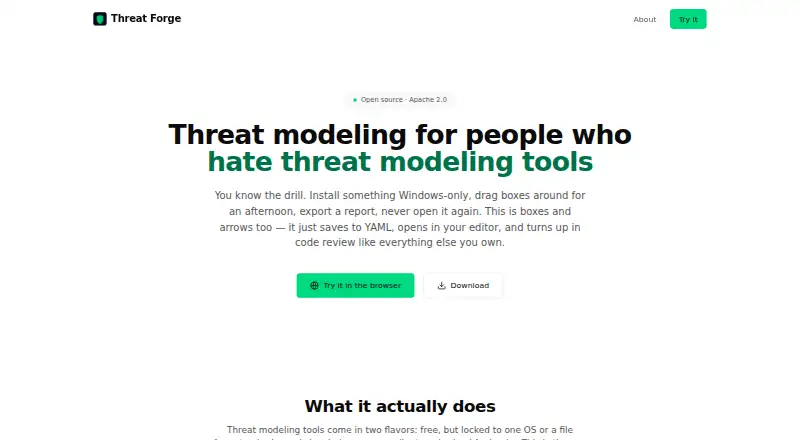
What ThreatForge is
ThreatForge is an open-source desktop app for creating threat models with diagrams, automated STRIDE analysis, and AI-assisted threat discovery. Its drag-and-drop canvas includes 44 typed components across 10 categories, with trust boundaries, annotations, and automatically routed connections. A built-in rule engine generates threats from element types and data-flow patterns and works offline. Users can also chat with Claude or GPT about a model to get suggested threats, mitigations, or answers to security questions; this AI feature uses the user’s own API key. Models are saved as human-readable YAML, suitable for Git diffs, pull-request review, and versioning. Six templates cover cloud microservices, e-commerce, mobile banking, SaaS, IoT smart buildings, and healthcare systems. The maker says there is no telemetry and models stay on the user’s machine. No account is required to start. The full application is free and open source under Apache 2.0, with no freemium upsells or enterprise-only features. It supports Linux, macOS, Windows, and web; the maker describes the download as approximately 10 MB.
Good
- STRIDE rule engine works fully offline.
- No account is required to get started.
- Models use human-readable, git-diffable YAML.
- Six templates cover varied system types.
- Free under the Apache 2.0 license.
Watch out
- AI assistance requires the user's own API key.
- No free trial is listed.
- The maker describes the download as approximately 10 MB.
Who it suits
ThreatForge suits developers and teams looking for threat modeling without an enterprise procurement cycle. It may fit users who want offline STRIDE rules and are comfortable providing their own API key for AI assistance.
Verdict
ThreatForge combines visual modeling, offline STRIDE analysis, and optional AI assistance in a free open-source app. Its AI features require a user-provided API key.
Plans and prices
From ThreatForge's own pricing page, checked 7 Oct 2026.
| Plan | Price | What it gives you |
|---|---|---|
| Threat Forge | Free | Free and open source under Apache 2.0 · no account required · full application available to everyone |
The facts
Each one read from ThreatForge's own pages, with the date it was checked.
What it does
- Account
- No account is required to get started.checked 7 Oct 2026
- AI analysis
- The app supports chatting with Claude or GPT about a threat model and can suggest threats, propose mitigations, and answer security questions; it uses BYOK.checked 7 Oct 2026
- Diagrams
- Its drag-and-drop canvas has 44 typed components across 10 categories, with trust boundaries, text annotations, and automatically routed connections.checked 7 Oct 2026
- Download size
- The maker describes the download as approximately 10 MB.checked 7 Oct 2026
- File format
- Threat models use human-readable, git-diffable YAML files that can be reviewed in pull requests and versioned over time.checked 7 Oct 2026
- Intended users
- The maker positions Threat Forge as a developer-friendly alternative for teams seeking threat modeling without an enterprise procurement cycle.checked 7 Oct 2026
- License
- The application is released under the Apache 2.0 license, with no freemium upsells or enterprise-only features.checked 7 Oct 2026
- Privacy
- The maker says there is no telemetry and threat models stay on the user's machine.checked 7 Oct 2026
- Product
- Threat Forge is an open-source desktop app for threat modeling with visual diagrams, automated STRIDE analysis, and AI-assisted threat discovery.checked 7 Oct 2026
- STRIDE
- The built-in rule engine generates threats from element types and data-flow patterns and works fully offline.checked 7 Oct 2026
- Templates
- Six templates cover Cloud Microservices, E-Commerce, Mobile Banking, SaaS Platform, IoT Smart Building, and Healthcare System.checked 7 Oct 2026
Where it runs
- Platforms
- The desktop app runs on macOS, Windows, and Linux.checked 7 Oct 2026
The full review of ThreatForge
Overview
ThreatForge is an open-source app for building threat models with diagrams and automated STRIDE analysis. It is best suited to developers and teams who want a lightweight way to model threats without an enterprise procurement process. The trade-off is that AI assistance requires a user-provided API key.
Key features
The visual canvas offers 44 typed components across 10 categories, with trust boundaries, annotations and automatically routed connections. Six templates cover cloud microservices, e-commerce, mobile banking, SaaS, IoT smart buildings and healthcare systems, giving teams a starting point for common architectures rather than a blank canvas.
ThreatForge’s rule engine derives STRIDE threats from component types and data flows, and works offline. That makes its core analysis usable without sending a model to an AI service; it is rule-based, rather than a substitute for judgment about system-specific risks. Optional Claude or GPT chat can suggest threats and mitigations or answer security questions, but requires your own API key.
Models are stored as human-readable YAML, so teams can version them and review changes in pull requests. The maker says models stay on the user’s machine and the app has no telemetry. No account is needed to start. The download is described as approximately 10 MB.
Pricing
Threat Forge costs nothing. The Apache 2.0 application is available in full, with no freemium upsells or enterprise-only features. There is no free trial because the software is free. The main caveat is that AI analysis requires a user-provided API key; the core rule-based STRIDE analysis works offline.
| Plan | Price | What it includes |
|---|---|---|
| Threat Forge | free | Full application, open source under Apache 2.0, no account required |
Platforms
ThreatForge supports Linux, macOS, Windows and the web. Its deployment is categorized as cloud, so readers choosing a desktop app should confirm which experience fits their workflow.
Who it's for
ThreatForge fits developers and teams who want visual threat modeling, offline STRIDE analysis and version-controlled model files without enterprise procurement. It is less suitable for anyone who needs AI assistance without supplying an API key or expects the rule engine alone to resolve nuanced security decisions.
Pros and cons
Pros
- Full app is free and open source. Apache 2.0 licensing and no enterprise-only features avoid a paid tier as a prerequisite for core capabilities.
- Offline STRIDE analysis. The rule engine works from components and data flows without relying on AI services.
- Reviewable models. Human-readable YAML makes changes suitable for version history and pull-request review.
- Useful starting points. Six templates span cloud, commerce, mobile, SaaS, IoT and healthcare scenarios.
Cons
- AI has an extra requirement. Claude or GPT assistance depends on a user-provided API key.
- Analysis is rule-based at its core. Threat generation uses element types and data-flow patterns, so teams still need to assess context-specific risks.
Alternatives
Threat Modeling Software is the broader category directory for comparing tools. CAIRIS is another free, Apache-licensed option across desktop, web, API and self-hosted platforms. OWASP Threat Dragon is also free and open source, with no paid plans or usage limits stated, and supports desktop, web and self-hosted use.
ThreatModeler Nexus offers a free Community Edition for practitioners, students, developers, architects and security teams to try threat modeling before scaling. ThreatOpus may suit teams looking for a paid team-workspace and repository workflow: its Starter plan is £129.99 a month for 15 users, 10 team workspaces, 50 threat-modeling generations per month and 10 repositories.
ThreatTree suits users who want a free, capped structure: its Free plan allows up to 3 forests, 3 DFDs per forest and 5 attack trees per DFD; Pro is $29 a month per user. AWS Threat Composer is another free option across desktop, web, API and self-hosted platforms. IriusRisk offers a free Community Edition capped at 3 active models and one user with limited collaboration. itemis SECURE is a paid alternative for web and Windows users, with named-user or floating licenses.
Verdict
Choose ThreatForge if you want a free, open-source threat-modeling app whose offline STRIDE engine and diffable YAML models fit a developer workflow. Its strongest reason to choose it is the combination of accessible visual modeling and reviewable files without an enterprise gate. Look elsewhere if AI-assisted analysis without your own API key is essential, or if you need capabilities beyond rule-generated threats.
Getting started
- Open the ThreatForge website
- Download the application for Linux, macOS, or Windows, or use the web version
- Start without creating an account
- Choose one of the six available templates or begin a model
- Add components and connections on the drag-and-drop canvas
- Add your own API key to chat with Claude or GPT
Limits worth knowing
The free plan provides the full application under Apache 2.0 and does not require an account. AI-assisted suggestions, mitigations, and security answers use your own API key, while the built-in STRIDE engine works offline.
Questions
How much does ThreatForge cost?
ThreatForge is free at no cost and open source under Apache 2.0.
Which platforms are supported?
It supports Linux, macOS, Windows, and the web.
Is an account required?
No account is required to get started.
What AI services can it use?
You can chat with Claude or GPT about a threat model using your own API key.
Are threat models stored online?
The maker says threat models stay on your machine, and there is no telemetry.
What file format does it use?
Threat models use human-readable YAML files that can be compared in Git diffs, reviewed in pull requests, and versioned over time.
Alternatives to ThreatForge
- 1

Dethernety
Free planOpen sourceWebAPISelf-hosted7.2Free plan - 2

ThreatModeler Nexus
Free planWebAPISelf-hosted6.7From $4,000 a year - 3

ThreatOpus
Free planWebAPI6.7From £129.99 a month - 4
ThreatTree
Free planWebAPI6.6From $29 a month - 5
OWASP Threat Dragon
Free planWebLinuxmacOSSelf-hosted6.4Free plan - 6
CAIRIS
Free planWebAPILinuxmacOS6.3Free plan