TBase
TBase is Tencent-published, open-source database software for distributed hybrid transactional and analytical processing (HTAP).
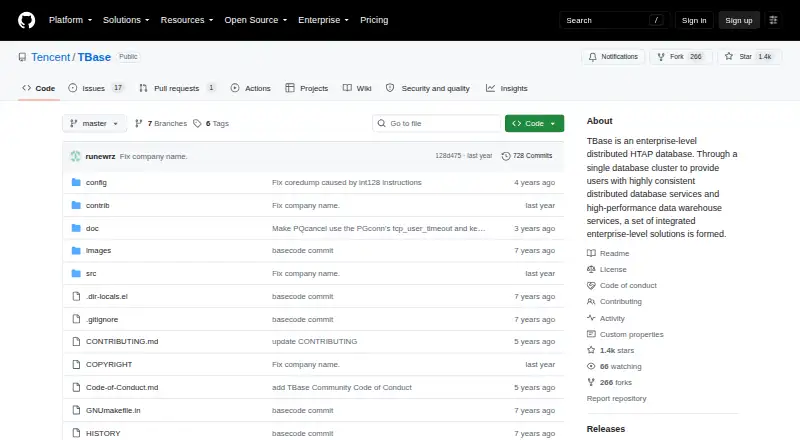
What TBase is
TBase is Tencent-published, open-source database software for distributed hybrid transactional and analytical processing (HTAP). It combines database and data-warehouse services in one cluster and supports an extended subset of SQL, including transactions, foreign keys, user-defined types, and functions. TBase is compatible with PostgreSQL and is self-hosted: deployment guidance describes compiling from source and setting up a cluster across one or more hosts, including basic x86 servers. A cluster uses Coordinator Nodes to plan queries, DataNodes to hold user data, and a Global Transaction Manager. Tables can be distributed or replicated, and the system sends queries to DataNodes and gathers their results. Administrators can configure and manage clusters with pgxc_ctl. Table choices include shard, partitioned shard, hot-and-cold partitioned shard, and replication tables. Shard-table distribution-key values, lengths, and types cannot be changed. Replication tables keep a full copy on every DataNode, making them unsuitable for large tables and slower to update. Monitoring features include session memory, DataNode operator details, and cluster-wide active sessions. The software is free under the BSD 3-Clause License, with a listed third-party component exception.
Good
- Combines database and warehouse services in one cluster.
- Supports transactions, foreign keys, types, and functions.
- Tables can be distributed or replicated.
- Includes cluster administration and monitoring features.
- Free, open-source software under BSD 3-Clause.
Watch out
- Shard-table distribution keys cannot be modified.
- Replicated tables are unsuitable for large tables.
- Replicated tables have low update performance.
- Deployment involves compiling from source.
Who it suits
TBase is suited to teams that need a self-hosted distributed database and data-warehouse cluster, with SQL capabilities and PostgreSQL compatibility. It may also suit administrators who want cluster management and query-monitoring tools.
Verdict
TBase brings distributed database and warehouse services together, with self-hosted deployment and several table strategies. Consider the fixed shard distribution keys and replication limits when planning a cluster.
Plans and prices
From TBase's own pricing page, checked 3 Oct 2026.
| Plan | Price | What it gives you |
|---|---|---|
| TBase | Free | BSD 3-Clause licensed open-source database |
The facts
Each one read from TBase's own pages, with the date it was checked.
What it does
- Cluster administration
- The pgxc_ctl tool helps configure and manage clusters.checked 3 Oct 2026
- Cluster architecture
- A TBase cluster uses Coordinator Nodes, DataNodes and a Global Transaction Manager; coordinators plan queries and DataNodes store user data.checked 3 Oct 2026
- Database capabilities
- TBase supports an extended subset of SQL, including transactions, foreign keys, user-defined types and functions.checked 3 Oct 2026
- Deployment
- The maker's quick-start guide describes compiling from source and deploying the cluster across one or more hosts, including basic x86 servers.checked 3 Oct 2026
- Distribution
- Tables can be distributed or replicated, and TBase sends queries to data nodes and collects the results.checked 3 Oct 2026
- Language connectivity
- The repository says TBase has language interfaces similar to PostgreSQL.checked 3 Oct 2026
- Product
- TBase is an enterprise-level distributed HTAP database that provides distributed database and data warehouse services through one cluster.checked 3 Oct 2026
- Query and memory monitoring
- The V2.2.0 notes describe viewing session memory, inspecting execution details for operators on DataNodes, and viewing cluster-wide active sessions from a coordinator.checked 3 Oct 2026
- Replication-table limit
- Replication tables store a full copy on every DataNode; the guide says they are unsuitable for large tables and have low update performance.checked 3 Oct 2026
- Security and auditing
- The repository describes security and audit as included functions and specifies the BSD 3-Clause License, with a listed third-party component exception.checked 3 Oct 2026
- Shard-table limit
- For shard tables, the distribution-key field's value, length and type cannot be modified.checked 3 Oct 2026
- Table types
- The usage guide covers shard tables, partitioned shard tables, hot and cold partitioned shard tables, and replication tables.checked 3 Oct 2026
The company
- Maker
- The repository is published under Tencent; the opened official pages do not state TBase's headquarters or founding year.checked 3 Oct 2026
The full review of TBase
TBase is a self-hosted distributed database that combines transactional and analytical workloads in one cluster. It suits teams prepared to compile and operate database infrastructure, especially those already using PostgreSQL-style interfaces. Its open-source price is attractive, but schema choices and replication behavior call for careful planning.
Overview
TBase brings distributed database and warehouse services together in a cluster built from Coordinator Nodes, DataNodes and a Global Transaction Manager. Coordinators plan queries, while DataNodes store user data; the system can distribute or replicate tables and collect query results from the nodes. This architecture is intended to support horizontal scaling and HTAP workloads, but it also makes TBase an infrastructure product to deploy and administer rather than a managed database service.
Its extended SQL subset includes transactions, foreign keys, user-defined types and functions. Language interfaces similar to PostgreSQL offer a familiar integration path for teams in that ecosystem, though the stated compatibility should not be taken as a promise of complete PostgreSQL feature parity.
Key features
Table choices include shard tables, partitioned shard tables, hot and cold partitioned shard tables, and replication tables. That range gives administrators ways to arrange data for different needs, but shard-table distribution keys demand advance thought: their value, length and type cannot be modified. A mistaken key can therefore become a lasting schema constraint.
Replication tables keep a full copy on every DataNode. That can suit data where replicas are useful, but the approach is explicitly unsuitable for large tables and has low update performance, so it is a poor default for growing or frequently updated datasets.
Deployment involves compiling from source and configuring a cluster across one or more hosts, including basic x86 servers. The pgxc_ctl tool helps configure and manage that cluster. This gives operators control over a self-hosted installation, while placing setup and ongoing administration in their hands.
Monitoring covers session memory, execution details for DataNode operators, and cluster-wide active sessions viewed from a coordinator. These views can help operators inspect resource use and query activity across the cluster. Security and audit are included functions, and the project uses the BSD 3-Clause License with a stated exception for a third-party component.
Pricing
TBase is free: its TBase plan costs nothing and is an open-source database under the BSD 3-Clause License. There is no paid tier in the stated plan. The trade-off is operational rather than a subscription charge: teams deploy and manage it themselves, so the zero-price plan is most compelling for organizations able to provide that infrastructure work.
Platforms
TBase is self-hosted and lists Android, iOS, Linux, macOS and Windows platforms. Its deployment guide focuses on compiling the database and placing cluster hosts; the platform list should not be confused with a claim that every listed device is a database server target. The product also names C++, Java, Kotlin, Swift and Objective-C SDK languages, with Unity and UE4 supported game engines and Android and iOS target platforms. Automated test execution and hybrid test environments are supported; playtesting workflows are not.
Who it's for
TBase is a fit for teams that need distributed SQL database and warehouse services in one cluster, want horizontal scaling, and can operate a self-hosted deployment. The PostgreSQL-like interfaces may ease adoption for teams with related tooling, while its table strategies provide layout options. It is less suitable for teams wanting managed deployment, effortless changes to shard distribution keys, or large replication tables with strong update performance.
Pros and cons
Pros
- One cluster combines distributed database and warehouse services, suiting teams with both transactional and analytical workloads.
- Transactions, foreign keys, user-defined types and functions provide a substantial SQL feature set, alongside PostgreSQL-like language interfaces.
- Multiple shard and replication table strategies, plus session and query monitoring, give operators useful control over data layout and cluster activity.
- The open-source plan costs nothing, avoiding a software subscription charge.
Cons
- Compiling from source and deploying across hosts requires database operations capability; self-hosting is not a hands-off option.
- Shard-table distribution-key value, length and type cannot be changed, making initial schema design consequential.
- Replication tables duplicate all data on each DataNode, are unsuitable for large tables, and have low update performance.
- PostgreSQL-like interfaces do not establish full PostgreSQL compatibility.
Alternatives
Distributed SQL Databases is the relevant category for comparing distributed SQL options. Consider MySQL instead if its freemium model, free plan and free trial better suit an evaluation that includes SQL and NoSQL applications and replication or high-availability components. CrateDB is worth considering when a managed shared free tier with 2 vCPUs, 2 GiB RAM and 8 GiB storage is a better starting point than TBase's self-hosted model. OceanBase Database offers a free, open-source Community Edition with full kernel capabilities, alongside an Enterprise option with custom pricing.
VoltDB may suit individual developers exploring a database through its free Developer Edition, which includes sample apps, tutorials and documentation. CockroachDB Cloud is a cloud alternative with a Standard plan priced at $0.06 a month. PrestoDB is a self-hosted open-source SQL query engine, a different choice for teams focused on query-engine use. TiDB Cloud may suit teams seeking a cloud starter plan with free quotas, including 25 GiB row storage and 25 GiB column storage. SingleStore Helios offers a free shared workspace for evaluation, development and non-production testing.
The Game Testing Software and Mobile Databases categories provide adjacent comparisons for readers evaluating those specific needs.
Verdict
Choose TBase if you need distributed database and warehouse services in one self-hosted cluster, value its SQL capabilities and table options, and have operators able to manage deployment. Its open-source price and combined workload focus are the main reasons to choose it. Look elsewhere if you need managed operations, flexible post-deployment shard-key changes, or efficient large replication tables.
Alternatives to TBase
- 1
CrateDB
Free planOpen sourceWebAPILinuxmacOS8.4Free plan - 2
OceanBase Database
Free planOpen sourceWebAPILinuxmacOS8.2$2.38 usage-based - 3
SingleStore Helios
Free planWebAPILinuxmacOS8.1Free plan - 4

TiDB Cloud
Free planOpen sourceWebAPILinuxSelf-hosted8.1Free plan - 5

MySQL
Free planAPILinuxmacOSSelf-hosted7.9Free plan - 6
PrestoDB
Free planOpen sourceWebAPILinuxmacOS7.7Free plan