Tank
Tank is a free, MIT-licensed package manager for AI agent skills and related packages.
What Tank is
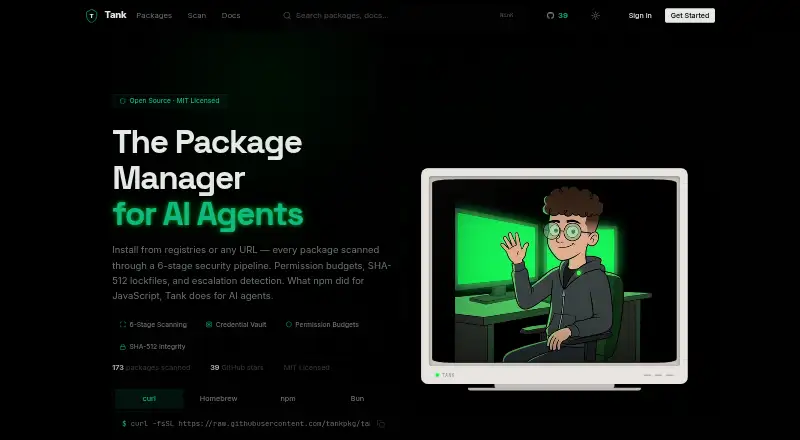
Tank is a free, MIT-licensed package manager for AI agent skills and related packages. It handles skills, instructions, hooks, tools, agents, rules, resources, prompts, and bundles, with dependency resolution, lockfiles, and private registry authentication. Packages pass six scanning stages: ingestion, validation, static analysis, injection detection, secrets scanning, and dependency audit. Tank records SHA-512 hashes in a lockfile and detects tampering during verification. Packages can declare network, filesystem, and subprocess limits; those exceeding the permission budget are rejected before execution. Its Credential Vault tokenizes detected API keys and proxies requests so real credentials stay local, according to Tank. Integrations include Claude Code, Cursor, GitHub Copilot, Codex, Windsurf, OpenCode, Cline, and Roo Code. An MCP server provides 17 editor tools. Organizations can self-host with Docker Compose, private storage, authentication, roles, and CI service accounts.
Good
- Six-stage package security scanning
- SHA-512 lockfile integrity checks
- Permission budgets reject risky packages
- Supports eight named agent environments
- Self-hosting keeps data in-network
Watch out
- Supported integrations are limited to listed editors
- Credential Vault behavior is described by Tank
- Self-hosting requires organizational setup
Who it suits
Tank suits developers and organizations managing AI-agent packages across its supported editors. It is especially relevant when package scanning, permissions, self-hosting, or private registries matter.
Verdict
Tank combines package management with scanning, integrity checks, permission controls, and editor integrations. Its free MIT-licensed registry, CLI, and scanner provide a broad foundation for teams handling agent packages.
Plans and prices
From Tank's own pricing page, checked 11 Oct 2026.
| Plan | Price | What it gives you |
|---|---|---|
| Free | Free | Registry, CLI, and security scanner; open source under MIT license |
The facts
Each one read from Tank's own pages, with the date it was checked.
What it does
- Agent integrations
- Tank says it works with Claude Code, Cursor, GitHub Copilot, Codex, Windsurf, OpenCode, Cline, and Roo Code.checked 11 Oct 2026
- Authentication
- Self-hosted Tank supports GitHub OAuth, any OIDC-compliant identity provider, or email and password.checked 11 Oct 2026
- Availability and license
- Tank states that its registry, CLI, and security scanner are free to use and that the project is MIT licensed.checked 11 Oct 2026
- Credential Vault
- The Credential Vault tokenizes detected API keys and proxies requests so real credentials stay local, according to Tank’s site.checked 11 Oct 2026
- Dependency resolution
- Yeschecked 21 Sep 2026
- Editor tools
- Tank’s MCP server provides 17 tools for installing, searching, scanning, publishing, verifying, and troubleshooting packages from supported editors.checked 11 Oct 2026
- Integrity
- Tank pins packages with SHA-512 hashes in a lockfile and detects tampering during verification.checked 11 Oct 2026
- Lockfile support
- Yeschecked 21 Sep 2026
- Organizations and CI
- Tank supports organizations with scoped publishing and roles, plus service accounts for CI/CD pipelines.checked 11 Oct 2026
- Package formats
- Tank supports seven skill primitives: instruction, hook, tool, agent, rule, resource, and prompt, which can be combined into bundles.checked 11 Oct 2026
- Package scanning
- Packages are scanned through six stages: ingestion, validation, static analysis, injection detection, secrets scanning, and dependency audit.checked 11 Oct 2026
- Permission controls
- Packages can declare network, filesystem, and subprocess limits, and those exceeding the permission budget are rejected before running.checked 11 Oct 2026
- Private registry auth
- Yeschecked 21 Sep 2026
- Purpose
- Tank is a security-first package manager for AI agent packages and skills.checked 11 Oct 2026
- Security audit results
- Tank says packages receive a transparent 0–10 audit score and a PASS, FLAGGED, or FAIL verdict.checked 11 Oct 2026
- Self-hosted storage
- Self-hosted deployments support S3-compatible storage such as AWS, MinIO, and Cloudflare R2, or local filesystem storage.checked 11 Oct 2026
- Self-hosting
- Organizations can run Tank with Docker Compose and use their own database, storage, and authentication while keeping data in their network.checked 11 Oct 2026
- Support and community
- Tank directs users to GitHub discussions and invites them to contribute to the open-source project.checked 11 Oct 2026
Money
- Free plan
- Yeschecked 21 Sep 2026
Where it runs
- Supported platforms
- Claude Code,Cursor,GitHub Copilot,Codex,Windsurf,OpenCode,Cline,Roo Codechecked 21 Sep 2026