Synmetrix
Synmetrix is an open-source data engineering platform and semantic layer for centrally defining and distributing organizational metrics.
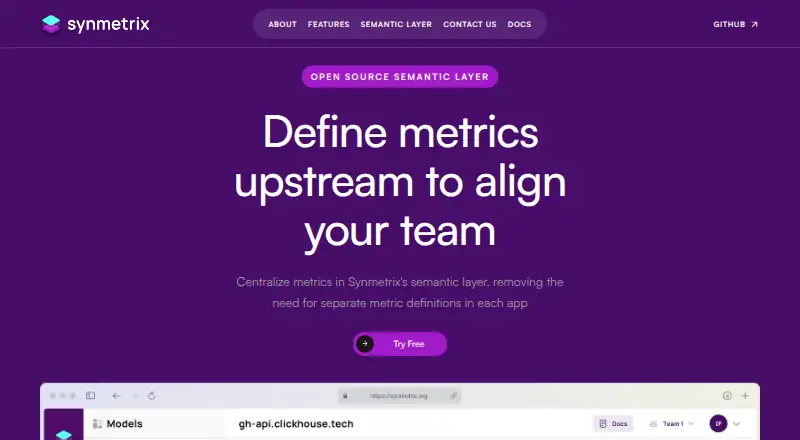
What Synmetrix is
Synmetrix is an open-source data engineering platform and semantic layer for centrally defining and distributing organizational metrics. It uses Cube data models to describe metrics and dimensions, then applies transformations and aggregations so applications can share consistent definitions. The maker says it connects to more than 50 data sources. Teams can explore metrics in the interface or provide them to BI tools, dashboards, reporting, and data science consumers through a SQL API. Model versioning and branching track changes, while query logs, caching, and pre-aggregations are among its listed features. Role-based access controls govern access to models and metrics; the project also describes upstream data controls for security and governance across data applications. Synmetrix supports scheduled reports and configurable alerts, with delivery by email, Slack, or webhooks. It is free and designed for self-hosted deployment, including on-premise use. Setup uses Docker and Docker Compose with PostgreSQL. Listed hardware requirements include a 3.2 GHz or faster processor, at least 8 GB of RAM, and 30 GB of free disk space. The core is licensed under Apache 2.0.
Good
- Connects to more than 50 data sources.
- SQL API distributes metrics to BI and reporting tools.
- Supports model versioning and branching.
- Scheduled reports can go by email, Slack, or webhooks.
- Core is Apache 2.0 licensed and self-hosted.
Watch out
- Setup requires Docker and Docker Compose.
- Hardware requirements include at least 8 GB RAM.
- Requires at least 30 GB of free disk space.
Who it suits
Synmetrix may suit data engineers, developers, analysts, decision makers, and enterprises that want centrally governed metric definitions. It is oriented toward users prepared to deploy and operate a self-hosted platform.
Verdict
Synmetrix centralizes metric definitions and makes them available through an interface and SQL API, with access controls, reporting, and alerts. Its self-hosted setup and stated hardware requirements are worth considering before deployment.
Plans and prices
From Synmetrix's own pricing page, checked 9 Oct 2026.
| Plan | Price | What it gives you |
|---|---|---|
| Open-source self-hosted app | Free | Core Synmetrix is Apache-2.0 licensed; no paid plan or usage limits stated on the opened pages |
The facts
Each one read from Synmetrix's own pages, with the date it was checked.
What it does
- Access control
- Synmetrix provides role-based access control for data models and metric access.checked 9 Oct 2026
- API and BI
- A SQL API distributes the metrics model to BI tools, reporting, dashboards, and data science consumers.checked 9 Oct 2026
- Data connections
- The homepage says Synmetrix connects to more than 50 data sources.checked 9 Oct 2026
- Data modeling
- It uses Cube data models to define metrics and dimensions and apply transformations and aggregations.checked 9 Oct 2026
- Deployment
- Synmetrix is described as self-hosted and can be deployed using Docker Compose with a Postgres database.checked 9 Oct 2026
- Features
- Listed features include query logs, model versioning, caching and pre-aggregations, alerts, reports, role-based access, teams, and a SQL API.checked 9 Oct 2026
- Installation
- The repository's setup instructions use Docker and Docker Compose to deploy Synmetrix with PostgreSQL.checked 9 Oct 2026
- Integrations
- The maker says Synmetrix connects to more than 50 data sources and can integrate with any BI tool.checked 9 Oct 2026
- Intended users
- The maker presents Synmetrix for data engineers, developers, analysts, decision makers, and enterprises.checked 9 Oct 2026
- License
- The repository says the Synmetrix core is available under the Apache License 2.0.checked 9 Oct 2026
- Metric definitions
- It centralizes metric definitions so applications can use consistent metrics without defining them separately.checked 9 Oct 2026
- Product
- Synmetrix is an open source data engineering platform and semantic layer for centralized metrics management.checked 9 Oct 2026
- Purpose
- It centralizes metric definitions so applications can use a consistent view of organizational data.checked 9 Oct 2026
- Querying and BI
- Users can explore metrics in the UI or distribute them to BI tools and other consumers through a SQL API.checked 9 Oct 2026
- Report delivery
- Reports can be delivered by email, Slack, or webhooks and scheduled for a chosen time.checked 9 Oct 2026
- Reports and alerts
- It supports scheduled reports and configurable alerts that notify users about metric changes.checked 9 Oct 2026
- Requirements
- The repository lists a 3.2 GHz or higher processor, at least 8 GB RAM, and at least 30 GB free disk space as hardware requirements.checked 9 Oct 2026
- Security
- The site describes upstream data access controls for uniform security and governance, and lists role-based access control.checked 9 Oct 2026
- Security and governance
- The maker describes upstream data access control as a way to apply uniform security and governance across data applications.checked 9 Oct 2026
- Setup requirements
- The quick start requires Docker and Docker Compose, and says dependency installation takes approximately 5–7 minutes.checked 9 Oct 2026
- Support
- The project lists its documentation, Slack community, and GitHub for help, discussion, and bug reports.checked 9 Oct 2026
- Use cases
- The repository lists business intelligence and reporting, embedded analytics, data democratization, and semantic-layer use with LLMs as use cases.checked 9 Oct 2026
- Version control
- Its data modeling feature supports versioning and branching to track changes to models and workflows.checked 9 Oct 2026
- What it does
- Synmetrix is an open-source data engineering platform and semantic layer for centrally modeling, integrating, transforming, aggregating, and distributing metrics.checked 9 Oct 2026
The full review of Synmetrix
Synmetrix is a self-hosted semantic layer for teams that need a shared, governed set of business metrics across analytics tools and applications. It is best suited to organizations with data engineering capacity; the main trade-off is operating the platform yourself.
Overview
Synmetrix uses Cube data models to define metrics and dimensions, then apply transformations and aggregations. That shared model gives applications a consistent view of organizational data instead of leaving each dashboard or product to define measures independently.
Users can explore metrics in the interface or distribute them through a SQL API to BI tools, reporting, dashboards, and data science consumers. The maker says it connects to more than 50 data sources and integrates with any BI tool. Its core is Apache 2.0 licensed, and deployment is self-hosted, including on-premise.
Key features
Versioning and branching let teams track changes to models and workflows, a practical safeguard when metric definitions evolve. Query logs provide visibility into query activity; caching and pre-aggregations address performance. Role-based access, teams, and upstream data access controls support consistent governance for applications consuming the shared metrics.
Scheduled reports and configurable alerts extend the platform beyond ad hoc exploration. Reports can be delivered by email, Slack, or webhooks at a chosen time, while alerts notify users of metric changes. These capabilities make Synmetrix relevant to teams that need routine distribution as well as a central model, though they also require an operational owner to configure and maintain the deployment.
Pricing
Synmetrix's open-source self-hosted app costs nothing. The Apache-2.0 core includes governed metrics, dimensions and joins, and the query API; no paid plan or usage limits are stated. That makes it a low-cost option for teams able to run it themselves, rather than a managed service with an ongoing subscription.
The price does not remove the infrastructure and maintenance burden. Setup uses Docker and Docker Compose with PostgreSQL, and the stated hardware requirements are a 3.2 GHz or higher processor, at least 8 GB RAM, and at least 30 GB of free disk space. The quick start says dependency installation takes approximately 5–7 minutes, but that is not a measure of ongoing administration.
Platforms
Synmetrix is available as an API, on Linux and macOS, through the web, and as self-hosted software. Its self-hosted deployment suits teams that want on-premise control, but is less attractive to buyers seeking a vendor-operated platform.
Who it's for
Data engineers and developers are the natural owners: they can manage the data models, integrations, and deployment. Analysts can explore and share centralized metrics, while decision makers can consume consistent reports. The project also names embedded analytics, data democratization, and semantic-layer use with LLMs as use cases; those are better fits when an organization already has the engineering capacity to govern the underlying data.
Documentation, a Slack community, and GitHub are the project's support channels. Teams should be comfortable relying on those community-oriented routes rather than assuming a dedicated support arrangement.
Pros and cons
- Pros: Apache 2.0 licensing and a free plan offer a self-hosted route to governed metrics without stated usage limits.
- Pros: SQL API, broad stated source connectivity, and versioned models support reuse across analytics consumers.
- Pros: Access controls, scheduled reports, and alerts cover governance and recurring distribution alongside modeling.
- Cons: Self-hosting puts deployment and ongoing operations on the adopting team.
- Cons: The stated processor, memory, and disk requirements make it a poor fit for users who cannot provision suitable infrastructure.
Alternatives
Semantic Layer Software is the category directory for comparing options.
Choose Cube if a free plan with a stated 1,000 daily requests, five workbooks, and one-day query history better matches a bounded workload. Starburst Enterprise Context Layer is another freemium option, with a free tier capped at three clusters and standard execution mode for ad hoc queries.
dbt Semantic Layer may suit teams whose needs fit its free Developer plan: one developer seat, 3,000 successful models per month, and one project, with no Semantic Layer listed on that plan. Sema offers a Sandbox tier capped at one connector, one user, 100 chat queries per month, and five saved reports, without scheduled delivery, alerts, or signals.
Strata offers a free plan with one developer, 25 users, and two data sources per project, which may suit teams needing explicit user and source caps. Definite has a free tier limited to two users, two connectors, 1 GB storage, five credits per month, and daily sync.
Malloy is a free alternative. Verdonz is a freemium alternative.
Verdict
Synmetrix is a strong fit for engineering-led teams that want centrally governed metrics, broad reuse through a SQL API, and control over self-hosted deployment without a stated usage cap. Choose it when that control and open-source model outweigh the cost of operating the stack; look elsewhere if you need a managed service or cannot meet its hardware and maintenance demands.
Getting started
- Review the project documentation, GitHub, or Slack community for guidance and discussion.
- Prepare a system with Docker, Docker Compose, and PostgreSQL.
- Check that the system meets the listed processor, memory, and disk requirements.
- Follow the repository setup instructions to deploy Synmetrix.
Limits worth knowing
The listed Open-source self-hosted app plan is free, with no paid plan or usage limits stated. Setup requires Docker and Docker Compose with PostgreSQL, and the listed hardware requirements are a 3.2 GHz or faster processor, at least 8 GB of RAM, and at least 30 GB of free disk space.
Questions
How much does Synmetrix cost?
The Open-source self-hosted app plan is listed as free.
Is Synmetrix open source?
Yes. Its core is available under the Apache License 2.0.
Can I use Synmetrix without hosting it myself?
Synmetrix is described as self-hosted, with on-premise deployment listed as a benefit.
How does Synmetrix share metrics with other tools?
Its SQL API distributes the metrics model to BI tools, reporting, dashboards, and data science consumers. The maker says it can integrate with any BI tool.
What is required to set it up?
The quick start uses Docker and Docker Compose, and the repository setup instructions deploy Synmetrix with PostgreSQL.
What hardware does the repository recommend?
The listed requirements are a 3.2 GHz or faster processor, at least 8 GB of RAM, and at least 30 GB of free disk space.
Alternatives to Synmetrix
- 1
MetricFlow
Free planOpen sourceWebAPILinuxmacOS8.1From $100 a month - 2

Cube
Free planOpen sourceWebAPILinuxSelf-hosted7.9From $40 a month - 3

dbt Semantic Layer
Free planWebAPIExtension7.5From $100 a month - 4

Starburst Enterprise Context Layer
Free planWebAPISelf-hosted7.5$0.50 usage-based - 5
Sema
Free planWebAPISelf-hosted7.3From $49 a month - 6

Looker
AndroidiOSWebAPI6.9