Strands Evals
Strands Evals is an open-source Python SDK and CLI for evaluating AI agent behavior during development and after deployment.
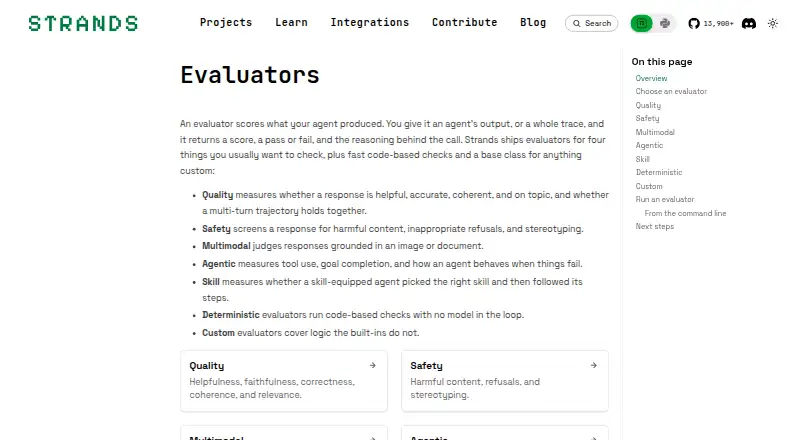
What Strands Evals is
Strands Evals is an open-source Python SDK and CLI for evaluating AI agent behavior during development and after deployment. It scores outputs and trajectories, helps diagnose failures, probes unsafe behavior, and can simulate users and tools. Evaluators can assess an output, tool call, trace, or entire session, and multiple evaluators can be used in one experiment. Built-in groups cover quality, safety, multimodal responses, agent behavior, and skill selection and instruction following. Deterministic checks such as Equals, Contains, StartsWith, ToolCalled, StateEquals, and SkillInvoked run without an LLM judge; developers can also extend the Evaluator base class for domain-specific logic. Install the package with pip as strands-agents-evals to use its Python API or the strands-evals command. The CLI can generate experiments, validate experiment JSON, run evaluations, render reports, and diagnose sessions, with documented CI workflow steps. Trace providers can fetch from AWS CloudWatch Logs, Langfuse, and OpenSearch, and session mappers support several tracing formats. The default judge uses Amazon Bedrock with Claude; its example requires authorized credentials. Red-teaming is experimental and may change in a minor release.
Good
- Evaluates outputs, tool calls, traces, and sessions.
- Includes deterministic checks without an LLM judge.
- Supports custom evaluators through the base class.
- CLI supports experiment validation and CI workflows.
- Can evaluate traces without rerunning agents.
Watch out
- Default judge requires authorized Amazon Bedrock Claude credentials.
- Red-teaming API is experimental.
- Trace integrations may require separate credentials or services.
Who it suits
It suits developers who want to validate agent behavior, measure changes, or evaluate agents during development cycles. It can also be used to assess production or staging traces without rerunning the agents that generated them.
Verdict
Strands Evals offers multiple evaluation levels, deterministic checks, and trace-based evaluation through a Python SDK and CLI. The default judge setup requires credentials, while red-teaming is explicitly experimental.
Plans and prices
From Strands Evals's own pricing page, checked 4 Oct 2026.
| Plan | Price | What it gives you |
|---|---|---|
| Strands Evals SDK | Free | Open-source Python SDK and CLI · install with pip · model-provider and trace-provider access may require separate credentials or services |
The facts
Each one read from Strands Evals's own pages, with the date it was checked.
What it does
- Built-in evaluators
- Built-in evaluator groups cover quality, safety, multimodal responses, agentic behavior, and skill selection and instruction following.checked 4 Oct 2026
- Custom evaluators
- Developers can implement domain-specific evaluation logic by extending the base Evaluator class.checked 4 Oct 2026
- Default judge
- The quickstart states that evaluators use Amazon Bedrock with Claude as the default judge model, and that running its example requires credentials authorized to invoke Claude.checked 4 Oct 2026
- Deterministic checks
- Deterministic evaluators run code-based checks without an LLM judge and include Equals, Contains, StartsWith, ToolCalled, StateEquals, and SkillInvoked.checked 4 Oct 2026
- Evaluation levels
- Evaluators can assess a single output, tool call, trace, or full session, and multiple evaluators can be combined in one experiment.checked 4 Oct 2026
- Experimental feature
- The red-teaming API is marked experimental and may change in a minor release.checked 4 Oct 2026
- Intended users
- The SDK is presented for developers who want to validate agent behavior, measure improvements, and evaluate agents during development cycles.checked 4 Oct 2026
- License
- The maker’s announcement identifies Strands Agents as an open-source project licensed under Apache License 2.0.checked 4 Oct 2026
- Local and remote use
- The SDK can run evaluations against production or staging traces without rerunning the agents that produced them.checked 4 Oct 2026
- Purpose
- Strands Evals measures agent behavior before shipping and after deployment by scoring outputs and trajectories, diagnosing failures, probing unsafe behavior, and simulating users and tools.checked 4 Oct 2026
- SDK and CLI
- The package installs with pip as strands-agents-evals and provides both a Python API and the strands-evals command-line interface.checked 4 Oct 2026
- Test generation and CI
- The CLI can generate experiments, validate experiment JSON, run evaluations, render reports, and diagnose sessions; its documentation shows validation and evaluation steps in a CI workflow.checked 4 Oct 2026
- Trace integrations
- Trace providers fetch data from AWS CloudWatch Logs, Langfuse, and OpenSearch, with optional package extras for Langfuse and OpenSearch.checked 4 Oct 2026
Where it runs
- Trace mapping
- Session mappers include support for Strands in-memory spans, LangChain OpenTelemetry spans, and OpenInference instrumentation such as Arize Phoenix.checked 4 Oct 2026
Alternatives to Strands Evals
- 1

W&B Weave
Free planOpen sourceiOSWebAPILinux8.7From $60 a month - 2

Opik
Free planOpen sourceWebAPILinuxmacOS8.4From $19 a month - 3

DeepEval
Free planOpen sourceWebAPILinuxmacOS8.3From $200 a month - 4

Future AGI AI Evaluation SDK
Free planOpen sourceWebAPILinuxmacOS8.2From $250 a month - 5

LangWatch
Free planOpen sourceWebAPILinuxmacOS8.2From €29 a month - 6

LangSmith
Free planWebAPILinuxmacOS8.0$39 usage-based