
Future AGI AI Evaluation SDK
Future AGI AI Evaluation SDK is an open-source platform for evaluating, optimizing, monitoring, and protecting AI agents.
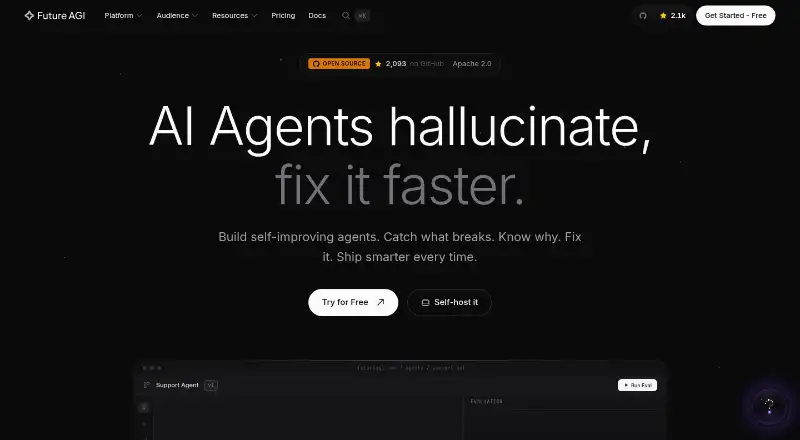
What Future AGI AI Evaluation SDK is
Future AGI AI Evaluation SDK is an open-source platform for evaluating, optimizing, monitoring, and protecting AI agents. Evaluation options include heuristic, code-based, LLM-as-judge, and agentic methods, with templates and CI/CD support. Its traceAI instrumentation turns LLM calls, tool use, retrieval, and chain steps into OpenTelemetry spans. Simulation supports text and voice testing with personas and scenarios; the free plan includes 1M text simulation tokens and 60 voice minutes per month.
The platform lists integrations and SDK packages for Python, TypeScript, and Java, including featured connections to OpenAI, Anthropic, Google GenAI, Vertex AI, AWS Bedrock, and Azure OpenAI. Its Apache 2.0 offering includes Docker and SDK self-hosting options. Future AGI says a Docker Compose deployment keeps traces, datasets, evaluations, and model calls within the customer's network. Free usage pauses at its cap, while pay-as-you-go can incur overage charges. The product is presented for startup and enterprise teams building and operating AI agents, with API, web, self-hosted, Linux, macOS, and Windows options.
Good
- Supports four evaluation approaches
- Includes templates and CI/CD support
- Traces LLM calls and tool use as OpenTelemetry spans
- Free plan includes text and voice simulation allowances
- Docker Compose self-hosting keeps data within the customer's network
Watch out
- Free usage pauses at its cap
- Pay-as-you-go usage can incur overage charges
Who it suits
Future AGI suits startup and enterprise teams building or operating AI agents. It may fit teams that need evaluation, tracing, simulation, or self-hosting options.
Verdict
Future AGI combines agent evaluation, tracing, and simulation with self-hosting options. Free use is capped, while continued usage or paid plans have distinct pricing terms.
Plans and prices
From Future AGI AI Evaluation SDK's own pricing page, checked 15 Oct 2026.
| Plan | Price | What it gives you |
|---|---|---|
| Free | Free | 50 GB storage · 2,000 AI credits · 100,000 gateway requests · 100,000 cache hits · 1,000,000 text-simulation tokens · 60 voice-simulation minutes · 50,000 tracing events · 30-day retention · $0 platform fee; usage blocked after allowance |
| Pay-as-you-go | Free | Free allowances included · usage continues past allowance · 30-day retention · $0 platform fee; overage billed |
| Boost | $250 a month | 90-day retention · 500 API requests/minute · 20,000 ingestion events/minute · $250.00/month; usage billed separately |
| Scale | $750 a month | 365-day retention · 2,000 API requests/minute · 100,000 ingestion events/minute · $750.00/month; usage billed separately |
| Enterprise | $2,000 a month | 7-year retention · unlimited API rate · unlimited ingestion rate · $2,000.00/month; usage billed separately |
The facts
Each one read from Future AGI AI Evaluation SDK's own pages, with the date it was checked.
What it does
- API scope
- The API reference covers simulations, evaluations, scenarios, personas, datasets, annotations, test runs and execution analytics.checked 15 Oct 2026
- Audience
- The site presents the product for startups and enterprise teams building and operating AI agents.checked 29 Sep 2026
- Built-in evaluators
- The documentation lists 132 ready-made evaluators covering quality, safety, retrieval, format and related categories.checked 15 Oct 2026
- Documentation depth
- The docs include Python SDK references, a complete REST API reference, integration guides, cookbooks and an MCP server.checked 15 Oct 2026
- Documentation limitation
- Future AGI describes its documentation as a work in progress and asks readers to submit feedback on pages.checked 15 Oct 2026
- Enterprise deployment
- The enterprise page offers managed cloud, private cloud in the customer's AWS, GCP, or Azure account, and air-gapped on-premise deployment.checked 29 Sep 2026
- Evaluation
- Its evaluation product includes heuristic, code, LLM-as-judge, and agentic evaluations, with templates and CI/CD support.checked 29 Sep 2026
- Evaluation layer
- The evaluation system scores AI responses against user-defined quality goals and supports text and voice inputs.checked 15 Oct 2026
- Funding
- Preqin reports a $1.6 million February 2025 pre-seed round co-led by Powerhouse Ventures and Snow Leopard Ventures.checked 15 Oct 2026
- Integrations
- Future AGI documents integrations with OpenAI, LangChain, LlamaIndex and more than 30 frameworks.checked 15 Oct 2026
- License
- The public platform repository identifies the core as Apache License 2.0 and self-hostable.checked 15 Oct 2026
- Limit: deployment maturity
- Another independent review cites nightly-release warnings, rough edges and no official Kubernetes or Helm support at its review date.checked 15 Oct 2026
- Limit: Gartner complaints
- The Gartner review page lists UI and console issues, a security gap and performance impact among dislikes.checked 15 Oct 2026
- Limit: integrations and exports
- G2 reviewers ask for more BI exports and annotation-tool integrations.checked 15 Oct 2026
- Limit: self-host operations
- An independent review reports that self-hosting can involve roughly 17 Docker containers and substantial ClickHouse/Kafka operations work.checked 15 Oct 2026
- Limit: setup and usability
- G2 reviewers report trial-and-error during setup, unclear initial documentation and reduced intuitiveness for nontechnical users.checked 15 Oct 2026
- Limit: tracing coverage
- A G2 reviewer says some classic machine-learning models could not be traced.checked 15 Oct 2026
- Local metrics
- The SDK documentation says more than 76 local metrics run without a Future AGI API key.checked 15 Oct 2026
- Notable news: self-hosting
- The October 13, 2026 changelog announced a signed Helm chart and a standalone self-host deployment of about three containers using roughly 1 GB idle memory.checked 15 Oct 2026
- Open source
- The homepage describes the platform as Apache 2.0 licensed and provides Docker, Python SDK, and Node SDK self-hosting options.checked 29 Sep 2026
The company
- Company
- Future AGI Inc. is privately held and headquartered in San Francisco.checked 15 Oct 2026
- Founded and size
- LinkedIn lists Future AGI as founded in 2024 with 11–50 employees.checked 15 Oct 2026
- Headquarters
- San Francisco, California, United States; Bengaluru, Karnataka, Indiachecked 28 Sep 2026
Money
- Free-plan limit
- The pricing FAQ says free-plan usage pauses at its cap, while pay-as-you-go usage continues and incurs overage charges.checked 29 Sep 2026
The full review of Future AGI AI Evaluation SDK
Overview
Future AGI AI Evaluation SDK is an open-source platform for teams building and operating AI agents. It suits developers who want evaluation, tracing, and simulation in one toolkit, especially when they need self-hosting; the main trade-off is that the free tier pauses at its usage cap.
Its breadth is a strength: teams can test agent behavior, inspect traces, and simulate text or voice interactions without assembling separate tools for each task. The SDK is a better fit for teams with ongoing evaluation and observability needs than for someone seeking only a local test runner.
Key features
Evaluation and tracing
Evaluation combines heuristic, code-based, LLM-as-judge, and agentic methods, with templates and CI/CD support. Tool-call checks, safety evaluations, and regression runs make it relevant to teams checking changes across agent workflows, not just isolated model outputs.
TraceAI turns LLM calls, tool use, retrieval, and chain steps into OpenTelemetry spans. That gives teams a way to follow activity across an agent's workflow. The catalog lists 79 integrations; SDK packages cover Python, TypeScript, and Java, with featured provider integrations including OpenAI, Anthropic, Google GenAI, Vertex AI, AWS Bedrock, and Azure OpenAI.
Simulation and deployment
Text and voice simulations use personas and scenarios, which can help teams exercise interactions beyond fixed evaluation cases. Free accounts receive 1M text simulation tokens and 60 voice minutes per month, but teams running frequent or extensive simulations may hit the free usage cap.
The platform is Apache 2.0 licensed and offers Docker, Python SDK, and Node SDK self-hosting options. Its Docker Compose deployment keeps traces, datasets, evaluations, and model calls within the customer's network. Enterprise deployments also include managed cloud, private cloud in a customer's AWS, GCP, or Azure account, and air-gapped on-premise options. The enterprise security portfolio includes SOC 2 Type II, GDPR, HIPAA, ISO 27001, and CCPA; ISO 42001 is in progress.
Pricing
The Free plan costs $0 /month and includes 50 GB storage/mo, 2K AI credits/mo, 100K gateway requests/mo, 100K cache hits/mo, the monthly simulation allowance, 30-day data retention, and community support. It is a useful starting point, but usage pauses at the free cap, so it is not a dependable option for uninterrupted workloads that outgrow the allowance.
Pay-as-you-go starts at $0 /mo + usage. It includes everything in Free, usage-based billing after the free tier, volume discounts at scale, 30-day retention, email support, billing alerts, and spending caps. This suits teams that need usage to continue past the free allowance; the trade-off is overage charges rather than a fixed monthly bill.
Boost costs $250 /mo, adding 90-day retention, five knowledge bases, 10 annotation queues, 15 monitors, SOC 2 Type II, OAuth SSO, audit logs, a 99.5% SLA, and 48-hour email support. It is aimed at teams that need longer retention and governance features, but the queue and monitor limits matter for larger review operations.
Scale costs $750 /mo and includes everything in Boost, one-year retention, unlimited queues and monitors, review workflow, inter-annotator agreement, HIPAA BAA, SAML SSO plus SCIM, a 99.9% SLA, 24-hour email support, and a Slack channel. It is the more suitable tier for larger teams with formal review and identity-management needs; the higher price buys materially broader capacity and support.
Enterprise costs $2,000 /mo and includes everything in Scale, custom retention, ABAC, data masking, a dedicated support engineer and CSM, training, architecture review, a financial SLA, and custom rate limits. It is designed for organizations with deployment, security, or service requirements beyond the standard tiers, not cost-conscious small teams.
Platforms
Future AGI supports API, Linux, macOS, self-hosted, web, and Windows. The mix of hosted access and self-hosting is useful for teams that need deployment flexibility, including organizations that keep agent data within their own network.
Who it's for
Startups can begin with capped free usage or move to pay-as-you-go as demand grows. Teams operating agents at scale have clearer reasons to consider Boost or Scale, where retention, SSO, review capacity, SLAs, and support expand. Organizations with strict control or custom service needs can assess Enterprise and its private-cloud or air-gapped deployment options.
It is less compelling for a developer who only wants a lightweight local evaluation runner: the platform's advantage is the combination of evaluation, observability, simulation, and deployment choices.
Pros and cons
- Pro: Multiple evaluation methods, regression runs, safety checks, and tool-call checks cover varied agent testing needs.
- Pro: OpenTelemetry-based tracing and a broad integrations catalog connect evaluation with workflow observability.
- Pro: Self-hosting and private or air-gapped enterprise deployments give teams meaningful control over where data stays.
- Con: Free usage pauses at its cap, so growing workloads must move to usage billing or a paid tier to continue.
- Con: Boost and higher plans add significant monthly costs; smaller teams may not need their retention, governance, or support features.
Alternatives
AI Agent Evaluation Tools is the category list for comparing options across the field.
- W&B Weave is a reasonable alternative for teams seeking a free tier with evaluations, tracing, and scorers; its free plan has 1 GB/mo of data ingestion and 5 GB/mo of storage.
- DeepEval is the better fit for developers who want an Apache 2.0 open-source evaluation framework designed to run locally and in CI/CD.
- Noveum is another freemium option, with a free plan that includes 2.5K credits/mo, 1M spans/mo, 2 GB storage, three members, and 30-day retention.
- Promptfoo may suit teams prioritizing local or self-hosted evaluation and red-team testing; its Community plan includes 10k red-team probes/month.
- Opik is an alternative when running open-source observability and evaluation code locally is a priority.
- AgentClash may suit a small team that can work within one workspace, 25 eval runs per month, and up to four models per run on its free plan.
- Tangle is another freemium option; its free plan requires prepaid credit before using AI models.
- Braintrust is an alternative with a free Starter plan that includes 1 GB processed data, 10,000 scores, 14-day retention, and unlimited users, projects, and datasets.
Verdict
Future AGI is a strong choice for teams that want agent evaluation, tracing, simulation, and self-hosting options under one roof. Its breadth and deployment flexibility are the main reasons to choose it; look elsewhere if you need only a lean local evaluator or cannot accept free-tier pauses and usage-based charges as workloads grow.
Getting started
- Visit https://futureagi.com/.
- Choose the web or API option, or select a listed platform such as Linux, macOS, or Windows.
- For self-hosting, use the Docker, Python SDK, or Node SDK options.
- Select Free to begin with its included monthly allowances, or choose a paid plan for usage-based billing or expanded features.
Limits worth knowing
The Free plan includes 30-day data retention and monthly allowances of 2K AI credits, 100K gateway requests, 100K cache hits, 1M text simulation tokens, and 60 voice simulation minutes. Free usage pauses at its cap; Pay-as-you-go continues beyond the free tier and incurs overage charges.
Questions
Is Future AGI free?
Yes. The Free plan is $0 per month and includes 50 GB storage per month, 2K AI credits per month, and the listed request, cache, simulation, retention, and support allowances.
What does Pay-as-you-go cost?
Usage-based charges apply after the free tier, and the plan includes email support and billing alerts and spending caps.
Which platforms are supported?
The listed options are API, Linux, macOS, self-hosted, web, and Windows.
Can Future AGI be self-hosted?
Yes. The platform offers Docker, Python SDK, and Node SDK self-hosting options. Future AGI says its Docker Compose deployment keeps traces, datasets, evaluations, and model calls within the customer's network.
Is the platform open source?
The homepage describes it as Apache 2.0 licensed.
Which providers does it integrate with?
Featured integrations include OpenAI, Anthropic, Google GenAI, Vertex AI, AWS Bedrock, and Azure OpenAI. The integrations page lists 79 integrations and SDK packages for Python, TypeScript, and Java.
Alternatives to Future AGI AI Evaluation SDK
- 1

W&B Weave
Free planOpen sourceiOSWebAPILinux8.7From $60 a month - 2

Opik
Free planOpen sourceWebAPILinuxmacOS8.4From $19 a month - 3

Langfuse
Free planOpen sourceWebAPILinuxSelf-hosted8.2From $29 a month - 4

LangWatch
Free planOpen sourceWebAPILinuxmacOS8.2From €29 a month - 5

Agenta
Free planOpen sourceWebAPISelf-hosted8.0From $29 a month - 6

LangSmith
Free planWebAPILinuxmacOS8.0$39 usage-based