Starry
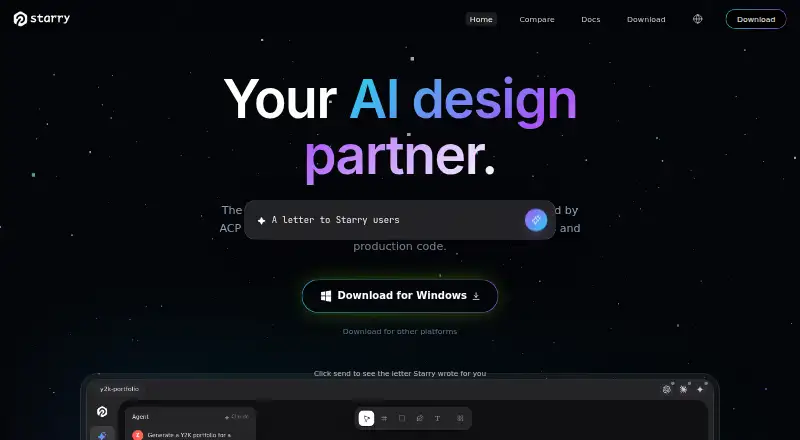
Starry is an AI design editor that turns natural-language prompts into editable interface layers and exports production code.
What Starry is
Starry is an AI design editor that turns natural-language prompts into editable interface layers and exports production code. Its canvas AI, powered by ACP, can create and modify auto-layout designs from prompts. Export choices include React JSX, HTML, SVG, design tokens, and raster files such as PNG, JPG, and WEBP. Starry reads native Figma .fig files and supports copying and pasting selections between Starry and Figma. For AI features, users provide their own API key for a supported provider; custom OpenAI- or Anthropic-format endpoints are also supported. Starry says keys are stored locally and prompts go directly to the selected provider. Designs are saved as local .pen and .fig files that can be committed to Git. Real-time collaboration runs peer-to-peer over WebRTC without a server or account, and a headless CLI can export documents and automate design operations, including in CI workflows. Starry is intended for designers, engineers, and teams working between an idea and a running app. Documented requirements are macOS 12 or later, Windows 10 or later, or Linux, with about 150 MB of free disk space.
Good
- Exports React JSX, HTML, SVG, and design tokens
- Reads native Figma .fig files
- Saves local .pen and .fig files
- Peer-to-peer collaboration needs no account
- Headless CLI supports CI workflows
Watch out
- AI chat requires your own provider API key
- macOS 12 or later is required
- Windows 10 or later is required
Who it suits
Starry suits designers, engineers, and teams who want to move from prompts and interface designs toward app code. It may also fit workflows involving Figma files, local design files, or command-line exports.
Verdict
Starry connects prompt-based interface editing with code exports, Figma file support, and local design documents. AI use depends on a provider key supplied by the user, and supported operating systems have stated minimum versions.
Plans and prices
From Starry's own pricing page, checked 5 Oct 2026.
| Plan | Price | What it gives you |
|---|---|---|
| Free | Free | Free to download and use · no subscription required · AI chat requires your own provider API key |
| Pro | $29 a month | Home page shows no plan limits or inclusions |
| Custom | Priced on request | — |
The facts
Each one read from Starry's own pages, with the date it was checked.
What it does
- AI providers
- Users provide their own API key for supported AI providers, and Starry also supports custom OpenAI or Anthropic format endpoints.checked 5 Oct 2026
- AI workflow
- The canvas AI is powered by ACP and can create and modify auto-layout designs from natural language.checked 5 Oct 2026
- Audience
- Starry describes itself as intended for designers, engineers, and teams working between an idea and a running app.checked 5 Oct 2026
- CLI
- A headless CLI can export documents and automate design operations, including use in CI workflows.checked 5 Oct 2026
- Code export
- It exports React JSX, HTML, SVG, design tokens, and raster formats including PNG, JPG, and WEBP.checked 5 Oct 2026
- Collaboration
- The docs say real-time collaboration runs peer-to-peer over WebRTC without a server or account.checked 5 Oct 2026
- Figma support
- Starry reads native Figma .fig files and supports copying and pasting selections between Starry and Figma.checked 5 Oct 2026
- Integrations
- Starry provides an MCP server for connecting AI coding tools and editors such as Cursor, VS Code, Claude Code, and OpenAI Codex.checked 5 Oct 2026
- Local files
- Starry saves designs as local .pen and .fig files that can be committed to Git.checked 5 Oct 2026
- Privacy
- Starry says API keys are stored locally and prompts go directly to the chosen provider without passing through Starry's servers.checked 5 Oct 2026
- Product
- Starry is an AI design editor that creates editable interface layers from natural-language prompts and exports production code.checked 5 Oct 2026
- Requirements
- The documented requirements are macOS 12 or later, Windows 10 or later, or Linux, with about 150 MB of free disk space.checked 5 Oct 2026
- Support
- The site links to a Discord community for connecting with Starry.checked 5 Oct 2026
The full review of Starry
Starry is an AI design editor for turning natural-language instructions into editable interface work and implementation-ready output. It fits designers, developers, and teams that move repeatedly between a canvas, Figma, and a codebase. The strongest reason to choose it is the local, code-oriented workflow; the main reservation is that AI chat requires your own provider credentials.
Overview
Starry treats interface design as an intermediate step rather than a final image. Prompt-driven editing, design-system support, Figma interchange, and exports for both code and graphics let a team carry one concept toward a running application. Local documents can be committed to Git, which suits projects that want design assets versioned beside source code.
That flexibility shifts some responsibility to the user. AI access is not simply included with the download: you supply a key for a supported provider or configure a custom OpenAI- or Anthropic-format endpoint. Users who already manage provider accounts will value the choice; people seeking an all-in-one subscription may find the setup less convenient.
Key features
Prompt-based canvas editing
The ACP-powered canvas AI creates and changes auto-layout designs from natural-language prompts. Because the output remains editable and Starry supports design systems, it is better suited to iterating on interface structure than tools that only return a flattened picture. The workflow still depends on your API key, so its usefulness is tied to your provider setup and willingness to manage usage costs there.
Code and design interchange
Exports cover React JSX, HTML, SVG, design tokens, PNG, JPG, and WEBP. That range supports both developer handoff and ordinary visual delivery, with tokens offering a practical route for preserving system values in implementation. Starry reads native Figma .fig files and allows selections to be copied and pasted between the two applications, making it a reasonable bridge for teams that cannot abandon Figma.
Local, automatable workflow
Documents are saved as local .pen and .fig files, so they can be reviewed and committed through Git rather than locked in a hosted workspace. A headless CLI exports documents and automates design operations, including CI workflows. An MCP server connects coding tools and editors such as Cursor, VS Code, Claude Code, and OpenAI Codex, which is particularly useful when design changes are part of an AI-assisted engineering process.
Privacy and collaboration
Starry says API keys stay on the local device and prompts go directly to the selected provider instead of through Starry's servers. Real-time collaboration uses peer-to-peer WebRTC without a server or account. That architecture can reduce account and server dependencies, while teams that require centrally managed workspaces may prefer a service built around hosted administration. A Discord community is provided for support and user connection.
Pricing
Starry has a freemium model, with paid access described as starting from $12/mo. The Free plan costs nothing, is free to download and use, and requires no subscription; AI chat requires your own provider API key. This is the sensible route for individual users who can bring credentials and want to evaluate the editor without a recurring app charge.
The Pro plan is $29 a month. The plan page does not state its inclusions or limits, so buyers should confirm what changes before committing. Custom uses custom pricing and is the option to discuss for organizations needing a tailored arrangement. The free tier gives up bundled AI access, while the paid tiers do not have published quota or seat terms in the plan information provided.
Platforms
Starry runs on Linux, macOS, Windows, and the web. Documented desktop requirements are macOS 12 or later, Windows 10 or later, or Linux, with about 150 MB of free disk space. That cross-platform coverage is useful for mixed teams, while the stated minimums matter when deploying it on older machines.
Who it's for
Choose Starry if you are a designer or engineer who wants prompt-based interface work to remain editable, export cleanly into code, and stay close to Figma and Git. It is also a fit for teams using MCP-connected coding tools or CI automation. Look elsewhere if you want provider-backed AI included in the subscription, a clearly documented paid-plan allowance, or collaboration centered on a hosted account and server.
Pros and cons
- Pros: Editable auto-layout generation makes prompts useful for real interface iteration.
- Pros: React, HTML, SVG, token, and raster exports cover implementation and visual handoff.
- Pros: Native Figma files, local .pen/.fig documents, and Git support reduce format and version-control friction.
- Pros: MCP, CLI, and CI support connect design operations to engineering workflows.
- Cons: AI chat requires a user-supplied provider key, adding setup and external usage responsibility.
- Cons: Peer-to-peer collaboration without accounts may not meet teams that need centralized workspace administration.
Alternatives
For a broad comparison of this category, see AI UI Design Generators.
- UXPin is the better choice when you need Android and iOS coverage, a 14-day trial, and a stated free allowance of two prototypes and 50 AI credits.
- Paper suits teams wanting unlimited viewers and editors, 100 weekly MCP calls, and a limited free image-generation allowance.
- Figma Make is preferable when you want a Figma-centered workflow with a Starter allowance of 150 AI credits per day and 500 per month, or a Professional seat at 16.00 USD monthly with 3,000 monthly credits.
- pen.dev is a free alternative with five agent days per month, 25 image and SVG generations, and one agent at a time.
- Coherent is a free, open-source option with unlimited projects, all 10 atmospheres, 40-plus validators with auto-fix, and bring-your-own-LLM-key support.
- Relume is aimed at site building, with a free tier limited to one project, one page, read-only sharing, and 30 Webflow and 30 React components.
- Visily is a browser-oriented alternative whose Starter plan provides 300 AI credits per month and limited boards and elements; Pro is 14.00 USD monthly with 3,000 credits.
- UX Pilot is worth considering for an enterprise API, SSO, team access controls, and design-system integration.
Verdict
Starry is a strong fit for designers and developers who want one editable, local design workflow that can move into Figma, Git, code exports, and AI-assisted engineering tools. Choose it for that bridge and for provider flexibility; look elsewhere if you want turnkey AI access or fully specified paid-plan limits before purchase.
Alternatives to Starry
- 1

UXPin
Free planAndroidiOSWebmacOS8.4From $29 a month - 2

Figma Make
Free planAndroidiOSWebAPI8.2Free plan - 3
pen.dev
Free planWebAPIExtensionLinux7.8From $16 a month - 4

floow.design
Free planWebAPI7.4From $7.99 a month - 5

Mowgli
Free planWebAPI7.4From $12 a month - 6

Visily
Free planWebExtension7.3From $14 a month