
Coherent
Coherent is an AI design method for building multi-page products with pages that share components and a growing design system.
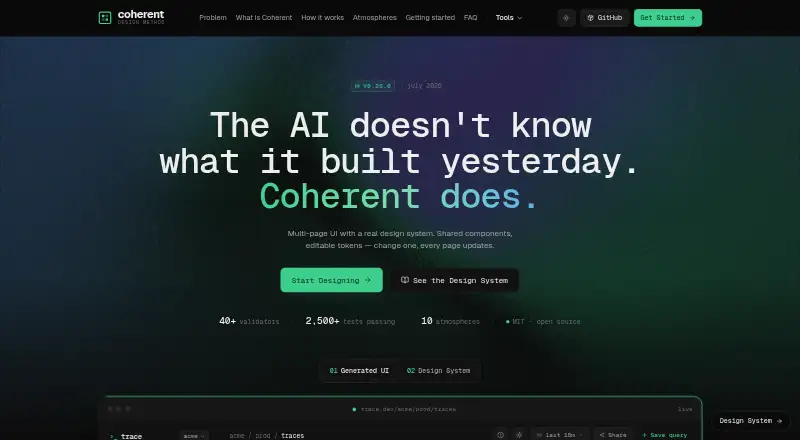
What Coherent is
Coherent is an AI design method for building multi-page products with pages that share components and a growing design system. It generates a Next.js project using Tailwind CSS and shadcn/ui, suitable as a prototype, developer handoff, or frontend. Changes to shared components and editable design tokens carry across pages, with design-system.config.ts serving as the editable configuration. Users can choose from 10 prebuilt atmospheres or set their own design-system foundation. Coherent supplies context for Cursor, Claude Code, and other AI editors through .cursorrules and CLAUDE.md files. It uses Anthropic Claude or OpenAI GPT with the user's own API key; typical model costs are estimated at $0.01–$0.03 per page. Its MCP server can validate code, read tokens, extract a design system from a URL, or apply a DESIGN.md file. Coherent can import DESIGN.md and export tokens as W3C DTCG JSON, CSS variables, or Tailwind configuration. It is open source under the MIT license, free, and available on Linux, macOS, and Windows.
Good
- Shared components and tokens propagate changes across pages.
- Includes 10 prebuilt atmospheres.
- Generates a Next.js, Tailwind CSS, and shadcn/ui project.
- Free plan includes unlimited projects and all atmospheres.
- Supports Linux, macOS, and Windows.
Watch out
- Full retrofit into existing codebases is not supported yet.
- Direct Figma token import is not supported yet.
- AI model use requires the user's own API key.
Who it suits
Coherent suits founders making multi-page prototypes, designers who ship code, product teams preparing demos, and developers seeking a Next.js starting point with a design system.
Verdict
Coherent combines multi-page generation with shared design-system controls and code output. Its current limitation is that it does not support a full retrofit into an existing codebase.
Plans and prices
From Coherent's own pricing page, checked 3 Oct 2026.
| Plan | Price | What it gives you |
|---|---|---|
| Open source | Free | Everything included · unlimited projects · all 10 atmospheres · 40+ validators with auto-fix · bring your own LLM key · forever |
The facts
Each one read from Coherent's own pages, with the date it was checked.
What it does
- AI editors
- Coherent provides context for Cursor, Claude Code, and any AI editor through .cursorrules and CLAUDE.md files.checked 3 Oct 2026
- Atmospheres
- The site lists 10 prebuilt atmospheres and says users can define their own design system foundation.checked 3 Oct 2026
- Design import/export
- Coherent can import a DESIGN.md file and export tokens as W3C DTCG JSON, CSS variables, and Tailwind configuration; direct Figma token import is not supported yet.checked 3 Oct 2026
- Design system
- Shared components and editable design tokens propagate changes across pages, with a design-system.config.ts as the editable configuration.checked 3 Oct 2026
- Existing projects
- Full retrofit into an existing codebase is not supported yet, though its extractor and MCP validation can be used alongside other projects.checked 3 Oct 2026
- License
- The product is described as open source under the MIT license.checked 3 Oct 2026
- MCP
- Its MCP server lets AI agents validate code, read tokens, extract a design system from a URL, or apply a DESIGN.md file.checked 3 Oct 2026
- Output
- It generates a clean Next.js, Tailwind CSS, and shadcn/ui project that can be used as a prototype, developer handoff, or frontend.checked 3 Oct 2026
- Security
- The project README says API keys are stored locally in .env and AI calls go directly from the user's machine to the provider; Coherent has no servers.checked 3 Oct 2026
- Support
- The site directs bug reports and feature requests to GitHub Issues and questions to GitHub Discussions, and says issue responses usually arrive within 24 hours.checked 3 Oct 2026
- What it does
- Coherent is an AI design method for multi-page products that generates interconnected pages with shared components and a growing design system.checked 3 Oct 2026
- Who it is for
- The site names founders building multi-page prototypes, designers who ship code, product teams needing demos, and developers seeking a Next.js starting point with a design system.checked 3 Oct 2026
Money
- AI models and cost
- It supports Anthropic Claude or OpenAI GPT using the user's own API key, and the site estimates $0.01–$0.03 per page in typical model costs.checked 3 Oct 2026
The full review of Coherent
Coherent is an open-source AI design tool for building connected, multi-page products directly in code. It is aimed at founders, designers who ship, product teams making demos, and developers who want a Next.js foundation. Choose it for a new product that should share one design system across every page; look elsewhere if you need to retrofit an established codebase.
Overview
Coherent turns a prompt into interconnected pages, shared components, and an evolving design system. Its output is a clean project built with Next.js, Tailwind CSS, and shadcn/ui, so it can function as a prototype, a developer handoff, or the basis of a frontend. That code-first result is more useful for implementation-oriented teams than for anyone seeking only a visual screen generator.
Edits to shared components and design tokens can flow through the whole product, with design-system.config.ts providing an editable source of configuration. The MIT license keeps the workflow open and permits unlimited projects under its sole plan.
Key features
Multi-page generation and design control
Coherent generates multiple connected screens instead of isolated concepts. Ten prebuilt atmospheres provide starting directions, while teams can define their own design-system foundation. Shared tokens make a change to spacing, color, or other system values a product-wide decision rather than a page-by-page chore.
Code and AI-editor context
The generated Next.js, Tailwind CSS, and shadcn/ui project is a tangible handoff for developers and can be used as a frontend starting point. .cursorrules and CLAUDE.md files give Cursor, Claude Code, and other AI editors project context, reducing the gap between generated design and subsequent coding work.
Agents, import, and export
Its MCP server lets agents validate code, read tokens, extract a design system from a URL, or apply a DESIGN.md file. Coherent can import that file and export tokens as W3C DTCG JSON, CSS variables, or Tailwind configuration. Direct Figma token import is not supported, so Figma-centered teams need an intermediate workflow.
Model costs and security
Anthropic Claude and OpenAI GPT are supported through your own API key; typical model usage is estimated at $0.01–$0.03 per page. Keys stay locally in .env, calls go directly from your machine to the provider, and Coherent has no servers. That is a clear privacy advantage, while the per-page provider cost remains your responsibility.
Existing-code limitation
Coherent does not yet provide a full retrofit into an existing codebase. Its extractor and MCP validation can work alongside other projects, but teams with a mature application should not expect an automatic conversion of that application into Coherent's structure.
Pricing
Open source — free
Billed forever, this plan includes everything: unlimited projects, all 10 atmospheres, more than 40 validators with auto-fix, and the ability to bring your own LLM key. There is no separate trial period because the product is free from the outset. The main ongoing expense is the model provider's usage, estimated at $0.01–$0.03 per page. For founders, designers, and developers who can manage their own keys, this is unusually unrestricted; there is no paid tier offering extra capacity or a hosted alternative.
Platforms
Coherent supports Linux, macOS, and Windows.
Who it's for
It is a strong fit for founders building a multi-page prototype, designers who want their work to become code, product teams preparing a demo, and developers seeking a Next.js project with a working design system. It is a weaker choice for teams that need direct Figma token import or a turnkey migration of an existing application.
Pros and cons
Pros
- Shared system across pages: token and component changes can propagate through a multi-page product.
- Useful code output: Next.js, Tailwind CSS, and shadcn/ui make the result suitable for prototypes, handoff, or a frontend start.
- Complete free plan: unlimited projects, every atmosphere, and 40+ auto-fixing validators cost nothing beyond model usage.
- Local key handling: API calls run from the user's machine and Coherent operates without servers.
- Agent interoperability: MCP validation, URL extraction, token reading, and DESIGN.md application extend the workflow beyond initial generation.
Cons
- No full retrofit: existing codebases cannot yet be converted wholesale into Coherent.
- No direct Figma token import: Figma-based systems require another path into the project.
- User-funded model calls: Claude or GPT usage needs your own API key and adds an estimated per-page cost.
- Community support: help runs through GitHub Issues and Discussions rather than a dedicated support channel, although issue replies usually arrive within 24 hours.
Alternatives
Choose UXPin instead if you need a freemium product spanning Android, iOS, macOS, web, and Windows, with a 14-day trial and a limited free plan capped at two prototypes and 50 AI credits.
Paper suits teams wanting browser and extension access, unlimited viewers and editors, and 100 weekly MCP tool calls on its free plan.
Figma Make is the alternative when a Figma-centered workflow and daily or monthly AI-credit plans matter more.
pen.dev is preferable if you want agent-day and image/SVG-generation quotas, including a free allowance of five agent days per month.
Starry is an option for a downloadable cross-platform tool whose AI chat uses your own provider API key.
Relume fits a web and extension workflow with a free plan limited to one project, one page, and capped Webflow and React components.
Visily is better for a conventional visual-design workflow with 300 AI credits per month on its free Starter plan.
UX Pilot is the alternative when you need an enterprise option with API access, SSO, team controls, and design-system integration.
For a wider comparison, see AI UI Design Generators.
Verdict
Coherent is an excellent choice for a new multi-page product that needs consistent tokens, connected screens, and usable Next.js code without a subscription. Its decisive advantages are the unrestricted MIT-licensed plan, shared design-system controls, and agent-friendly exports. Look elsewhere if your priority is importing Figma tokens directly or bringing an existing codebase into the system wholesale.
Alternatives to Coherent
- 1

UXPin
Free planAndroidiOSWebmacOS8.4From $29 a month - 2

Figma Make
Free planAndroidiOSWebAPI8.2Free plan - 3
pen.dev
Free planWebAPIExtensionLinux7.8From $16 a month - 4

floow.design
Free planWebAPI7.4From $7.99 a month - 5

Mowgli
Free planWebAPI7.4From $12 a month - 6

Visily
Free planWebExtension7.3From $14 a month