
SQLite
SQLite is a transactional SQL database engine that runs inside an application, without a separate server process or configuration.
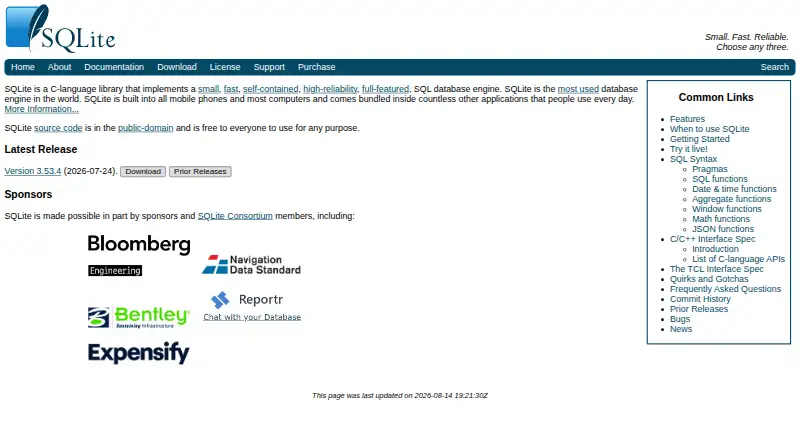
What SQLite is
SQLite is a transactional SQL database engine that runs inside an application, without a separate server process or configuration. Each complete database is stored in one disk file that can be used across platforms. Its SQL capabilities include partial indexes, indexes on expressions, JSON, common table expressions, and window functions. Transactions are atomic, consistent, isolated, and durable, including after system crashes and power failures. Many readers can access a database at once, but each database file supports only one writer at a time. The project recommends SQLite for device-local storage with low writer concurrency and less than a terabyte of content. SQLite is free for commercial or private use, and its source code is in the public domain. Downloads include source and precompiled binaries for Android, Linux, Mac OS X, and Windows, plus WebAssembly and JavaScript bundles for web applications. A free public forum is available, alongside paid private email and technical support options. The maker is based in Charlotte, North Carolina, and was founded in 2000.
Good
- No separate server process or configuration
- Stores each database in one cross-platform file
- Free for commercial and private use
- Supports JSON and window functions
- Unlimited simultaneous readers
Watch out
- Only one writer per database file at a time
- Private email and technical support are paid
Who it suits
SQLite suits developers who need device-local database storage, have low writer concurrency, and expect less than a terabyte of content.
Verdict
SQLite is a compact choice for application-embedded storage where write activity is limited. Its single-writer limit per database file is an important consideration for workloads with concurrent writes.
Plans and prices
From SQLite's own pricing page, checked 29 Sep 2026.
| Plan | Price | What it gives you |
|---|---|---|
| SQLite | Free | Embedded SQL database engine · no separate server process · Free for any purpose; no license required. |
| Public Forum | Free | community help and advice · public forum · Free |
| Annual Maintenance Subscription | $1,500 a year | private expert email support · non-disclosure promise · $1500/year |
| SQLite Encryption Extension (SEE) | $2,000, paid once | AES-encrypted database read/write support · drop-in replacement source · $2000 one time fee |
| CEROD | $2,000, paid once | compressed and encrypted read-only database support · $2000 one time fee |
| ZIPVFS | $4,000, paid once | compressed and encrypted read/write database extension · $4000 one time fee |
| ZIPVFS Read/Write Compressed Database Extension | $4,000, paid once | Source code · compresses and encrypts data when written and decompresses and decrypts it when read · One time |
| SQLite License | $6,000, paid once | warranty of title · perpetual right to use source code · $6000 one time fee |
| SQLite Consortium Membership | — | enterprise support · on-site visits · proprietary extensions and test suites · $150K/year |
| Technical Support | — | priority email and phone support · guaranteed response time available · $8K-85K/year |
The facts
Each one read from SQLite's own pages, with the date it was checked.
What it does
- ACID transactions
- Transactions remain atomic, consistent, isolated and durable through crashes and power failures.checked 19 Oct 2026
- API
- SQLite supplies a C/C++ API reference, Tcl bindings and application-defined SQL-function interfaces; bindings for many other languages are separate.checked 19 Oct 2026
- Capacity
- The documented maximum database size is 281 terabytes and the maximum row size is 1 gigabyte.checked 19 Oct 2026
- CLI
- A standalone command-line client is included for administering SQLite databases.checked 19 Oct 2026
- Concurrency limit
- SQLite permits unlimited simultaneous readers but only one writer at a time per database file.checked 19 Oct 2026
- Database format
- A complete SQLite database is stored in a single cross-platform disk file.checked 29 Sep 2026
- Deployment
- The project says SQLite is embedded in billions of applications and is the world's most widely deployed database engine.checked 19 Oct 2026
- Documentation
- Documentation includes overview guides, SQL syntax, pragmas, C/C++ APIs, compilation instructions, Android bindings, testing, FAQs and compatibility material.checked 19 Oct 2026
- Downloads
- The official download page provides source, Android AAR, Linux, macOS, Windows, WebAssembly/JavaScript and documentation bundles.checked 19 Oct 2026
- Footprint
- A fully configured build can be smaller than 900 KiB.checked 19 Oct 2026
- Intended use
- The project recommends SQLite for device-local storage with low writer concurrency and less than a terabyte of content.checked 29 Sep 2026
- Latest release
- Version 3.54.1 was released on 2026-10-16.checked 19 Oct 2026
- Licence
- SQLite source code is dedicated to the public domain and may be used for any purpose.checked 19 Oct 2026
- License
- SQLite source code is in the public domain and is free for commercial or private use without a license.checked 29 Sep 2026
- Limit: Trustpilot complaints
- The two Trustpilot reviews are one-star complaints alleging a problematic code-of-ethics message and a virus download.checked 19 Oct 2026
- Limit: TrustRadius reviewers
- Repeated complaints include weak high-throughput or multi-user scaling, missing advanced SQL or stored procedures, limited tooling, encryption costs and uneven language integration.checked 19 Oct 2026
The company
- Company founded
- Dun & Bradstreet lists Hipp Wyrick & Company Inc. as founded in 2001, while its summary says the company has provided services since 1992.checked 19 Oct 2026
- Company headquarters
- Hwaci's headquarters are listed at 6200 Maple Cove Lane, Charlotte, North Carolina.checked 19 Oct 2026
- Company legal name
- Hipp, Wyrick & Company, Inc. (Hwaci) is identified as SQLite's developer and an independent software development and consulting firm.checked 19 Oct 2026
- Company size
- Dun & Bradstreet lists an employee count of 5.checked 19 Oct 2026
- Founded
- 2000checked 23 Sep 2026
- Headquarters
- Charlotte, North Carolina, USAchecked 23 Sep 2026
- Maker
- Paid support and products are provided by Hipp, Wyrick & Company, Inc. (Hwaci), headquartered in Charlotte, North Carolina, and in business since 1992.checked 29 Sep 2026
Money
- Free plan
- Yeschecked 22 Sep 2026
The full review of SQLite
Overview
SQLite is an SQL database engine built into an application rather than run as a separate server. It is especially suited to developers adding structured, local storage to an app; its single-file design and broad SQL support are compelling, provided writes to each database remain low in concurrency.
Key features
Embedded, single-file storage
A complete database lives in one cross-platform disk file, and SQLite runs in-process without a separate server or configuration. That makes it a practical fit for device-local application data and avoids operating a database service. It is not a managed database offering: deployment is self-hosted.
SQL, transactions, and concurrency
SQLite supports partial indexes, expression indexes, JSON, common table expressions, and window functions, giving applications a substantial set of SQL tools. Transactions are atomic, consistent, isolated, and durable even after crashes or power failures. Unlimited simultaneous readers are supported, but a database file can have only one writer at a time. Read-heavy use can suit that model; applications requiring concurrent writes to the same file should look elsewhere.
Security and distribution
Downloads include source code and precompiled binaries for Android, Linux, Mac OS X, and Windows, along with WebAssembly and JavaScript bundles for web applications. SQLite is extensively fuzz-tested, and its security guidance recommends defensive settings and lower input limits when applications accept untrusted SQL. Those precautions matter to developers embedding the engine; fuzz testing is not a substitute for configuring an application carefully.
The source code is public domain and free for commercial or private use without a license. A free public forum is available, while private email and technical support are paid options.
Pricing
The core SQLite engine costs free, for any purpose, with no license required. This is the relevant option for most developers embedding the database; it includes the engine, not a separate server process.
Paid options are aimed at organizations needing support, extensions, or specific rights:
- SQLite Consortium Membership: $150 a year for premium enterprise support, on-site visits, proprietary extensions, and test suites.
- Technical Support: $885 a year for high-priority email and phone support; a guaranteed response time is available as an option.
- Annual Maintenance Subscription: $1,500 a year for private expert email advice from SQLite developers.
- SQLite Encryption Extension (SEE): $2,000, paid once for source code that reads and writes AES-encrypted databases.
- CEROD: $2,000, paid once for source code that reads compressed and encrypted databases.
- ZIPVFS Read/Write Compressed Database Extension: $4,000, paid once for source code that compresses and encrypts data on write and decompresses and decrypts it on read.
- SQLite License: $6,000, paid once for a warranty of title and perpetual right to use SQLite source code.
The free engine is sufficient for use without a license; the paid license is for buyers seeking its stated warranty and right-to-use terms. The support and extension purchases serve narrower enterprise or technical needs rather than changing the basic engine's free pricing.
Platforms
SQLite supports Android, iOS, Linux, macOS, Windows, web, API, and self-hosted use. Its downloadable binaries and web bundles give developers several ways to incorporate it, while the self-hosted model means teams manage deployment themselves.
Who it's for
SQLite is a strong choice for developers building device-local storage into applications, particularly where content is below a terabyte and reads are more frequent than writes. It is less appropriate for workloads that need multiple writers to a single database file at once, or teams seeking a managed database service.
Pros and cons
- Pro: The entire database is one cross-platform file, and the engine runs inside the application without a separate server or setup.
- Pro: Public-domain source code can be used commercially or privately without a license fee.
- Pro: Broad SQL support includes JSON, window functions, and common table expressions, alongside durable transactions.
- Con: Only one writer at a time can access each database file, which rules it out for some concurrent-write workloads.
- Con: There is no managed service; users must handle self-hosted deployment.
- Con: Private support, proprietary extensions, and specialized encryption or compression source code carry substantial paid prices.
Alternatives
Choose MySQL if you want a database with SQL and NoSQL applications, replication, and high-availability components; its Community Edition is GPL-licensed. InterSystems IRIS is another option with a free Community Edition, though AWS infrastructure costs may apply.
H2 Database Engine is a free database alternative with source code included. For a hosted PostgreSQL option with published free-tier limits, Neon offers 10 projects, 50 CU-hours per month per project, 0.5 GB storage per project, 10 branches per project, and 5 GB monthly egress on its free plan. MariaDB Server offers a free, self-hosted Community Server for non-production applications, while PostgreSQL is free and open source for use, copying, modification, and distribution.
Microsoft SQL Server is an alternative with freemium pricing and edition options. Aiven for PostgreSQL is a hosted alternative whose free plan includes one CPU, 1 GB RAM, 1 GB disk, a single node, and no support services.
Verdict
Choose SQLite for application-embedded, device-local storage when a compact, self-contained database and zero license cost matter more than simultaneous writes. Its capable SQL feature set and durable transactions make it useful well beyond trivial data storage, but the one-writer-per-file limit is decisive for write-heavy concurrency. If that constraint or self-managed deployment does not fit, choose another database model.
Getting started
- Visit https://www.sqlite.org/.
- Choose source code or a precompiled binary for Android, Linux, Mac OS X, or Windows, or a web bundle.
- Use the SQLite engine within an application; it does not require a separate server process.
- Use the free engine for commercial or private purposes without a license.
Limits worth knowing
The free SQLite engine allows only one writer at a time per database file. The project recommends it for low writer concurrency and less than a terabyte of content.
Questions
How much does SQLite cost?
The SQLite engine is free for any purpose, with no license required. Paid options include annual support and membership plans, as well as one-time fees for extensions and a SQLite license.
Is SQLite open source?
Its source code is in the public domain and is free for commercial or private use without a license.
What platforms can I download SQLite for?
The download page offers source code and precompiled binaries for Android, Linux, Mac OS X, and Windows. WebAssembly and JavaScript bundles are available for web applications.
Does SQLite need a database server?
No. SQLite runs in-process as a self-contained engine and does not require a separate server process.
Can multiple users write to a SQLite database at once?
SQLite supports unlimited simultaneous readers, but only one writer at a time per database file.
What support does SQLite offer?
A free public forum is available. Private email and technical support options are paid.
Alternatives to SQLite
- 1

Firestore
Free planAndroidiOSWebAPI8.8$0.03 usage-based - 2

MySQL
Free planAPILinuxmacOSSelf-hosted8.7Free plan - 3
SingleStore Helios
Free planWebAPILinuxmacOS8.7Free plan - 4

TiDB Cloud
Free planOpen sourceWebAPILinuxSelf-hosted8.7Free plan - 5
CrateDB
Free planOpen sourceWebAPILinuxmacOS8.7Free plan - 6

Chroma
Free planOpen sourceAndroidiOSWebAPI8.7From $250 a month