
PostgreSQL
PostgreSQL is a free, open-source object-relational database system that uses and extends SQL for complex data workloads.
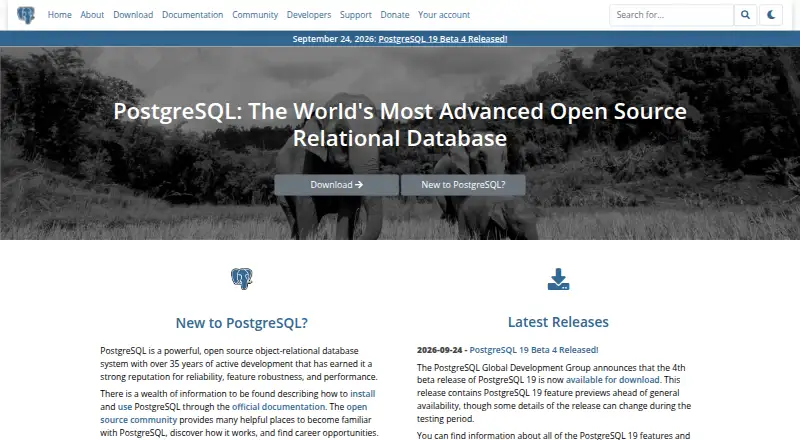
What PostgreSQL is
PostgreSQL is a free, open-source object-relational database system that uses and extends SQL for complex data workloads. It supports primitive, structured, document, geometric, and custom data types, including JSON/JSONB, XML, arrays, ranges, and UUIDs. For data integrity, it offers keys, constraints, locks, transactions, savepoints, and SQL-standard transaction isolation levels. Performance features include several index types, query planning and optimization, parallel queries, partitioning, just-in-time expression compilation, and asynchronous I/O. Recovery and replication options include write-ahead logging, asynchronous, synchronous, and logical replication, point-in-time recovery, and active standbys. Security capabilities include multiple authentication methods, access controls, row- and column-level security, and multi-factor authentication. Extensions such as PostGIS, procedural languages, and foreign data wrappers add capabilities or connect to other databases and streams. PostgreSQL is self-hosted; no managed service is listed. Its license permits use, copying, modification, and distribution without a fee, subject to its conditions. The project advises using the latest minor version; PostgreSQL 14 is scheduled to stop receiving fixes on November 12, 2026.
Good
- Supports JSON/JSONB, XML, arrays, ranges, and UUIDs.
- Includes point-in-time recovery and multiple replication methods.
- Offers row- and column-level security and multi-factor authentication.
- License permits use, modification, and distribution without a fee.
Watch out
- Self-hosted; no managed service is listed.
- PostgreSQL 14 is scheduled to stop receiving fixes on November 12, 2026.
Who it suits
PostgreSQL suits developers building applications and administrators focused on data integrity and fault-tolerant environments. It is a self-hosted option rather than a managed service.
Verdict
PostgreSQL offers broad data, transaction, recovery, and security capabilities under a license with no usage fee. It requires self-hosting, and the project recommends using the latest minor version.
Plans and prices
From PostgreSQL's own pricing page, checked 29 Sep 2026.
| Plan | Price | What it gives you |
|---|---|---|
| PostgreSQL | Free | Free and open source · Use, copy, modify, and distribute without fee |
The facts
Each one read from PostgreSQL's own pages, with the date it was checked.
What it does
- Data types
- It supports primitive, structured, document, geometric, and custom data types, including JSON/JSONB, XML, arrays, ranges, and UUIDs.checked 29 Sep 2026
- Extensions and integrations
- PostgreSQL supports extensions such as PostGIS, procedural languages, and foreign data wrappers that connect to other databases or streams through SQL.checked 29 Sep 2026
- Integrity and transactions
- Features include primary and foreign keys, constraints, explicit and advisory locks, transactions, savepoints, and all SQL-standard transaction isolation levels.checked 29 Sep 2026
- License
- The PostgreSQL License permits use, copying, modification, and distribution for any purpose without a fee or written agreement, subject to its conditions.checked 29 Sep 2026
- Performance
- PostgreSQL includes multiple index types, a query planner and optimizer, parallel query processing, table partitioning, just-in-time expression compilation, and asynchronous I/O.checked 29 Sep 2026
- Recovery and replication
- It supports write-ahead logging, asynchronous, synchronous, and logical replication, point-in-time recovery, and active standbys.checked 29 Sep 2026
- Release lifecycle
- PostgreSQL 14 is scheduled to stop receiving fixes on November 12, 2026, according to the project homepage.checked 29 Sep 2026
- Security
- Listed security features include GSSAPI, LDAP, SCRAM-SHA-256, certificate and OAuth 2.0 authentication, access controls, row- and column-level security, and multi-factor authentication.checked 29 Sep 2026
- Security process
- The project says it releases security fixes in minor-version updates and advises users to use the latest available minor version.checked 29 Sep 2026
- Security reporting
- The PostgreSQL Project is a CVE Numbering Authority and accepts vulnerability reports at [email protected]; it does not offer bug bounties.checked 29 Sep 2026
- Support
- Community support options include documentation, community resources, mailing lists, and IRC, while commercial support and PostgreSQL-specific hosting are available from listed providers.checked 29 Sep 2026
- What it does
- PostgreSQL is an open source object-relational database system that uses and extends SQL to store and scale complex data workloads.checked 29 Sep 2026
- Who it is for
- The project describes features for developers building applications and administrators protecting data integrity and building fault-tolerant environments.checked 29 Sep 2026
Money
- Free plan
- Yeschecked 22 Sep 2026
Where it runs
- Platforms
- The project says PostgreSQL runs on all major operating systems and provides downloads for Linux, macOS, Windows, BSD, and Solaris.checked 29 Sep 2026
The full review of PostgreSQL
PostgreSQL is an open-source object-relational database for building and operating applications with complex data needs. It suits developers who need flexible data types and administrators who prioritize integrity and fault tolerance. Its feature set is broad, but you must host and manage it yourself.
Overview
PostgreSQL extends SQL for workloads that reach beyond conventional tables. Its support for document, geometric, structured, and custom data types gives teams room to model varied information in one database. The trade-off is operational responsibility: PostgreSQL is self-hosted, not a managed service.
The PostgreSQL License allows use, copying, modification, and distribution for any purpose without a fee or written agreement, subject to its conditions. The project describes the system as serving both application developers and administrators building environments that protect data integrity and tolerate faults. It belongs in Relational Databases and Database Software.
Key features
Data and integrity controls
PostgreSQL supports primitive and structured types alongside JSON and JSONB, XML, arrays, ranges, UUIDs, geometric values, and custom types. That range is useful when applications need different data shapes without giving up a relational database. Primary and foreign keys, constraints, explicit and advisory locks, transactions, savepoints, and all SQL-standard transaction isolation levels help define rules and coordinate concurrent work.
Query performance and scale
Multiple index types, a query planner and optimizer, parallel query processing, table partitioning, just-in-time expression compilation, and asynchronous I/O provide several ways to handle demanding workloads. These capabilities make PostgreSQL a serious option for growing applications, though the self-hosted model means the team remains responsible for deployment and operation.
Recovery, replication, and security
Write-ahead logging, asynchronous and synchronous replication, logical replication, point-in-time recovery, and active standbys support recovery planning and resilient deployments. Read replicas and high availability are supported. Authentication options include GSSAPI, LDAP, SCRAM-SHA-256, certificates, OAuth 2.0, and multi-factor authentication; access controls and row- and column-level security add ways to limit access.
Extensions such as PostGIS, procedural languages, and foreign data wrappers broaden what PostgreSQL can do and let it connect to other databases or streams through SQL. The project releases security fixes in minor-version updates and advises users to run the latest available minor version. PostgreSQL 14 is scheduled to stop receiving fixes on November 12, 2026. The project accepts vulnerability reports at [email protected] as a CVE Numbering Authority, but does not offer bug bounties.
Pricing
PostgreSQL costs nothing. The free and open-source plan permits use, copying, modification, and distribution without a fee, subject to the license conditions. There is no free trial because the software is free. There are no paid PostgreSQL plans to weigh against it, but there is also no managed-service option: users need to provide and operate their own deployment.
Community support includes documentation, community resources, mailing lists, and IRC. Commercial support and PostgreSQL-specific hosting are available from listed providers, which may suit teams that want outside operational help.
Platforms
PostgreSQL supports Linux, macOS, and Windows, as well as self-hosted deployment. That platform coverage gives teams flexibility over where to run the database, but does not remove the need to manage it themselves.
Who it's for
PostgreSQL is a strong fit for developers building applications that need varied data types, rigorous transaction controls, and extensibility. It also suits administrators planning replication, recovery, and access controls for fault-tolerant environments. Readers seeking a database service that handles hosting and operations for them should look elsewhere.
Pros and cons
Pros
- No usage fee: The license permits use and distribution for any purpose without a fee or written agreement.
- Broad data and transaction support: Document, geometric, and custom types sit alongside SQL transaction controls and constraints.
- Resilience and security options: Replication, point-in-time recovery, multiple authentication methods, and row- and column-level security support demanding deployments.
- Extensible: Extensions and foreign data wrappers can add capabilities and connect to external data sources through SQL.
Cons
- Self-hosted only: Teams must take responsibility for deployment and operation rather than relying on a PostgreSQL managed service.
- Minor-version upkeep matters: The project advises using the latest available minor version for security fixes.
- No bug bounty: The project accepts vulnerability reports but does not offer bounty payments.
Alternatives
Consider MySQL if its freemium model and Community Edition for SQL and NoSQL applications, with replication and high-availability components, better fit your needs.
Azure SQL Database may suit readers who prefer a free hosted offer with stated storage and compute quotas: 100,000 vCore seconds, 32 GB data storage, 32 GB backup storage, and 10 databases per subscription.
Choose SQLite when a free embedded SQL database engine better suits the application than a self-hosted PostgreSQL deployment.
Neon is an option for readers seeking a freemium database with a free tier capped at 10 projects, 50 CU-hours per month per project, 0.5 GB storage per project, 10 branches per project, and 5 GB monthly egress.
Amazon RDS may fit those who want a database service with a free tier, including AWS Free Tier credits valid for up to 12 months.
Oracle Autonomous AI Database offers an always-free option with 20 GB storage per database, up to two instances per tenancy, and up to 30 simultaneous database sessions.
Aiven for PostgreSQL may suit readers seeking hosted PostgreSQL: its free plan includes 1 CPU, 1 GB RAM, 1 GB disk, a single node, and no support services.
Microsoft SQL Server is another database option for readers considering enterprise or standard editions with volume licensing and hosting.
Verdict
Choose PostgreSQL if you want a capable, extensible relational database with no usage fee and you can manage its deployment. Its transaction, recovery, and security breadth is the main reason to choose it; the lack of a managed service is the main reason to look elsewhere.
Alternatives to PostgreSQL
- 1

SQLite
Free planOpen sourceAndroidiOSWebAPI9.3Free plan - 2

Firestore
Free planAndroidiOSWebAPI8.8$0.03 usage-based - 3

MySQL
Free planAPILinuxmacOSSelf-hosted8.7Free plan - 4
SingleStore Helios
Free planWebAPILinuxmacOS8.7Free plan - 5

TiDB Cloud
Free planOpen sourceWebAPILinuxSelf-hosted8.7Free plan - 6
CrateDB
Free planOpen sourceWebAPILinuxmacOS8.7Free plan