
Chroma
Chroma is open-source data infrastructure for AI that stores embeddings and metadata and supports search and retrieval across text, images, and other modalit…
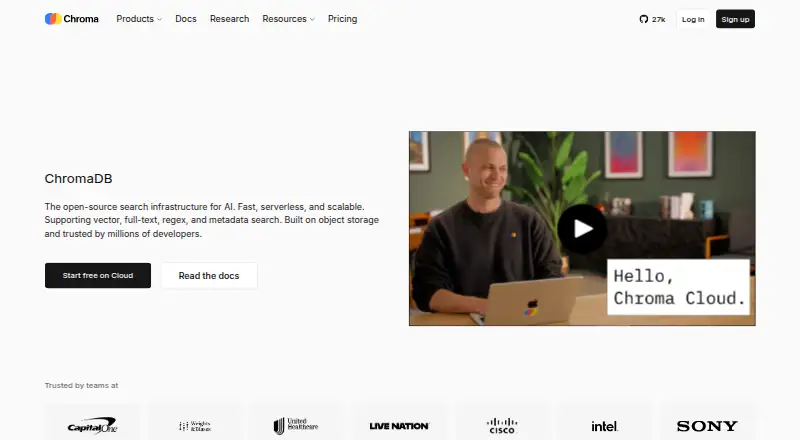
What Chroma is
Chroma is open-source data infrastructure for AI that stores embeddings and metadata and supports search and retrieval across text, images, and other modalities. Search options include dense, sparse, and hybrid vector search, along with full-text and regex search and metadata filtering. Chroma can run locally through pip, npm, or Docker, on Chroma Cloud, or in a customer’s own VPC. Documented embedding integrations include OpenAI, Cohere, Google Gemini, Hugging Face, Jina AI, and Ollama. Framework integrations include LangChain, LlamaIndex, Haystack, Streamlit, and DeepEval. Chroma is licensed under Apache 2.0, and the maker says the same codebase powers its open-source database and Chroma Cloud. Cloud security options include encryption in transit and at rest, SSO, role-based access control, and employee MFA. Starter is free and includes 10 databases and 10 team members. Team costs $250 a month plus usage, includes $100 credits, and supports 100 databases and 30 team members. Enterprise pricing is not listed. Exceeding usage limits pauses the service until a limit changes.
Good
- Supports dense, sparse, and hybrid vector search
- Includes full-text, regex, and metadata search
- Can run locally, in Chroma Cloud, or in a customer VPC
- Apache 2.0 license for the open-source code
- Documented integrations include LangChain and LlamaIndex
Watch out
- Team costs $250 a month plus usage
- Enterprise pricing is not listed
- Exceeding usage limits pauses the service
Who it suits
Chroma suits developers building AI applications that need embedding storage, search, and retrieval across multiple data types. It offers local, cloud, and customer-VPC deployment options.
Verdict
Chroma offers several search methods and deployment choices for AI data infrastructure, with a free Starter plan and paid cloud options. Review database, team-member, and usage limits before selecting a plan.
Plans and prices
From Chroma's own pricing page, checked 15 Oct 2026.
| Plan | Price | What it gives you |
|---|---|---|
| Team | $250 a month | 100 databases · 30 team members · $100 usage credits · Slack support · SOC 2 · volume discounts · $250/month + usage |
| Starter | Free | 10 databases · 10 team members · Community Slack · $0/month + usage |
| Enterprise | Priced on request | Unlimited databases · Unlimited team members · Dedicated support · Single-tenant clusters · BYOC clusters · SLAs · Custom pricing |
The facts
Each one read from Chroma's own pages, with the date it was checked.
What it does
- Changelog update
- The changelog lists EU region support in April 2026 and Chroma Sync for S3, GitHub and Web in March 2026.checked 15 Oct 2026
- CLI installation
- The CLI is installable through the Python package, JavaScript package, pipx or a standalone curl installer.checked 15 Oct 2026
- Cloud API
- The CloudClient accepts a tenant, database and API key, with environment-variable configuration also supported.checked 15 Oct 2026
- Cloud architecture
- Chroma Cloud is serverless and uses object storage with automatic tiering and caching.checked 15 Oct 2026
- Cloud performance limits
- The product page lists 1 million collections per database and 5 million records per collection as technical specifications.checked 28 Sep 2026
- Compliance
- Chroma Cloud says it completed a SOC 2 Type II examination.checked 28 Sep 2026
- Dataset forking
- Forking supports dataset versioning, A/B tests and staged rollouts.checked 15 Oct 2026
- Deployment
- The maker says Chroma can run locally with pip, npm, or Docker, on Chroma Cloud, or in a customer’s own VPC.checked 28 Sep 2026
- Documentation depth
- The docs cover quickstarts, SDK references, cloud clients, deployment, Docker, production client-server mode, performance and migrations.checked 15 Oct 2026
- Embedding integrations
- Documented embedding integrations include OpenAI, Cohere, Google Gemini, Hugging Face, Jina AI, Ollama, and others.checked 28 Sep 2026
- Enterprise deployment
- Enterprise deployment options listed include multi-tenant cloud, single-tenant nodes and clusters, BYOC, and on-premises deployment.checked 28 Sep 2026
- Enterprise options
- The enterprise page lists single-region, multi-region, and multi-cloud regions, active-active and active-passive replication, and AWS, GCP, and Azure.checked 28 Sep 2026
- Framework integrations
- Documented framework integrations include LangChain, LlamaIndex, Haystack, Streamlit, and DeepEval.checked 28 Sep 2026
- Full-text and regex
- Its search interface includes trigram full-text matching and regular-expression queries.checked 15 Oct 2026
- Funding news
- Chroma announced an $18 million seed round led by Quiet Capital on April 7, 2023, and also disclosed a May 2022 pre-seed round.checked 15 Oct 2026
- Integrations: embedding providers
- Documented embedding integrations include OpenAI, Google Gemini, Cohere, Hugging Face, Jina AI, Ollama, Mistral and Together AI.checked 15 Oct 2026
- Integrations: frameworks
- Documented framework integrations include LangChain, LlamaIndex, DeepEval, Streamlit, Haystack, Google ADK, Mem0 and others.checked 15 Oct 2026
- Licence
- Chroma is released under the Apache 2.0 licence.checked 15 Oct 2026
- Limit: comparison performance
- A G2 reviewer says performance can fall below Pinecone in some scenarios.checked 15 Oct 2026
- Limit: documentation and learning curve
- A G2 reviewer cites limited advanced documentation, a potentially steep beginner learning curve and a focus narrower than general databases.checked 15 Oct 2026
The company
- Company founding
- Netfigo lists Chroma as founded in 2022 in San Francisco, with Jeff Huber and Anton Troynikov as founders.checked 15 Oct 2026
- Company legal name
- The terms identify the service provider as Chroma Inc.checked 15 Oct 2026
- Company location and size
- LinkedIn lists Chroma as privately held, headquartered in San Francisco and employing 11–50 people.checked 15 Oct 2026
Money
- Free plan
- Yeschecked 22 Sep 2026
The full review of Chroma
Overview
Chroma is open-source data infrastructure for storing embeddings and metadata and retrieving information across text, images, and other modalities. It suits developers and teams building AI search systems who want a choice of local, managed-cloud, or customer-controlled deployment. Its breadth of search methods and deployment options is compelling, though cloud plans impose database, seat, and usage limits that deserve attention.
Key features
- Flexible retrieval: Dense, sparse, and hybrid vector search sit alongside full-text and regex search, with metadata filtering to narrow results. That range makes Chroma a fit for mixed retrieval needs; teams seeking only a simple vector store may not need all these modes.
- Multiple index types: Chroma supports vector and sparse-vector indexes, full-text indexing, and inverted indexes for strings, integers, floats, and booleans. Maximum vector dimensions are 4096.
- Integration choices: Documented embedding integrations include OpenAI, Cohere, Google Gemini, Hugging Face, Jina AI, and Ollama. Framework integrations include LangChain, LlamaIndex, Haystack, Streamlit, and DeepEval. SDKs are available for Python, TypeScript, Rust, Kotlin, and Swift.
- Deployment and licensing: The Apache 2.0-licensed project can run locally through pip, npm, or Docker, on Chroma Cloud, or in a customer’s own VPC. The maker says the open-source database and Chroma Cloud use the same codebase, giving teams a path between deployment models.
- Cloud security and scale: Chroma Cloud says it encrypts customer data in transit and at rest, and offers SSO, role-based access control, and employee MFA. It has completed a SOC 2 Type II examination. Technical specifications list up to 1 million collections per database and 5 million records per collection; these high ceilings do not remove the need to assess plan quotas and usage charges.
- Enterprise choices: Options include multi-tenant cloud, single-tenant nodes and clusters, BYOC, and on-premises deployment, plus single- or multi-region and multi-cloud configurations, active-active or active-passive replication, and AWS, GCP, and Azure. These choices suit organizations with specific infrastructure requirements, but Enterprise pricing is custom.
Pricing
Chroma combines a free entry plan with usage-based cloud charges and a $250-per-month Team plan. Review both the included capacity and the usage terms before committing: if customer-set or Chroma-set limits are exceeded, service pauses until the limit is changed.
- Starter: Free credits, then usage-based pricing; 10 databases and 10 team members. Community Slack support is included. This is the sensible starting point for smaller projects, but the database and seat caps constrain growing teams.
- Team: $250/month + usage, with $100 credits, 100 databases, 30 team members, Slack support, SOC II, and volume-based discounts. It raises the capacity substantially and adds team support, but the base price does not cover usage beyond the included credits.
- Enterprise: Custom pricing, unlimited databases, and unlimited team members, with dedicated support. It is aimed at organizations that need uncapped team and database allowances or enterprise deployment options; buyers should weigh the custom price against those requirements.
Cloud technical specifications list 1 million collections per database and 5 million records per collection. Those are distinct from plan allowances and do not establish a plan’s billable usage quota.
Platforms
Chroma is available across Android, iOS, Linux, macOS, and Windows, as well as through its API, web, and self-hosted deployments. The local and self-hosted options give developers control over where they run the database; Chroma Cloud is the managed alternative.
Who it's for
Chroma is best suited to developers and organizations building AI applications that need several retrieval modes, broad embedding and framework integrations, or flexibility between local, cloud, VPC, and on-premises deployment. Starter can serve modest projects, while Team is for groups needing more databases and seats plus Slack support. It is less suitable for teams that need predictable total cloud costs without monitoring usage, or that want a managed plan with no database or member caps at a published price.
Pros and cons
- Pros: Dense, sparse, hybrid, full-text, and regex search plus metadata filtering cover varied retrieval patterns.
- Pros: Apache 2.0 licensing and local, cloud, VPC, and on-premises deployment options provide meaningful operational flexibility.
- Pros: The documented embedding providers, frameworks, and five SDK languages give developers several integration paths.
- Cons: Starter is capped at 10 databases and 10 members; Team costs $250/month plus usage and caps access at 100 databases and 30 members.
- Cons: Exceeding usage limits pauses service until a limit is changed, so teams must actively manage their thresholds.
- Cons: Enterprise uses custom pricing, making its unlimited database and member allowances harder to compare on price alone.
Alternatives
For a broader category comparison, browse Vector Databases, Search Databases, Embedded Databases, or Database Software.
- Qdrant is another freemium vector-database option; its free cloud tier specifies a single-node cluster with 0.5 vCPU, 1GB RAM, and 4 GB disk.
- Weaviate may suit readers whose free tier’s stated limits fit their needs: one cluster, 100,000 objects, 1 GB memory, 10 GB disk, one collection, and up to three tenants.
- Elasticsearch is an alternative for readers considering license-based, self-managed deployment on premises or in a private environment.
- Epsilla offers a free tier with one team member, project, AI application, and knowledge base, plus 10M vector storage and 50 messages per month; its data is cleared after three months.
- Pinecone is another freemium API and web option, with a Starter plan specifying up to five indexes and 2 GB storage among its limits.
- Upstash Vector offers a free tier with 10K daily queries and updates, 100 namespaces, and 1 GB maximum data and metadata, making its published free quotas a useful point of comparison.
- Zilliz Cloud has a free cluster capped at 5 GB storage and up to five collections.
- Cloudflare Vectorize is another freemium API and web option.
Verdict
Choose Chroma if your AI application needs more than dense-vector retrieval or you want the freedom to move between open-source, managed-cloud, and customer-controlled deployment. Its strongest case is the combination of search breadth and deployment flexibility. Look elsewhere if usage pauses, seat and database caps, or a custom-priced enterprise tier make cost and capacity difficult to manage.
Getting started
- Visit the Chroma product website.
- Choose a deployment route: run locally with pip, npm, or Docker, use Chroma Cloud, or deploy in your own VPC.
- Select Starter, Team, or Enterprise based on the listed plan limits and features.
- Connect a documented embedding integration such as OpenAI, Cohere, or Ollama.
- Connect a documented framework integration such as LangChain, LlamaIndex, or Haystack.
Limits worth knowing
Starter includes 10 databases and 10 team members. If customer-set or Chroma-set usage limits are exceeded, the service pauses until the limit is changed. The Team plan is $250/month plus usage, includes $100 credits, and has 100 databases and 30 team members.
Questions
Is Chroma open source?
Yes. Chroma is licensed under Apache 2.0. The maker says the same codebase powers its open-source database and Chroma Cloud.
What does the free Starter plan include?
Starter is free and includes 10 databases and 10 team members. Its pricing is described as free credits followed by usage-based pricing.
How much does the Team plan cost?
Team costs $250/month plus usage and includes $100 credits, 100 databases, 30 team members, Slack support, SOC II, and volume-based discounts.
Where can Chroma run?
It can run locally with pip, npm, or Docker, on Chroma Cloud, or in a customer’s own VPC. Enterprise deployment options also include multi-tenant cloud, single-tenant nodes and clusters, BYOC, and on-premises deployment.
Which integrations are documented?
Embedding integrations include OpenAI, Cohere, Google Gemini, Hugging Face, Jina AI, and Ollama. Framework integrations include LangChain, LlamaIndex, Haystack, Streamlit, and DeepEval.
What happens if a usage limit is exceeded?
The pricing FAQ says exceeding customer-set or Chroma-set usage limits pauses the service until the limit is changed.
Alternatives to Chroma
- 1

Vespa
Open sourceWebAPILinuxmacOS8.4 - 2
SingleStore Helios
Free planWebAPILinuxmacOS8.1Free plan - 3

ClickHouse Cloud
Open sourceWebAPILinuxmacOS7.9From $25.30 a month - 4

Pinecone
Free planWebAPILinuxmacOS7.8From $20 a month - 5

Supabase
Free planAndroidiOSWebAPI7.6From $25 a month - 6
Kinetica
Free planWebAPILinuxmacOS7.1$1.80 usage-based