Simian Similarity Analyzer
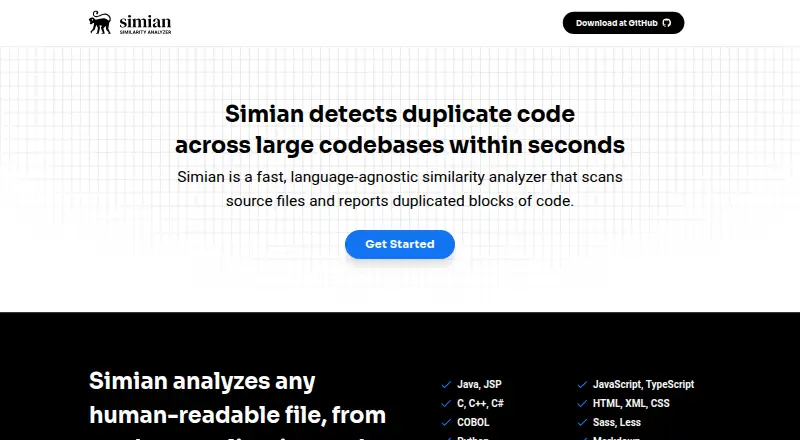
Simian Similarity Analyzer scans files in a repository to find duplicated blocks of code and other repeated text.
What Simian Similarity Analyzer is
Simian Similarity Analyzer scans files in a repository to find duplicated blocks of code and other repeated text. It handles human-readable file types including source code, markup, stylesheets, Markdown, and plain text, with listed language support spanning Java, C, C++, Python, JavaScript, TypeScript, HTML, CSS, and others. The tool runs on the Java Virtual Machine, and its generated JAR requires JDK 8 or newer. You can run it locally, from scripts, or in a build pipeline; its repository documents a Gradle integration example. Output is plain text by default, with XML, YAML, and editor-oriented formats also available. Settings include a duplicate-line threshold, file include and exclude patterns, language selection, and options to ignore differences such as identifiers, strings, or numbers. Simian is open source under the Apache Software License, Version 2.0, and can be self-hosted. The maker reports a JDK test that found more than 140,000 duplicate lines among over 2.4 million lines in under five seconds, while noting that results vary with hardware, operating system, and options.
Good
- Open source under Apache License 2.0.
- Supports many programming and text file types.
- Can run in build pipelines.
- Offers XML, YAML, and editor-friendly output.
- Configurable thresholds and file selection.
Watch out
- Requires JDK 8 or newer.
- No IDE integration is listed.
- Support is directed to Stack Overflow.
Who it suits
Simian suits developers who want repository-level duplicate-code checks that can run locally, from scripts, or in a build pipeline. It may also fit teams seeking configurable text-based clone detection without a paid license.
Verdict
Simian offers configurable duplicate detection across a broad range of human-readable files, with local and pipeline use. Its Java runtime requirement and lack of listed IDE integration are worth considering when choosing a workflow.
Plans and prices
From Simian Similarity Analyzer's own pricing page, checked 30 Sep 2026.
| Plan | Price | What it gives you |
|---|---|---|
| Simian Similarity Analyzer | Free | Open source · Apache License 2.0 |
The facts
Each one read from Simian Similarity Analyzer's own pages, with the date it was checked.
What it does
- Build integration
- The repository documents Gradle integration, including an example task that runs Simian against project source files.checked 30 Sep 2026
- Configuration
- Options include a configurable duplicate-line threshold, file include and exclude patterns, language selection, and controls for ignoring identifiers, strings, numbers, and other differences.checked 30 Sep 2026
- Contributions
- The maker welcomes feedback and contributions on GitHub.checked 30 Sep 2026
- File types
- The maker says Simian analyzes human-readable files, including source code, markup, stylesheets, Markdown, and plain text.checked 30 Sep 2026
- License
- Simian Similarity Analyzer is licensed under the Apache Software License, Version 2.0.checked 30 Sep 2026
- Output formats
- Results are plain text by default, with XML, YAML, and editor-friendly formats also supported.checked 30 Sep 2026
- Performance
- The maker reports a JDK test analyzing over 2.4 million lines and finding more than 140,000 duplicate lines in under five seconds, with results varying by hardware, operating system, and options.checked 30 Sep 2026
- Purpose
- Simian scans source files and reports duplicated blocks of code across codebases.checked 30 Sep 2026
- Runtime
- Simian runs on the Java Virtual Machine and the repository says its generated JAR runs on JDK 8 or newer.checked 30 Sep 2026
- Support
- The maker directs users to Stack Overflow for help with Simian.checked 30 Sep 2026
- Supported languages
- Listed languages include Java, C, C++, C#, COBOL, Python, Ruby, PHP, JavaScript, TypeScript, HTML, XML, CSS, Sass, Less, Visual Basic, and Groovy.checked 30 Sep 2026
- Usage
- The maker says it can be run locally, from scripts, or as part of a build pipeline.checked 30 Sep 2026
The company
- Founded
- 2003checked 28 Sep 2026
- Headquarters
- Los Angeles, California, United Stateschecked 28 Sep 2026
- Maker
- Quandary Peak Research is described on its about page as a Los Angeles-based consulting group.checked 30 Sep 2026
The full review of Simian Similarity Analyzer
Simian Similarity Analyzer finds repeated text blocks across repositories, making it a practical choice for developers who want configurable clone checks in local workflows or build pipelines. Its broad file coverage and scriptable use are appealing, though the Java runtime and lack of IDE integration narrow its fit.
Overview
Simian scans repositories for duplicated blocks in source code and other human-readable files. That includes markup, stylesheets, Markdown, and plain text, which helps teams find repetition that crosses the usual boundaries of a code-only scan. Its detection method is text-based, so it is best understood as a way to identify repeated content, not as a general-purpose code analyzer.
The tool runs on the Java Virtual Machine, and its generated JAR runs on JDK 8 or newer. Developers can invoke it locally, from scripts, or in a build pipeline; the repository also documents a Gradle task for scanning project source files. This flexibility suits teams that want to add clone checks to existing automation, but the JVM requirement is an extra dependency for workflows that do not already use Java.
Key features
Tunable duplicate detection
Users can set a minimum duplicate-line threshold, include or exclude files by pattern, select languages, and tell Simian to ignore identifiers, strings, numbers, or other differences. These controls help teams decide whether to focus on close textual matches or surface broader repetition. The trade-off is that scan quality depends on tuning options to the repository; a threshold or ignore rule that is too broad or too narrow can change which matches matter.
File coverage and output
Named language support spans Java, C, C++, C#, COBOL, Python, Ruby, PHP, JavaScript, TypeScript, HTML, XML, CSS, Sass, Less, Visual Basic, and Groovy. Results default to plain text, with XML, YAML, and editor-friendly formats also available. The range of formats gives pipeline users ways to consume or route output, while the default remains straightforward for a local review.
Performance and integration
The maker reports that a JDK test processed more than 2.4 million lines and found over 140,000 duplicate lines in under five seconds, with results dependent on hardware, operating system, and options. That is an encouraging scale signal, not a guarantee for every repository. Documented Gradle integration and CI support make Simian a sensible candidate for repeatable checks; teams looking for IDE integration should choose another workflow or tool.
Pricing
Simian Similarity Analyzer costs nothing. It is open source under the Apache License 2.0, with a free plan and a self-hosted option. There are no paid tiers to weigh against reduced capabilities; in return, users take on the setup of the Java runtime and their own scan configuration. The maker directs users to Stack Overflow for help and welcomes feedback and contributions on GitHub.
Platforms
Simian is available for Linux, macOS, and Windows. Its JVM-based JAR and JDK 8-or-newer requirement provide a consistent runtime basis across those desktop and server environments, while the documented build-pipeline use fits teams running scans as part of CI.
Who it's for
Simian is best suited to developers and teams that want repository-wide, configurable duplicate detection across code and other readable files, especially when they can run checks locally or automate them in a build pipeline. It is a weaker fit for users who need IDE integration, or for teams seeking analysis beyond text-based clone detection.
Pros and cons
- Pros: Scans source code, markup, stylesheets, Markdown, and plain text, giving mixed repositories a wider scope than source-only checks.
- Pros: Threshold, file-pattern, language, and ignore controls let teams tune which repetitions count.
- Pros: Local, scripted, Gradle, and CI use support both individual scans and repeatable pipeline checks.
- Cons: Requires a Java runtime, with the generated JAR requiring JDK 8 or newer.
- Cons: No IDE integration, so it does not suit teams that need clone findings embedded in an editor workflow.
- Cons: Text-based detection and configurable rules mean it is not a substitute for broader code analysis, and useful output depends on appropriate tuning.
Alternatives
Code Clone Detection Tools is the category directory for comparing tools in this area.
- Duplo is another free option for Linux, macOS, and Windows, distributed under GNU GPL v2 or later.
- PMD is a free static code analyzer for Linux, macOS, self-hosted environments, and Windows; choose it when static analysis is the priority rather than Simian's text-based clone detection.
- CloneWorks is free for Linux, macOS, and Windows, but its terms require acknowledgement and free redistribution and derivatives.
- dcd is a free AGPL-3.0 option for Linux and macOS; a priority-support plan is also offered, billed a years worth, with direct email support from the developer.
- jscpd is a free alternative with Linux, macOS, self-hosted, Windows, and API platforms.
- NiCad is free and open source under the MIT license, runs on Linux, macOS, self-hosted environments, and Windows, and requires OpenTxl 11 or later.
- CopyPaste is a free and open-source option for macOS and Windows with no premium tiers, subscriptions, or paywalls.
- Algo VPN is a free, self-hosted VPN setup tool rather than a code-clone detector, so it serves a different need.
Verdict
Choose Simian if you want free, configurable text-based clone detection across a repository and value local or pipeline use, including documented Gradle integration. Its broad file scope is the main reason to choose it; look elsewhere if Java-runtime setup or the absence of IDE integration conflicts with your workflow.