CCFinderSW
CCFinderSW is a free, open-source code clone detector for Windows that identifies and outputs similar code pairs using token-based matching.
What CCFinderSW is
CCFinderSW is a free, open-source code clone detector for Windows that identifies and outputs similar code pairs using token-based matching. It excludes pairs that contain inserted or deleted sentences. The command-line workflow takes a source directory, language, and output file; the minimum clone-token threshold defaults to 50 and can be changed with the -t argument. Users configure language handling with optional modifiable files, but execution requires a comment rule file for the target language. A reserved-word list is optional but recommended: without one, CCFinderSW detects type 1 clones, and with one it detects type 1 and type 2 clones. Its Java implementation recommends Java 8 or later. Output can be written in CCFinder, CCFinderX, CCFinderSW text, or JSON formats, and clone pair output can be read by Gemini or CCFX. The command line supports Shift-JIS, UTF-8, EUC-JP, and automatic encoding recognition. The project offers a CCFinderSW-1.0.zip download. It is MIT-licensed, with bundled libraries distributed under Apache License 2.0; PrettyPrinter and MetricsFiltering arguments are marked not implemented.
Good
- Free, open-source software with an MIT license.
- Outputs clone data in four formats, including JSON.
- Supports several encodings and automatic recognition.
- Threshold defaults to 50 and can be changed.
Watch out
- Requires Java 8 or later.
- A comment rule file is required for the target language.
- Lexer is not optimized for individual languages.
- PrettyPrinter and MetricsFiltering are not implemented.
Who it suits
CCFinderSW may suit Windows users who need command-line clone detection and can provide language configuration files. It is aimed at users comfortable with Java and text-based output.
Verdict
CCFinderSW offers configurable token-based clone detection and several output formats at no cost. Its required language rule file and Java command-line setup are important considerations.
Plans and prices
From CCFinderSW's own pricing page, checked 9 Oct 2026.
| Plan | Price | What it gives you |
|---|---|---|
| CCFinderSW | Free | MIT-licensed software · Java Runtime Environment 8 or later |
The facts
Each one read from CCFinderSW's own pages, with the date it was checked.
What it does
- Affiliation
- The README lists the author's affiliation as the Graduate School of Information Science and Technology, Osaka University, Osaka, Japan.checked 4 Oct 2026
- Author
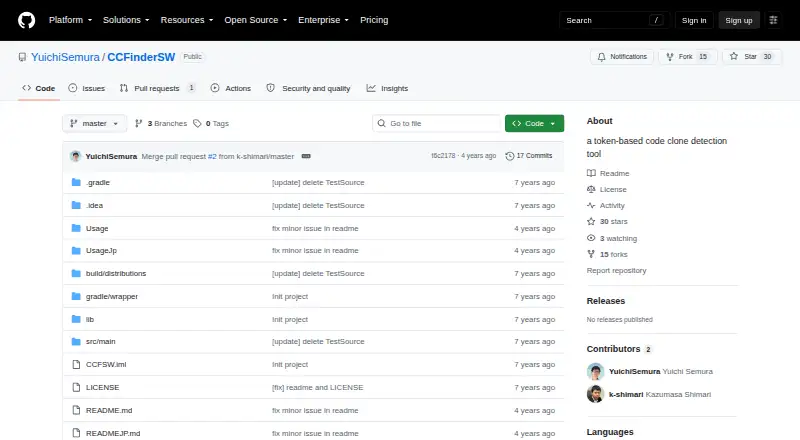
- The repository identifies Yuichi Semura as the author.checked 4 Oct 2026
- Bundled libraries
- The README says the software contains libraries distributed under Apache License 2.0.checked 4 Oct 2026
- Clone matching
- The README says it excludes clone pairs containing inserted or deleted sentences.checked 9 Oct 2026
- Clone types
- Without a reserved-word list, the tool detects type 1 clones; with one, it detects type 1 and type 2 clones.checked 9 Oct 2026
- Command line
- The usage guide shows running the tool from the command line with a source directory, language, and output file arguments.checked 4 Oct 2026
- Detection behavior
- It excludes clone pairs that contain inserted or deleted sentences.checked 4 Oct 2026
- Detection threshold
- The minimum clone token threshold defaults to 50 and can be changed with the -t argument.checked 9 Oct 2026
- Download
- The repository provides a CCFinderSW-1.0.zip download.checked 4 Oct 2026
- Encoding
- The command line supports Shift-JIS, UTF-8, EUC-JP, and automatic encoding recognition.checked 9 Oct 2026
- Execution
- The tool runs from the command line and recommends Java 8 or later.checked 9 Oct 2026
- Language configuration
- Language-specific lexical analysis is configured through optional files that users can modify.checked 9 Oct 2026
- Language handling
- It tailors lexical analysis to each language using optional files that users can modify.checked 4 Oct 2026
- Language limitation
- It does not use separate lexical analysis mechanisms for each language, and its lexer algorithm is not optimized for each language.checked 4 Oct 2026
- Language setup requirement
- Execution requires a comment rule file for the target language; a reserved-word list is optional but recommended.checked 9 Oct 2026
- License
- The repository license file includes the MIT License for CCFinderSW and a BSD 3-clause license for ANTLR components.checked 9 Oct 2026
- Output details
- CCFinderSW output can represent clone information as pairs or sets in a text file.checked 9 Oct 2026
- Output formats
- It can output clone data in CCFinder, CCFinderX, CCFinderSW text, or JSON formats.checked 9 Oct 2026
- Purpose
- CCFinderSW is a token-based code clone detection tool that detects similar code fragments and outputs clone pairs.checked 9 Oct 2026
- Runtime
- The project recommends Java 8 or later and says the program is implemented only in Java.checked 4 Oct 2026
- Support and limitations
- The documentation provides troubleshooting instructions, while its PrettyPrinter and MetricsFiltering command-line arguments are marked not implemented.checked 9 Oct 2026
- Viewer compatibility
- Clone pair output can be read by Gemini or CCFX.checked 9 Oct 2026
The company
- Founded
- 2017checked 28 Sep 2026
Where it runs
- Test platform
- The README lists Windows 10 Pro as its test environment.checked 4 Oct 2026