NiCad
NiCad is a near-miss source code clone detector for finding similar code fragments across a repository.
What NiCad is
NiCad is a near-miss source code clone detector for finding similar code fragments across a repository. It can analyze code at file, function, or block level, and its included language plugins cover C, C#, Java, Python, PHP, Ruby, WSDL, and ATL. Additional language plugins are possible when a TXL grammar is available. Configuration files let users adjust renaming, filtering, abstraction, and normalization before comparison. Output includes clone pairs and clone classes in XML-like formats, with optional browsable HTML reports. The default threshold for near-miss differences is 0.30; setting it to 0.00 means exact clones. NiCadCross can identify fragments in one system that also appear as clones in another. The software is free and uses an MIT-style license with stated conditions for use, modification, distribution, sublicensing, and sale. It runs on Linux, macOS, and Windows, either from its directory for personal use or through a system-wide installation script. NiCad 7.0 requires OpenTxl 11 or later, while building comparison tools requires Turing+ 6.2 or later.
Good
- Analyzes files, functions, or blocks
- Includes plugins for eight listed languages
- Allows customization before comparison
- Offers optional browsable HTML reports
- Free under an MIT-style license
Watch out
- Requires OpenTxl 11 or later
- Building comparison tools requires Turing+ 6.2 or later
- Other language plugins need a TXL grammar
Who it suits
NiCad suits developers and teams looking for code clones within repositories, including near-miss similarities. It is a fit for users who can meet its OpenTxl dependency and, when building comparison tools, Turing+ requirement.
Verdict
NiCad offers configurable clone detection across several analysis levels and languages. Check its dependencies and language-plugin requirements before adopting it.
Plans and prices
From NiCad's own pricing page, checked 4 Oct 2026.
| Plan | Price | What it gives you |
|---|---|---|
| Free and open source | Free | MIT-licensed software · requires OpenTxl 11 or later |
The facts
Each one read from NiCad's own pages, with the date it was checked.
What it does
- Analysis granularity
- It analyzes source code at file, function, or block granularity.checked 4 Oct 2026
- Cross-system detection
- NiCadCross reports fragments from one system that appear as clones in a second system.checked 4 Oct 2026
- Customization
- Configuration files support customized renaming, filtering, abstraction, and normalization before comparison.checked 4 Oct 2026
- Dependencies
- NiCad 7.0 requires OpenTxl 11 or later; building its comparison tools requires Turing+ 6.2 or later.checked 4 Oct 2026
- Detection threshold
- The default near-miss difference threshold is 0.30, and 0.00 means exact clones.checked 4 Oct 2026
- Extensibility
- Plugins for other languages can be added when a TXL grammar is available.checked 4 Oct 2026
- Install and use
- It can be run from its directory for personal use or installed system-wide with the provided installation script.checked 4 Oct 2026
- Languages
- Included language plugins cover C, C#, Java, Python, PHP, Ruby, WSDL, and ATL.checked 4 Oct 2026
- License
- The project uses an MIT-style license permitting use, modification, distribution, sublicensing, and sale subject to its stated conditions.checked 4 Oct 2026
- Purpose
- NiCad is a near-miss source code clone detection system.checked 4 Oct 2026
- Release
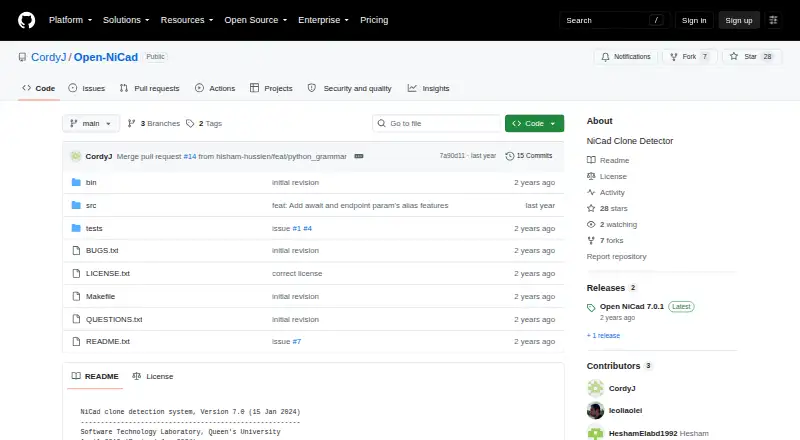
- The latest listed release is Open NiCad 7.0.1, described as the first open-source release of the clone detector.checked 4 Oct 2026
- Reports
- Results include clone pairs and clone classes in XML-like formats, with optional browsable HTML reports.checked 4 Oct 2026
- Support
- The repository's Issues page currently shows no open issues and says issue creation is restricted.checked 4 Oct 2026
The company
- Headquarters
- Kingston, Canadachecked 28 Sep 2026
Where it runs
- Platforms
- The README says NiCad should compile and run on Linux and macOS, and in Cygwin or MSYS2 (MinGW) on Windows.checked 4 Oct 2026