simDRIFT
The facts below are what the maker publishes about simDRIFT, checked and dated. Our editors have not written about it yet.
The facts
Each one read from simDRIFT's own pages, with the date it was checked.
What it does
- 3D visuals
- Yeschecked 24 Sep 2026
- Authoring tools
- Yeschecked 24 Sep 2026
- Availability
- The project README describes simDRIFT as open-source software.checked 11 Oct 2026
- Cell limits
- The reference recommends keeping total cell volume fraction at or below 0.40 because higher densities make sphere packing difficult and increase runtime.checked 11 Oct 2026
- Colab
- The quickstart provides GPU-enabled Google Colab installation steps for running an example simulation.checked 11 Oct 2026
- Colab workflow
- The quickstart describes a Google Colab GPU workflow for installing simDRIFT and running a basic simulation.checked 11 Oct 2026
- Configurable fibers
- Fiber bundles support user-defined radii, intrinsic diffusivities, orientations, and densities; the reference recommends no more than three or four bundles.checked 11 Oct 2026
- Data export
- Yeschecked 24 Sep 2026
- Delivery mode
- desktopchecked 24 Sep 2026
- Diffusion schemes
- The reference lists built-in DBSI, ABCD, and NODDI diffusion schemes, and allows user-supplied b-value and gradient-direction files.checked 11 Oct 2026
- GPU requirement
- simDRIFT requires a CUDA device with compute capability 3 or higher and is compatible with Python 3.8 or later.checked 11 Oct 2026
- Implementation
- The GitHub project says simDRIFT is written in Python and uses Numba's CUDA API to simulate spin trajectories in parallel on GPU threads.checked 11 Oct 2026
- Installation
- The guide recommends a dedicated conda environment and installs the package from its GitHub source repository using pip.checked 11 Oct 2026
- Intended users
- The documentation identifies diffusion MRI researchers as the intended users and says the software may also be useful for signal-processing or diffusion-imaging instructors.checked 11 Oct 2026
- License
- The GitHub repository identifies the project license as BSD-3-Clause.checked 11 Oct 2026
- Modeling limitation
- The simulation documentation says its cell random-walk implementation assumes zero exchange between compartments and is physically accurate only when diffusion time is less than the stated exchange time.checked 11 Oct 2026
- Model limits
- The reference recommends no more than three or four fiber bundles and says cell fractions above 0.40 can substantially increase runtime.checked 11 Oct 2026
- Outputs
- Simulation results can include spin trajectories, NIfTI signal files, an execution log, and a copy of the input configuration.checked 11 Oct 2026
- Project status
- The documentation says the project is under active development.checked 11 Oct 2026
- Purpose
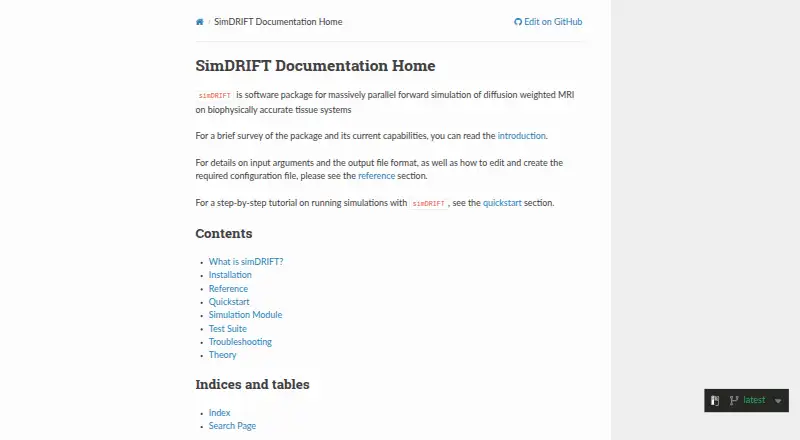
- simDRIFT runs massively parallel Monte Carlo forward simulations of diffusion-weighted MRI experiments in biophysical tissue systems.checked 11 Oct 2026
- Requirements
- The installation guide specifies Python 3.8 or later and a CUDA device with compute capability 3 or higher.checked 11 Oct 2026
The company
- Founded
- 2023checked 19 Oct 2026
Money
- Free plan
- Yeschecked 24 Sep 2026
- Mesh-free simulation
- The package describes its Monte Carlo simulations as mesh-free, avoiding the need to create meshes for tissue geometries.checked 11 Oct 2026
Alternatives to simDRIFT
- 1

SimFlow
Free planWebLinuxmacOSWindows8.2From €8,000 a year - 2

COMSOL Multiphysics
WebAPILinuxmacOS7.7 - 3
FeenoX
Free planWebAPILinuxSelf-hosted7.5Free plan - 4
myPhysicsLab
Free planWebLinuxmacOSSelf-hosted7.5Free plan - 5

OpenFOAM
Free planLinuxmacOSSelf-hostedWindows7.3Free plan - 6
MPTRAC
Free planWebLinuxSelf-hosted7.2Free plan