
OpenFOAM
OpenFOAM is a free, open-source computational fluid dynamics toolbox for simulating fluid flow, heat transfer, and related physical processes.
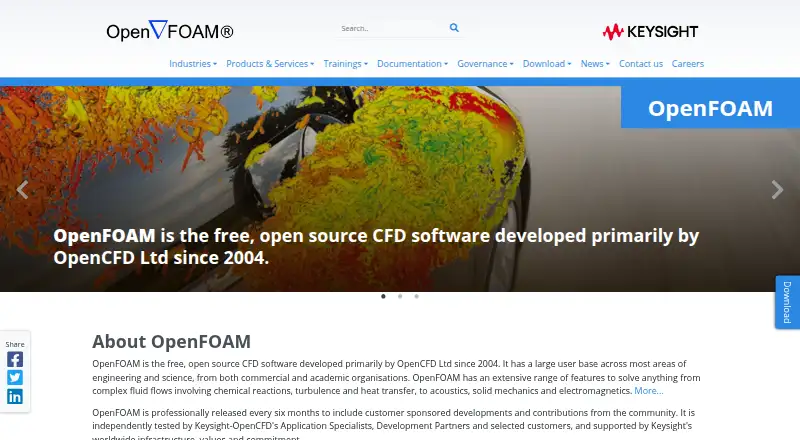
What OpenFOAM is
OpenFOAM is a free, open-source computational fluid dynamics toolbox for simulating fluid flow, heat transfer, and related physical processes. It brings together pre-processing, mesh generation, solvers for different flow and physics problems, and post-processing tools. Its mesh utilities include blockMesh and snappyHexMesh, and it can convert meshes from several external formats.
For visualization, OpenFOAM works with ParaView through the paraFoam launcher, reader modules, VTK conversion, and VTK output during simulations. The software is distributed under the GNU General Public Licence and runs on Linux, macOS, and Windows, with self-hosted use also supported. Its current release is v2606, released on 26 June 2026; that release adds GPU offloading as a compile-time option, while the GPU work remains on a separate development track.
OpenCFD offers a one-year support package for installation, bug fixes, updates, CFD assistance, and code customisation, with a maximum number of service hours per year. Support and code customisation are separate services from the free software. OpenCFD also offers Foundation, Advanced, application-focused, and virtual training courses.
Good
- Free and open source under the GNU General Public Licence.
- Includes pre-processing, mesh generation, solvers, and post-processing.
- Built-in mesh utilities include blockMesh and snappyHexMesh.
- Supports ParaView through several integration routes.
- Available for Linux, macOS, Windows, and self-hosted use.
- GPU offloading is available as a compile-time option in v2606.
Watch out
- Support and code customisation are separate services.
- Support packages limit service hours per year.
- OpenCFD does not respond to support queries without a prior support package.
Who it suits
OpenFOAM suits science and engineering companies, consultancies, and universities working on fluid flow, heat transfer, or related simulations. It is also a fit for users who want an open-source CFD toolbox with mesh tools and ParaView visualization support.
Verdict
Choose OpenFOAM if you need a free, open-source toolbox for CFD simulations and want its mesh and ParaView tools. Look to OpenCFD’s paid support or training services if you need assistance, code customisation, or instruction; support requires a prior package and has an annual service-hours limit.
Plans and prices
From OpenFOAM's own pricing page, checked 11 Oct 2026.
| Plan | Price | What it gives you |
|---|---|---|
| OpenFOAM | Free | Free and open source under GPL; support and code customisation are separate services with hours limited per year |
The facts
Each one read from OpenFOAM's own pages, with the date it was checked.
What it does
- 3D visuals
- Yeschecked 21 Sep 2026
- Current release
- The current release is OpenFOAM v2606, released on 26 June 2026.checked 11 Oct 2026
- Data export
- Yeschecked 21 Sep 2026
- Delivery mode
- desktopchecked 21 Sep 2026
- Features
- OpenFOAM includes pre-processing, mesh generation, solvers for multiple flow and physics types, and post-processing tools.checked 11 Oct 2026
- GPU support
- The v2606 release introduces GPU offloading as a compile-time option, while its GPU work remains on a separate development track.checked 11 Oct 2026
- Intended users
- OpenCFD describes its services for science and engineering companies, consultancies, and universities.checked 11 Oct 2026
- License
- OpenFOAM is distributed under the GNU General Public Licence (GPL).checked 11 Oct 2026
- Mesh tools
- Built-in mesh tools include blockMesh and snappyHexMesh, and the software can convert meshes from several external formats.checked 11 Oct 2026
- Privacy
- OpenCFD says personal data is kept on its or a supplier’s server with precautions against fraudulent access and is not stored longer than necessary.checked 11 Oct 2026
- Purpose
- OpenFOAM is an open-source computational fluid dynamics toolbox for simulating fluid flow, heat transfer, and related physical processes.checked 11 Oct 2026
- Security
- OpenFOAM documentation states that user-supplied system calls are disabled unless allowSystemOperations is enabled, and warns that system calls carry potential security risk.checked 11 Oct 2026
- Support
- OpenCFD offers a one-year support package covering installation, bug fixes, updates, CFD assistance, and code customisation, with a maximum number of service hours per year.checked 11 Oct 2026
- Support limit
- OpenCFD says it does not respond to support queries without a prior support package.checked 11 Oct 2026
- Training
- OpenCFD offers Foundation and Advanced training courses, application-focused courses, and virtual training; course pricing is provided through its schedule or enquiry process.checked 11 Oct 2026
- Visualization integration
- OpenFOAM supports ParaView through its paraFoam launcher, reader modules, VTK conversion, and VTK output during simulations.checked 11 Oct 2026
The company
- Founded
- 2004checked 28 Sep 2026
- Headquarters
- Bracknell, Berkshire, UKchecked 28 Sep 2026
Money
- Free plan
- Yeschecked 21 Sep 2026
Where it runs
- Platforms
- The v2606 release provides Linux packages and source code; Windows users can use WSL, native cross-compiled executables, or Docker, and macOS users can compile from source or use Docker.checked 11 Oct 2026
The full review of OpenFOAM
OpenFOAM is a desktop computational fluid dynamics toolbox for simulating flow, heat transfer and related physical processes. It is best suited to science and engineering users who want to shape their own simulation workflow. Its broad toolset is free under the GPL, but help from OpenCFD is a separate, limited-hours service.
Overview
OpenFOAM covers the main stages of CFD work: preparing meshes, running solvers across multiple flow and physics types, and post-processing results. That breadth makes it a strong fit for teams whose work spans different simulation problems; it is less suited to readers looking for a narrowly packaged application with support included.
The software is distributed under the GNU General Public Licence (GPL). The current release is v2606, released on 26 June 2026. It introduces GPU offloading as a compile-time option, but GPU development remains on a separate track, so users should not treat it as a settled, general-purpose GPU workflow.
Key features
Mesh preparation and simulation
Built-in mesh tools include blockMesh and snappyHexMesh, and OpenFOAM can convert meshes from several external formats. Together with its range of solvers, these tools let users handle mesh preparation and simulation within one toolbox. That flexibility is valuable for varied CFD work, but it puts the emphasis on users choosing and configuring the right tools for each case.
Visualisation and output
OpenFOAM integrates with ParaView through the paraFoam launcher and reader modules, and can also convert results to VTK or write VTK output during simulations. This gives users several routes into 3D visualisation and data export without making ParaView the only part of the workflow.
Security and privacy
User-supplied system calls are disabled unless allowSystemOperations is enabled. OpenFOAM’s documentation warns that enabling system calls carries security risk, so teams should weigh that setting carefully. OpenCFD says personal data is kept on its or a supplier’s server with precautions against fraudulent access and is not retained longer than necessary.
Pricing
OpenFOAM — free. The GPL software is free and open source, with no free-trial period. This is the natural choice for individuals and organisations able to manage their own installation and CFD work; the free plan does not include support or code customisation.
OpenCFD sells a one-year support package covering installation, bug fixes, updates, CFD assistance and code customisation. The package has a maximum number of service hours per year, and OpenCFD does not respond to support queries without a prior package. Pricing is custom pricing. Training is also offered separately, including Foundation, Advanced, application-focused and virtual courses; pricing is provided through its schedule or enquiry process.
Platforms
OpenFOAM is desktop software for Linux, macOS and Windows, and is also available for self-hosted use. Its ParaView integration and data-export options suit users who need to inspect and share simulation results as part of a broader workflow.
Who it's for
OpenFOAM is aimed at science and engineering companies, consultancies and universities. Its combination of mesh tools, solvers and post-processing makes it particularly suitable for teams with varied CFD needs and the capacity to work with a configurable toolbox. If your priority is assistance, code customisation or instruction, budget for OpenCFD’s separate services and their hour or course terms.
Pros and cons
- Pros: Free GPL software provides mesh generation, solvers for multiple flow and physics types, and post-processing in one toolbox.
- Pros: ParaView integration, VTK conversion and VTK output support flexible visualisation and export workflows.
- Cons: Support and code customisation cost extra, require a prior package, and are bounded by annual service hours.
- Cons: GPU offloading is a compile-time option on a separate development track, which limits how much users should rely on it as a standard GPU path.
Alternatives
OpenSim is another free, open-source option, with Linux, macOS and Windows support; downloading it requires a SimTK account.
SimFlow may suit readers who want to consider a freemium alternative with a free trial, across Linux, macOS, Windows and web.
Xcos is a free option for Linux, macOS and Windows, distributed with Scilab.
ngspice is free and available for Linux, Windows and self-hosted use, but it is a circuit simulator with command-line or file-based input and no schematic entry.
Open Source Physics is a free alternative spanning Android, iOS, Linux, macOS, web and Windows.
FeenoX is a free GPLv3+ option for Linux, self-hosted and web use, but it has no graphical interface and its generic binaries omit MUMPS and MPI.
COMSOL Multiphysics is a paid alternative with a free trial and a perpetual commercial or academic licence priced by quotation.
GNU FisicaLab is free software for Linux and Windows.
Verdict
Choose OpenFOAM if you need a free, GPL CFD toolbox that brings mesh preparation, simulation and post-processing together, and you can manage the workflow yourself. Look elsewhere if your work depends on GPU capability as a settled standard path, or if you need included support: OpenCFD’s assistance and customisation require a paid package with an annual service-hours ceiling.
Getting started
- Visit the OpenFOAM website.
- Choose the free OpenFOAM plan under the GNU General Public Licence.
- Use the version for Linux, macOS, or Windows, or choose self-hosted use.
- For support, arrange an OpenCFD support package before sending support queries.
- For training, consult OpenCFD’s course schedule or enquiry process.
Limits worth knowing
The free OpenFOAM plan does not include support or code customisation; these are separate services. The one-year support package has a maximum number of service hours per year.
Questions
Is OpenFOAM free?
Yes. The OpenFOAM plan is free and is open source under the GNU General Public Licence.
Which operating systems does OpenFOAM support?
It is available for Linux, macOS, and Windows, and supports self-hosted use.
Is OpenFOAM open source?
Yes. It is distributed under the GNU General Public Licence.
What does OpenFOAM do?
It is a computational fluid dynamics toolbox for simulating fluid flow, heat transfer, and related physical processes.
Does OpenFOAM support ParaView?
Yes. It supports ParaView through the paraFoam launcher, reader modules, VTK conversion, and VTK output during simulations.
Is support included with the free software?
Support and code customisation are separate services. OpenCFD offers a one-year support package with a maximum number of service hours per year.
Alternatives to OpenFOAM
- 1

SimFlow
Free planWebLinuxmacOSWindows8.2From €8,000 a year - 2

COMSOL Multiphysics
WebAPILinuxmacOS7.7 - 3
FeenoX
Free planWebAPILinuxSelf-hosted7.5Free plan - 4
myPhysicsLab
Free planWebLinuxmacOSSelf-hosted7.5Free plan - 5
MPTRAC
Free planWebLinuxSelf-hosted7.2Free plan - 6
FEST-3D
Free planLinuxmacOS7.2Free plan