
Sensu Go
Sensu Go is a commercial monitoring and observability solution for enterprises, designed for DevOps and SRE teams overseeing infrastructure from Kubernetes t…
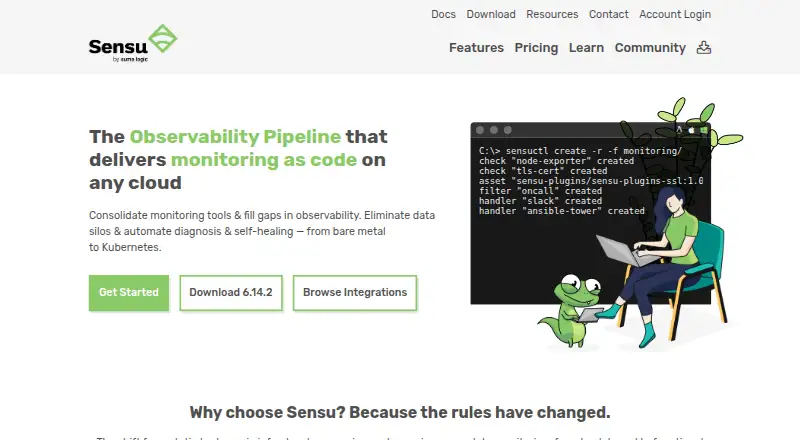
What Sensu Go is
Sensu Go is a commercial monitoring and observability solution for enterprises, designed for DevOps and SRE teams overseeing infrastructure from Kubernetes to bare metal. It collects, filters, and transforms monitoring events, then sends them to a database chosen by the customer. Teams can manage monitoring configuration declaratively and track system and service health, metrics, and logs, including through custom scripts and Nagios-style plugins. Agents discover and register virtual machines, cloud compute instances, containers, and services. Sensu can send alerts by email, Slack, or SMS, create or resolve incidents in PagerDuty, ServiceNow, and JIRA, and deduplicate alerts. It also supports remediation actions and security options including LDAP, Active Directory, OIDC SSO, and mTLS. Sensu Go is self-hosted and free for up to 100 nodes, with one site. A free 14-day trial is available for evaluating Sensu beyond 100 nodes. The backend is unsupported on Windows and macOS, though agent and CLI packages are offered for both.
Good
- Free plan covers up to 100 nodes.
- Agents discover VMs, cloud instances, and containers.
- Alerts can reach email, Slack, and SMS.
- Supports remediation actions and incident workflows.
- Offers a free 14-day trial beyond 100 nodes.
Watch out
- Self-hosted deployment model.
- Backend is unsupported on Windows and macOS.
- Pro has a 100-node minimum.
Who it suits
Sensu Go suits DevOps and SRE teams managing monitoring across cloud, container, and bare-metal environments. It may fit teams that want declarative configuration, alerting, and remediation in a self-hosted system.
Verdict
Sensu Go combines monitoring, event processing, alerting, and remediation for self-hosted infrastructure. Its free tier covers up to 100 nodes; evaluating beyond that is possible with a 14-day trial, while Pro starts at $3 per node per month paid annually.
Plans and prices
From Sensu Go's own pricing page, checked 3 Oct 2026.
| Plan | Price | What it gives you |
|---|---|---|
| Sensu Go FREE | Free | 100 nodes · 1 site · no trial required |
| Sensu Go Pro | $36 a year | 100-node minimum · 3,000 nodes · 1 site · 6-hours support response · $36.00 per node per year (= $3.00 per node/month, billed annually) |
| Sensu Go Enterprise | $60 a year | 300-node minimum · unlimited nodes up to amount purchased · unlimited sites · 3-hours support response · $60.00 per node per year (= $5.00 per node/month, billed annually) |
The facts
Each one read from Sensu Go's own pages, with the date it was checked.
What it does
- Alerting
- Sensu can send alerts through email, Slack, and SMS, create or resolve incidents in PagerDuty, ServiceNow, and JIRA, and deduplicate alerts.checked 3 Oct 2026
- Discovery
- Sensu agents automatically discover and register VMs, public cloud compute instances, containers, and their services.checked 3 Oct 2026
- Health and telemetry
- Sensu supports system and service health checks, custom scripts including Nagios-style plugins, basic system metrics, custom application metrics, and log collection.checked 3 Oct 2026
- Integrations
- Sensu names Elasticsearch, Splunk, PagerDuty, ServiceNow, Ansible Tower, Prometheus, and Nagios among its integrations and compatible tools.checked 3 Oct 2026
- Monitoring as code
- Sensu supports declarative monitoring configuration that teams can edit, review, version, and share.checked 3 Oct 2026
- Observability pipeline
- Sensu collects, filters, and transforms monitoring events and sends them to a database of the customer's choosing.checked 3 Oct 2026
- Pricing limit
- Sensu Go is free up to 100 nodes, and the pricing page describes a free 14-day trial for evaluating Sensu beyond 100 nodes.checked 3 Oct 2026
- Purpose
- Sensu Go is a commercial monitoring and observability solution for enterprises, designed to help DevOps and SRE teams automate monitoring workflows and see infrastructure from Kubernetes to bare metal.checked 3 Oct 2026
- Remediation
- Sensu supports self-healing actions such as restarting services, running custom scripts, and requesting Ansible jobs through Ansible Tower.checked 3 Oct 2026
- Scale
- Sensu says a single cluster can monitor tens of thousands of nodes and federation provides visibility across globally distributed infrastructure.checked 3 Oct 2026
- Security
- Sensu lists LDAP, Active Directory, and OIDC SSO, mTLS certificate authentication, external PKI verification, and CRL support.checked 3 Oct 2026
Where it runs
- Cloud platforms
- Sensu says it runs on AWS, GCP, Azure, Kubernetes, Red Hat OpenShift, Docker, and OpenStack.checked 3 Oct 2026
- Download platforms
- The download page offers Windows agent and CLI packages, macOS CLI and agent packages, and Linux backend, CLI, and agent packages; it states that the backend is unsupported on Windows and macOS.checked 3 Oct 2026
The company
- Company history
- Sensu Go OSS was released in 2017 by Sensu Inc., which was acquired by Sumo Logic in June 2021.checked 3 Oct 2026
- Founded
- 2017checked 28 Sep 2026
The full review of Sensu Go
Sensu Go is a self-hosted monitoring and observability platform for DevOps and SRE teams overseeing infrastructure from cloud instances and containers to bare metal. It is best for organizations that want to automate how monitoring data is handled and how incidents are acted on; its free tier is useful for smaller estates, but paid node minimums raise the cost of scaling up.
Overview
Sensu collects monitoring events, filters and transforms them, and forwards them to a database the customer chooses. That destination flexibility suits teams with an established data stack, while also leaving them responsible for operating the self-hosted system and its chosen database.
Monitoring configuration is declarative and can be edited, reviewed, versioned, and shared. This makes Sensu a stronger fit for teams that manage infrastructure changes through code review than for those seeking a monitoring service with little operational overhead. Agents discover and register virtual machines, public-cloud compute instances, containers, and their services, helping monitoring follow changing environments.
Sensu says one cluster can monitor tens of thousands of nodes, with federation for visibility across globally distributed infrastructure. That capacity is relevant to large or distributed estates, not a persuasive reason for a small team to take on a self-hosted platform.
Key features
Checks, telemetry, and event processing
Sensu supports system and service health checks, custom scripts including Nagios-style plugins, basic system metrics, custom application metrics, and log collection. Teams can combine familiar checks with application-specific telemetry, then filter and transform events before sending them to their chosen database. That breadth is useful when infrastructure and application monitoring need to share a workflow; teams wanting a narrowly focused service monitor may not need it.
Alerts and remediation
Alerts can go to email, Slack, or SMS, and Sensu can create or resolve incidents in PagerDuty, ServiceNow, and JIRA. Alert deduplication helps prevent repeated notifications from obscuring an issue. For response, teams can restart services, run custom scripts, or request Ansible jobs through Ansible Tower. These options make Sensu more compelling for teams prepared to define automated responses, while the need to configure those actions is part of its operational burden.
Security and integrations
Sensu supports LDAP, Active Directory, and OIDC single sign-on, mTLS certificate authentication, external PKI verification, and CRL support. Named integrations and compatible tools include Elasticsearch, Splunk, PagerDuty, ServiceNow, Ansible Tower, Prometheus, and Nagios. This combination suits organizations connecting monitoring to existing identity, data, and incident workflows.
Pricing
Sensu Go is freemium. The free plan costs nothing and covers 100 nodes at one site, with no trial required. That is a meaningful way to run a small deployment without a subscription, but the one-site cap excludes multi-site use on the free tier. A free 14-day trial is offered for evaluating Sensu beyond 100 nodes.
Sensu Go Pro costs $36.00 per node per year, equivalent to $3.00 per node/month, billed annually. It requires a 100-node minimum, covers up to 3,000 nodes at one site, and includes a six-hour support response. The minimum makes Pro a substantial commitment for teams just over the free limit, though it offers a clear path for a growing single-site deployment.
Sensu Go Enterprise costs $60.00 per node per year, equivalent to $5.00 per node/month, billed annually. It has a 300-node minimum, allows unlimited sites, and supports unlimited nodes up to the amount purchased, with a three-hour support response. It is aimed at larger or distributed organizations that need multi-site coverage and faster support; smaller deployments would pay for capacity they may not use. Both paid plans are billed annually.
Platforms
Sensu Go is self-hosted and lists API, Linux, macOS, web, and Windows platforms. Downloads include Windows agent and CLI packages, macOS CLI and agent packages, and Linux backend, CLI, and agent packages; the backend is unsupported on Windows and macOS. Sensu says it runs on AWS, GCP, Azure, Kubernetes, Red Hat OpenShift, Docker, and OpenStack. This range supports mixed environments, but Windows and macOS hosts cannot run the backend.
Who it's for
Sensu Go is a strong candidate for DevOps and SRE teams that want monitoring-as-code, flexible event routing, automatic discovery, and the option to automate remediation across varied infrastructure. Its self-hosted deployment and configurable workflows reward teams able to operate and maintain monitoring infrastructure. It is a weaker fit for users seeking a simple hosted service, or for small teams whose needs do not justify Pro's 100-node minimum once they exceed the free tier.
Pros and cons
- Pros: Declarative configuration can be reviewed and versioned, making monitoring changes part of a controlled workflow.
- Pros: Discovery, alerting, and remediation cover multiple stages of monitoring response, including scripted actions and Ansible Tower jobs.
- Pros: The free tier supports up to 100 nodes at one site, giving small deployments a usable entry point.
- Cons: Self-hosting means teams must operate the platform rather than rely on a hosted monitoring service.
- Cons: Pro's 100-node minimum and Enterprise's 300-node minimum can make paid adoption costly for smaller environments.
- Cons: The free plan is limited to one site, while multi-site coverage requires Enterprise.
Alternatives
Choose Netdata if its free Community plan's cap of five active connected nodes and one active custom dashboard per room fits a smaller monitoring setup. Consider openITCOCKPIT if you want its free Community Edition for infrastructure and application monitoring. Checkmk is another option for a free Community plan with 2,000+ pre-built integrations and coverage for up to about 100 hosts. Pick Checkmate if a free self-hosted plan with no monitor limits and 12 alert channels suits your needs. Icinga offers a forever-free edition with unlimited hosts and services. Consider Mackerel if its free plan's limits of five standard and micro hosts combined, 500 metrics, one-day retention, 10 monitoring rules, and one custom dashboard match your scale. MetricsHub is an open-source project built around OpenTelemetry. Choose Nagios XI if a free plan capped at seven nodes or 100 services, whichever comes first, is sufficient.
For more options, browse Infrastructure Monitoring or Container Monitoring.
Verdict
Sensu Go is best for infrastructure teams that want to control the monitoring pipeline and connect detection to automated response, especially across large or distributed self-hosted environments. Its free 100-node tier makes evaluation practical, but the annual paid minimums and operational demands are reasons to look elsewhere if you need a hosted, low-maintenance option or have only a modest deployment.
Alternatives to Sensu Go
- 1

Checkmk
Free planOpen sourceAndroidiOSWebAPI8.8From $275 a month - 2
Netdata
Free planOpen sourceAndroidiOSWebAPI8.7From $4.50 a month - 3

Nagios XI
Free planWebAPILinuxmacOS8.1$2,595 one-time - 4

MetricsHub
Free planOpen sourceWebAPILinuxSelf-hosted7.9From $15 a month - 5

openITCOCKPIT
Free planiOSWebAPILinux7.5From €1 a year - 6

Icinga
Free planWebAPILinuxSelf-hosted7.3From $2,000 a year