
Semaphore
Semaphore is an AI-native CI/CD platform for building, testing, releasing, and deploying code.
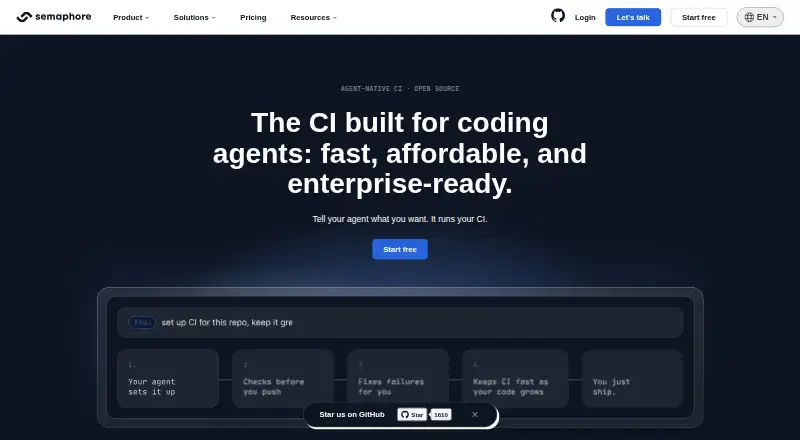
What Semaphore is
Semaphore is an AI-native CI/CD platform for building, testing, releasing, and deploying code. Workflows group pipelines that automate development tasks, and its visual Workflow Builder models pipelines, generates YAML configuration, and provides visual performance feedback. Teams can connect GitHub, GitLab, and Bitbucket repositories, then run hosted jobs or self-host agents on Linux, macOS, or Windows. Self-hosted agents can autoscale with Kubernetes or AWS. Semaphore is open source under the Apache 2.0 license and can be self-hosted. The pricing page includes 20 concurrent jobs by default, with higher limits available on request. Artifact use is free up to 20 GB of monthly egress and 100 GB of monthly storage; extra usage is charged separately. Free support covers account setup, projects, and Git integration, while advanced CI troubleshooting is offered through paid support plans. Semaphore says it has SOC 2 Type 2 and ISO 27001:2022 certifications and encrypts data in transit and at rest. Its listed customers range from SMBs and fast-growing startups to Fortune 500 companies.
Good
- Supports GitHub, GitLab, and Bitbucket
- Offers hosted and self-hosted runners
- Self-hosted agents support Linux, macOS, and Windows
- Open source under Apache 2.0
- Includes 20 concurrent jobs by default
Watch out
- Artifact use beyond listed limits costs extra
- Higher concurrency limits require a request
- Advanced CI troubleshooting requires paid support
Who it suits
Semaphore suits teams that need CI/CD workflows connected to GitHub, GitLab, or Bitbucket, including teams choosing hosted jobs or self-hosted agents. It lists SMBs, startups, and Fortune 500 companies among its customers.
Verdict
Semaphore combines pipeline automation with hosted and self-hosted execution, plus a visual workflow builder. Teams should account for artifact limits and the paid support options if they need advanced CI troubleshooting.
Plans and prices
From Semaphore's own pricing page, checked 21 Sep 2026.
| Plan | Price | What it gives you |
|---|---|---|
| Free usage credits | Free | $15 monthly credits |
| Self-Hosted | Free | Any machine · $0.0025/min |
| Ubuntu ARM 2vCPU | Free | 2 vCPU · $0.003/min |
| Ubuntu ARM 4vCPU | $0.01 a month | 4 vCPU · $0.006/min |
| Ubuntu ARM 8vCPU | $0.01 a month | 8 vCPU · $0.012/min |
| Ubuntu x64 2vCPU | $0.01 a month | 2 vCPU · $0.0075/min |
| Ubuntu x64 4vCPU | $0.02 a month | 4 vCPU · $0.015/min |
| MacOS 4vCPU | $0.09 a month | 4 vCPU · $0.09/min |
| Basic Support | $50 a month | Email support during business hours · No guaranteed response times · $50/month |
| Priority Response Support | $250 a month | Email + Slack · Best-effort accelerated responses 24/5 · $250/month |
| SLA Standard Support | $500 a month | Email + Slack + Customer Portal · 24/5 · P1 4h, P2 1 day, P3 3 days, P4 1 week · $500/month |
The facts
Each one read from Semaphore's own pages, with the date it was checked.
What it does
- Additional integrations
- The feature comparison lists Slack notifications, webhook notifications, SAML/SCIM, Okta, OpenID Connect, and GitHub SSO integrations, with some edition restrictions.checked 7 Oct 2026
- Agent scaling
- Self-hosted agents can run on Linux, macOS, or Windows and can autoscale with Kubernetes or AWS.checked 7 Oct 2026
- Artifacts limit
- Artifact usage is free up to 20 GB per month of egress and 100 GB per month of storage, with additional usage charged separately.checked 7 Oct 2026
- Build isolation
- Builds run in isolated sandbox virtual machines that are destroyed after each use.checked 7 Oct 2026
- Concurrency limit
- The pricing page includes 20 concurrent jobs by default and says higher limits are available on request.checked 7 Oct 2026
- Encryption
- Semaphore says data is encrypted in transit with 256-bit encryption and at rest with AES-256.checked 7 Oct 2026
- Intended customers
- Semaphore says it serves SMBs, fast-growing startups, and Fortune 500 companies.checked 7 Oct 2026
- Open source
- The company says Semaphore is open source under the Apache 2.0 license and can be self-hosted.checked 7 Oct 2026
- Product
- Semaphore is an AI-native CI/CD platform for building, testing, releasing, and deploying code.checked 7 Oct 2026
- Security certifications
- Semaphore says it has SOC 2 Type 2 and ISO 27001:2022 certifications, with reports or proof available on request.checked 7 Oct 2026
- Source control integrations
- Semaphore supports GitHub, GitLab, and Bitbucket repositories.checked 7 Oct 2026
- Support
- Free support includes help with account setup, projects, and Git integration; advanced CI troubleshooting is offered through paid support plans.checked 7 Oct 2026
- Workflow builder
- Its visual Workflow Builder models pipelines, generates YAML configuration, and provides visual performance feedback.checked 7 Oct 2026
- Workflows
- A workflow consists of one or more pipelines that automate development tasks such as build, release, and deployment.checked 7 Oct 2026
The company
- Company location
- Semaphore Technologies doo lists its registered seat in Novi Sad, Republic of Serbia.checked 7 Oct 2026
- Founded
- 2011checked 28 Sep 2026
- Headquarters
- Novi Sad, Serbiachecked 28 Sep 2026
The full review of Semaphore
Semaphore is a continuous integration and delivery platform for teams automating software builds, tests, releases, and deployments. It suits organizations that want to mix hosted and self-managed build capacity. Its strongest case is execution flexibility; artifact allowances and the cost of advanced support deserve attention before committing.
Overview
Workflows combine one or more pipelines to automate development tasks. Semaphore’s visual builder models pipelines, generates YAML, and provides visual performance feedback, so teams can start with a graphical workflow and retain a configuration-based approach. It supports GitHub, GitLab, and Bitbucket repositories, plus pull request checks.
Teams can use hosted runners or self-hosted agents on Linux, macOS, and Windows. Self-hosted agents can autoscale with Kubernetes or AWS, which is useful when build capacity needs to follow workload demand or run on a team’s own infrastructure. The company describes Semaphore as open source under Apache 2.0 and self-hostable.
Key features
Pipeline configuration and capacity
Visual and YAML configuration, artifact and dependency caching, and 20 concurrent jobs by default give teams several ways to shape and scale their CI workflows. Higher concurrency limits are available on request. The combination is a good fit for teams that want to manage pipeline design without giving up control over where jobs run.
Security and integrations
Builds run in isolated sandbox virtual machines that are destroyed after use. Semaphore says data is encrypted in transit with 256-bit encryption and at rest with AES-256, and it holds SOC 2 Type 2 and ISO 27001:2022 certifications. Integrations include Slack and webhook notifications, SAML/SCIM, Okta, OpenID Connect, and GitHub SSO, though some are edition-restricted.
Artifact limits and support
Artifact use is free up to 20 GB of monthly egress and 100 GB of monthly storage; additional usage is charged separately. That allowance may be sufficient for modest pipelines, but teams producing or retaining large build outputs should account for overages. Free support covers account setup, projects, and Git integration; advanced CI troubleshooting requires a paid support plan.
Pricing
Semaphore has a free plan and no free trial. Free usage credits are free and include $15 in monthly credits. The Self-Hosted plan is free, billed $0.0025/min for any machine. Hosted Ubuntu ARM runners cost nothing at $0.003/min for 2 vCPU, and $0.01 a month at $0.006/min for 4 vCPU or $0.012/min for 8 vCPU. Ubuntu x64 costs $0.01 a month at $0.0075/min for 2 vCPU, or $0.02 a month at $0.015/min for 4 vCPU. macOS 4vCPU is $0.09 a month, pay only for what you use.
These runner prices are usage-based, so the monthly price figures do not remove the need to budget for build minutes. The free credits suit teams evaluating or running limited workloads; teams with sustained usage should estimate consumption alongside the artifact allowance and separately charged overages.
Support is priced separately: Basic Support is $50 a month for business-hours email support with no guaranteed response times. Priority Response Support is $250 a month for email and Slack, with best-effort accelerated responses 24/5. SLA Standard Support is $500 a month and adds a customer portal and defined 24/5 response targets: P1 in 4 hours, P2 in 1 day, P3 in 3 days, and P4 in 1 week. These plans make sense for teams that need more than setup help, but the higher tiers add a notable recurring cost.
Platforms
Semaphore supports API, Linux, macOS, self-hosted, web, and Windows platforms. Its self-hosted agents run on Linux, macOS, or Windows, while hosted runner options include Ubuntu and macOS.
Who it's for
Semaphore is suited to development teams that want visual pipeline modeling with YAML output, established code-host integrations, and a choice of hosted or self-managed agents. Its autoscaling support can help teams running variable workloads, while its security credentials may matter to organizations with formal compliance needs. It is less compelling for teams with little need for advanced CI troubleshooting or whose artifact use would regularly exceed the included monthly allowances.
Pros and cons
- Pros: Visual pipeline design generates YAML and includes performance feedback, serving both graphical and configuration-led workflows.
- Pros: Hosted runners and self-hosted agents across Linux, macOS, and Windows give teams flexibility over execution environments.
- Pros: Autoscaling with Kubernetes or AWS and 20 default concurrent jobs support teams managing changing build demand.
- Cons: Artifact egress and storage have monthly free caps, with additional usage charged separately.
- Cons: Free support is limited to setup, projects, and Git integration; advanced troubleshooting requires paid support.
Alternatives
GitHub Codespaces is a freemium option with a free plan and 2-core compute at $0.18 a month, billed monthly, or 4-core compute at $0.36 a month. Consider it when its compute plans better match the development environment you need.
Codemagic is a freemium choice with a free plan that includes one team member, 500 build minutes refilled monthly, one parallel build, and 30 days of build history and artifact storage. It may suit a small team whose needs fit those caps.
GameCI is free and open source; its CI provider build minutes may cost extra. Choose it when a free, open-source game-development CI option is the priority.
Bitrise offers a free Hobby plan for a team of one, with build credits for a small project a few times per month and community support. It may fit an individual with occasional build needs.
GoCD is a free, downloadable open-source continuous delivery server; consider it if that model suits your delivery setup.
Travis CI has a free plan with 10,000 credits, unlimited unique users, private and open-source repositories, and Windows, Linux, and macOS support. It is an option for teams whose needs align with that allocation.
AppVeyor offers a free Open-source plan with unlimited public projects, one concurrent job, five self-hosted jobs, and community support. It may suit public-project workflows within those limits.
Argo Workflows is a free, open-source workflow engine for Kubernetes.
For category comparisons, see Game Build Automation Software, Continuous Integration Software, and Mobile CI/CD Software.
Verdict
Semaphore is a strong choice for teams that want flexible CI/CD execution, visual pipeline design, and the option to scale self-hosted agents. Choose it when those controls and its security posture matter enough to justify monitoring artifact consumption and, if needed, paying for advanced support. Look elsewhere if fixed artifact allowances or paid troubleshooting make its operating costs a poor fit.
Alternatives to Semaphore
- 1

Codemagic
Free planAndroidiOSWebAPI8.2From $99 a month - 2

TeamCity
Free planAndroidWebAPILinux8.2From $15 a month - 3

Azure Test Plans
Free planWebAPIExtensionLinux8.1From $6 a month - 4
Bitbucket Pipelines
Free planWebAPILinuxmacOS8.0From $3.65 a month - 5

AppVeyor
Free planWebAPILinuxmacOS7.9From $29 a month - 6

AWS CodeBuild
Free planWebAPILinuxmacOS7.9From $0.01 a month