SedonaDB
SedonaDB is a free, open-source, single-node analytical database engine built around geospatial data.
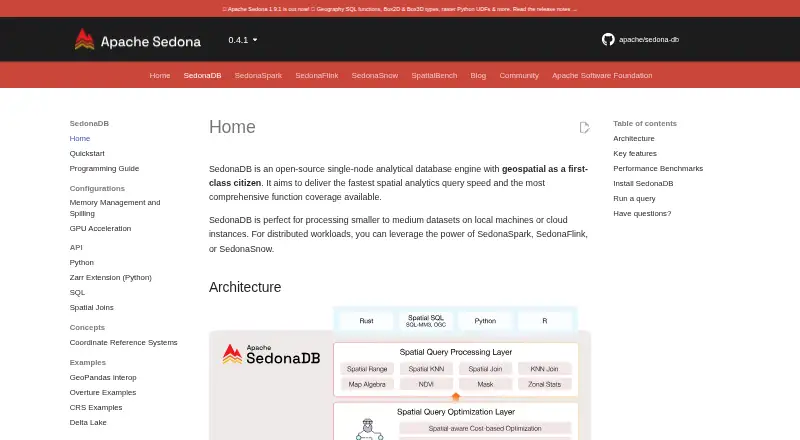
What SedonaDB is
SedonaDB is a free, open-source, single-node analytical database engine built around geospatial data. It is intended for smaller and medium datasets on a local machine or cloud instance; the project points to SedonaSpark, SedonaFlink, or SedonaSnow for distributed workloads. Its architecture uses columnar in-memory datasets, spatial indexing, coordinate-reference-system tracking, and Arrow format. Python and SQL interfaces are available, with an R package and SQL query function documented in the quickstart. Supported query types include spatial range, nearest-neighbor (KNN), spatial join, and KNN join. It interoperates with PyArrow-compatible tools such as GeoPandas, DuckDB, and Polars, and handles formats including GeoParquet, Shapefile, and GeoJSON. Documentation also demonstrates AWS S3 data and Iceberg tables through PyIceberg and Arrow. Memory-limited execution with automatic spill-to-disk is supported, but the default imposes no memory limit and does not spill. GPU-accelerated joins require a compatible build, NVIDIA CUDA 12 or later, and a qualifying NVIDIA GPU. The project is an Apache Sedona subproject under the Apache Software Foundation and uses the Apache-2.0 license.
Good
- Free and open source
- Supports spatial range and join queries
- Python and SQL interfaces
- Interoperates with GeoPandas, DuckDB, and Polars
- Supports memory-limited execution with disk spill
Watch out
- Single-node engine
- Default execution has no memory limit or disk spill
- GPU joins require compatible NVIDIA hardware and CUDA
Who it suits
SedonaDB suits developers and analysts working with geospatial data in local or single-node environments, especially through Python or SQL. Distributed workloads may call for the related SedonaSpark, SedonaFlink, or SedonaSnow projects.
Verdict
SedonaDB brings geospatial queries and common data-tool interoperability to a free, single-node engine. Check its workload and memory limits against your needs, particularly if you need distributed execution or GPU joins.
Plans and prices
From SedonaDB's own pricing page, checked 2 Oct 2026.
| Plan | Price | What it gives you |
|---|---|---|
| Apache SedonaDB | Free | Open-source single-node engine · no paid tiers stated |
The facts
Each one read from SedonaDB's own pages, with the date it was checked.
What it does
- Architecture
- Its architecture uses columnar in-memory datasets, spatial indexing, CRS tracking, and Arrow format.checked 2 Oct 2026
- File formats
- The feature list names GeoParquet, Shapefile, and GeoJSON; the repository README says vector support includes GeoParquet, WKT, WKB, and formats supported by GeoPandas.checked 2 Oct 2026
- Governance and license
- The repository describes SedonaDB as a subproject of Apache Sedona governed by the Apache Software Foundation and identifies its license as Apache-2.0.checked 2 Oct 2026
- GPU support
- GPU-accelerated spatial joins require a SedonaDB build with GPU support, NVIDIA CUDA 12 or later, and an NVIDIA GPU with compute capability 7.5 or higher.checked 2 Oct 2026
- Integrations
- The project describes interoperability with PyArrow-compatible libraries including GeoPandas, DuckDB, and Polars.checked 2 Oct 2026
- Intended workloads
- The project describes SedonaDB as suited to smaller and medium datasets on local machines or cloud instances, and points to SedonaSpark, SedonaFlink, or SedonaSnow for distributed workloads.checked 2 Oct 2026
- Interfaces
- SedonaDB offers Python and SQL interfaces, and its quickstart also documents an R package and SQL query function.checked 2 Oct 2026
- Memory limits
- Memory-limited execution with automatic spill-to-disk is supported, but the documented default enforces no memory limit and does not spill to disk.checked 2 Oct 2026
- Raster support
- The repository README says raster support is coming soon; release notes for 0.4.1 list GDAL-backed raster functions and raster-vector spatial joins.checked 2 Oct 2026
- Security
- The repository page links to a Security policy, but the opened page does not state specific security certifications or compliance claims.checked 2 Oct 2026
- Spatial queries
- Documented query types include spatial range, KNN, spatial join, and KNN join queries.checked 2 Oct 2026
- Storage integration
- The documentation demonstrates reading data from AWS S3 and working with Iceberg tables through PyIceberg and Arrow.checked 2 Oct 2026
- Support
- The project directs users to GitHub Discussions and its Discord community to ask developers questions.checked 2 Oct 2026
- What it does
- SedonaDB is an open-source single-node analytical database engine with geospatial data as a first-class citizen.checked 2 Oct 2026
The company
- Founded
- 2025checked 28 Sep 2026
Alternatives to SedonaDB
- 1
CrateDB
Free planOpen sourceWebAPILinuxmacOS8.4Free plan - 2
SingleStore Helios
Free planWebAPILinuxmacOS8.1Free plan - 3

ClickHouse Cloud
Open sourceWebAPILinuxmacOS7.9From $25.30 a month - 4

MySQL
Free planAPILinuxmacOSSelf-hosted7.9Free plan - 5
Virtuoso Universal Server
Open sourceWebAPILinuxmacOS7.9From $99.99 a year - 6

Apache Solr
Free planOpen sourceWebAPILinuxmacOS7.7Free plan