
Apache Solr
Apache Solr is a free, open-source search platform built on Apache Lucene, with full-text, vector, and geospatial search.
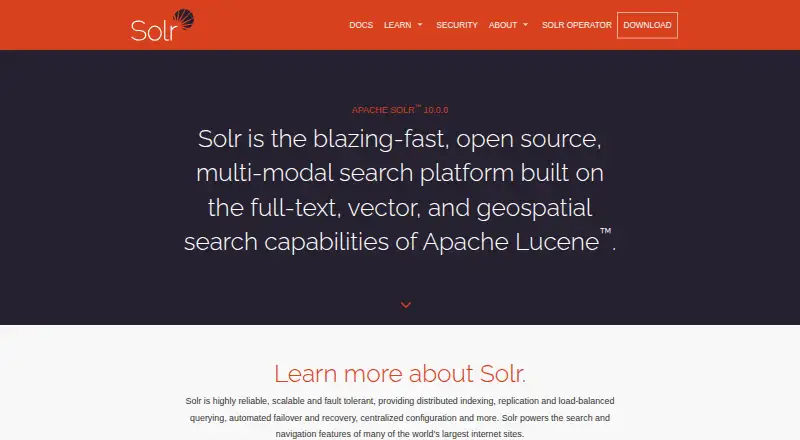
What Apache Solr is
Apache Solr is a free, open-source search platform built on Apache Lucene, with full-text, vector, and geospatial search. It accepts documents over HTTP in JSON, XML, CSV, or binary formats and returns results in those formats through a REST query interface. Search options include phrase matching, wildcards, joins, and grouping, while discovery tools include faceting, autocomplete, spelling suggestions, hit highlighting, and result clustering. Solr can distribute indexing, replicate data, balance queries, and provide automated failover and recovery. It works with Apache Tika to extract and process content from files such as PDFs and Microsoft Word documents. Administrators can use its interface to control instances and inspect cluster state, logs, threads, and metrics. Listed security features include SSL, authentication, and role-based authorization. Solr is self-hosted and runs on Linux, macOS, and Windows. It is licensed under Apache License, Version 2.0, with free community support. Releases are not scheduled in advance, and versions below 9.10 are end of life and will receive no further updates.
Good
- Free and open-source under Apache License 2.0.
- Supports full-text, vector, and geospatial search.
- Includes faceting, autocomplete, and spelling suggestions.
- Provides distributed indexing and automated failover.
- Offers SSL, authentication, and role-based authorization.
Watch out
- Self-hosted deployment requires operating the platform.
- Releases are not scheduled in advance.
- Versions below 9.10 are end of life.
Who it suits
Solr may suit developers and organizations that need self-hosted full-text, vector, or geospatial search. Its project describes use ranging from weekend projects to global enterprises.
Verdict
Apache Solr offers a broad set of search and administration capabilities as self-hosted open-source software. Readers should account for unscheduled releases and the end-of-life status of versions below 9.10.
Plans and prices
From Apache Solr's own pricing page, checked 4 Oct 2026.
| Plan | Price | What it gives you |
|---|---|---|
| Apache Solr | Free | Open-source search platform · binary and source releases · Apache License, Version 2.0 |
| Apache Solr Free | Free | Source and binary releases · self-hosted deployment · no usage fee |
The facts
Each one read from Apache Solr's own pages, with the date it was checked.
What it does
- Administration
- A responsive web administration interface and JMX metrics are supplied.checked 15 Oct 2026
- Community support
- The Solr community provides free user support through its users mailing list and other listed channels.checked 4 Oct 2026
- Current release
- Solr 10.0.0 is listed as the current stable major release, with 9.10.x receiving limited critical fixes.checked 15 Oct 2026
- Data formats
- Documents can be indexed through HTTP as JSON, XML, CSV or binary, with results returned in those formats.checked 15 Oct 2026
- Deployment integrations
- Official documentation covers Docker deployment and the project website links Kubernetes integration resources.checked 15 Oct 2026
- Discovery features
- Solr supports faceting, autocomplete, spelling suggestions, hit highlighting, and search results clustering.checked 4 Oct 2026
- Discovery tools
- Autocomplete, spell suggestions, result clustering and configurable hit highlighting are included.checked 15 Oct 2026
- Distributed scale
- Solr provides distributed indexing, replication, load-balanced querying, automated failover, and recovery.checked 4 Oct 2026
- Documentation
- The official reference guide covers concepts, deployment, configuration, indexing, querying and upgrades, and is written by Solr committers.checked 15 Oct 2026
- Downloads and support limits
- Solr releases are not scheduled in advance; older versions below 9.10 are end of life and will not receive further updates.checked 4 Oct 2026
- Extensibility
- Plugins can extend indexing, analysis, request handling and query parsing, and the source can be modified.checked 15 Oct 2026
- Faceting
- Term, query, range, date and pivot faceting are built in for filtering and data exploration.checked 15 Oct 2026
- Full-text search
- It supports phrase, wildcard, join, grouping and other Lucene-powered matching methods.checked 15 Oct 2026
- Geospatial
- Solr supports location filtering, polygons, latitude/longitude queries and Java Topology Suite integration.checked 15 Oct 2026
- Indexing and queries
- Solr accepts documents as JSON, XML, CSV, or binary over HTTP and returns query results in those formats.checked 4 Oct 2026
- Intended users
- The project describes Solr as suitable for global enterprises and weekend projects, and says it powers heavily trafficked websites and applications.checked 4 Oct 2026
- License
- Solr is released under the permissive Apache License 2.0.checked 15 Oct 2026
- Limit: configuration and scaling
- Gartner reviewers cite complex configuration, imperfect schema management, scaling difficulties and dependence on ZooKeeper.checked 15 Oct 2026
- Limit: documentation
- G2 reviewers repeatedly request clearer documentation, more examples and better guidance for beginners.checked 15 Oct 2026
- Limit: learning curve
- Reviewers report that Solr is complex for newcomers and requires substantial technical skill during setup and operation.checked 15 Oct 2026
- Limit: real-time and UI gaps
- G2 reviews mention weaker real-time architecture, slow feature evolution and no built-in JavaScript data-grid component.checked 15 Oct 2026
The company
- Founded
- 2006checked 23 Sep 2026
- Maker funding model
- Crunchbase describes the foundation as a US nonprofit funded by individual donations and corporate sponsors.checked 15 Oct 2026
- Maker headquarters and size
- LinkedIn lists the Apache Software Foundation headquarters in Wilmington, Delaware, with 5,001–10,000 employees.checked 15 Oct 2026
The full review of Apache Solr
Apache Solr is an open-source search platform built on Apache Lucene, with full-text, vector and geospatial search. It suits teams that can run and administer self-hosted software and need configurable search across large or distributed collections. Its breadth is compelling, but release timing is unscheduled and versions below 9.10 are end of life.
Overview
Solr accepts JSON, XML, CSV and binary documents over HTTP, then returns query results in those formats through a REST interface. Its hybrid search approach combines full-text and vector capabilities, with geospatial search also supported. That range makes Solr a strong fit for applications that need more than basic keyword lookup, provided their operators are prepared to manage the deployment.
The Apache License, Version 2.0 permits use as open-source software. The project describes Solr as serving both weekend projects and global enterprises, including heavily trafficked websites and applications. That range speaks to its flexibility, not to a low-maintenance setup: Solr is self-hosted, and administration remains with the operator.
Key features
Full-text matching covers phrases, wildcards, joins and grouping, giving search teams ways to shape results around varied query needs. Faceting, autocomplete, spelling suggestions, hit highlighting and results clustering add discovery and presentation options without narrowing Solr to a single search pattern.
For scale, Solr supports distributed indexing, replication, load-balanced queries, automated failover and recovery. Those capabilities are useful when a single instance is not enough, though they also make operational responsibility central to the choice. Apache Tika integration extracts and processes rich content, including PDFs and Microsoft Word documents, which can bring document collections into the same search system.
The responsive administrative interface lets operators control instances and inspect cluster state, logs, threads and metrics. SSL, authentication and role-based authorization are built-in security capabilities.
Pricing
Apache Solr costs free. The free plan includes the open-source search platform, binary and source releases, and the Apache License, Version 2.0. There is no free trial because the software is free. The trade-off is self-management rather than a paid hosted tier: deployment and administration are the operator’s responsibility. The Solr community offers free user support through its users mailing list and other channels.
Releases are not scheduled in advance, so teams should plan around uncertain release timing. Versions below 9.10 are end of life and will not receive further updates; choosing an older version means giving up future fixes and updates.
Platforms
Solr is available for API use and runs on Linux, macOS and Windows. It is self-hosted, with REST as its query interface, so it fits teams that want control over their deployment rather than a managed service.
Who it's for
Solr is best for developers and operations teams that need flexible full-text, vector or geospatial search, and can take responsibility for hosting, security and version maintenance. Distributed indexing and failover support make it a credible option for demanding applications; smaller projects can also use it, but may find its administration heavier than their needs justify.
It is a poor fit for readers who want a hosted search service or predictable release dates. The free license removes a software charge, not the work of operating the platform.
Pros and cons
- Pros: Broad query and discovery features—including vector search, faceting, autocomplete and spelling suggestions—support varied search experiences.
- Pros: Distributed indexing, replication, load balancing, failover and recovery give operators tools for scaling and resilience.
- Pros: Free open-source licensing, multiple document formats and Tika content extraction make it adaptable across projects and collections.
- Cons: Self-hosting places deployment and ongoing administration on the user, which is a meaningful cost in staff time.
- Cons: Unscheduled releases complicate upgrade planning, and versions below 9.10 no longer receive updates.
Alternatives
Meilisearch is worth considering for teams seeking a self-hosted free option with no usage limits and a MIT license; it also offers a free trial. Algolia may suit readers who prefer a freemium service with Android, iOS and web platforms, but its free plan caps usage at 10K search requests and 50K records per month’s allowance.
Typesense is another freemium search alternative with self-hosted and web platforms and a free trial. Vespa is a paid alternative with a free trial and usage-based Startup rates for compute, memory, disk and GPU memory. Elasticsearch offers a freemium route and self-managed deployment, with license-based pricing based on node count and RAM use.
Qdrant is a freemium alternative whose free cloud tier has a single-node limit and specified compute, memory and disk allowances. Manticore Search is a free alternative for Linux, macOS and Windows. Pinecone is a freemium option with a Starter plan that sets index, namespace, storage and usage limits.
For broader comparisons, browse Search Databases or Spatial Databases.
Verdict
Choose Apache Solr if you need a capable, open-source search platform with full-text, vector and geospatial support, and have the team to operate it. Its distributed features and rich discovery toolkit are the main reasons to choose it. Look elsewhere if you need managed hosting, simpler operations or predictable release timing.
Alternatives to Apache Solr
- 1

Vespa
Open sourceWebAPILinuxmacOS8.4 - 2

Algolia
Free planAndroidiOSWebAPI8.2From $0.50 a month - 3
Searchanise
Free planWebAPI7.5From $19 a month - 4

Prefixbox Search Analytics
Free planAndroidiOSWebAPI7.4Free plan - 5
Site Search 360
Free planWebAPI7.4From $9 a month - 6

Meilisearch
Free planWebAPILinuxmacOS7.2From $20 a month