
Typesense
Typesense is an open-source search engine for adding search to a website or app.
What Typesense is
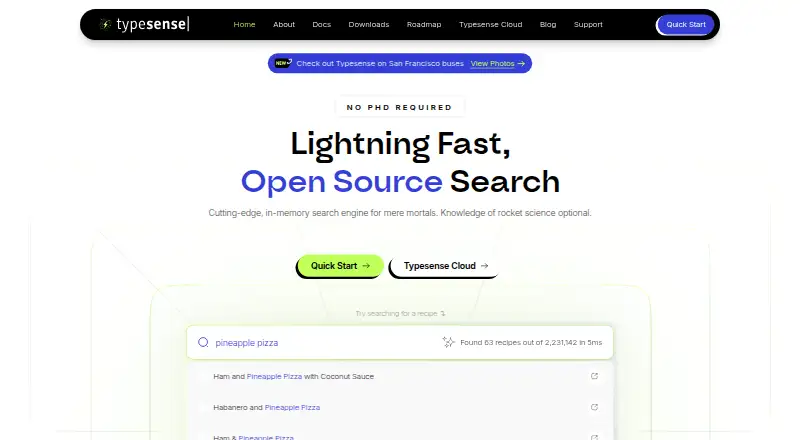
Typesense is an open-source search engine for adding search to a website or app. It does not crawl the web: users supply the data they want people to search. Its typo-tolerant, search-as-you-type experience is designed to respond in typically under 50 milliseconds. Search tools include tunable ranking, sorting, faceting, filtering, grouping, federated search, and geo search. Listed AI capabilities include vector and hybrid search, built-in RAG, natural-language search, image search, and voice search.
Typesense can run locally or on a server, or through the hosted Typesense Cloud service. Its REST API has listed integrations including Firebase, AWS Amplify, Laravel Scout, LangChain, LlamaIndex, InstantSearch, OpenAI, and Google ML platforms. Cloud charges for cluster runtime and bandwidth, and the hourly cluster fee continues while a cluster is running even without traffic. Its free Cloud tier is a one-time allowance for selected configurations, not a monthly renewal.
Good
- Open-source search engine with a free plan.
- Supports typo tolerance and search-as-you-type.
- Offers local, server, and hosted deployment.
- Includes vector search and faceted search.
Watch out
- Does not crawl the web; users supply data.
- Cloud charges for runtime and bandwidth.
- The free Cloud tier is one-time, not monthly.
- Cloud clusters incur runtime fees without traffic.
Who it suits
Typesense suits developers who want to add search to an app or website using data they provide. It offers local, self-hosted, and hosted deployment options, with search tools ranging from filters and facets to vector search.
Verdict
Typesense is a flexible search component for teams that manage their own search data and need conventional or AI-related search features. Account for ongoing Cloud runtime and bandwidth costs, and note that its free Cloud allowance does not renew monthly.
Plans and prices
From Typesense's own pricing page, checked 19 Sep 2026.
| Plan | Price | What it gives you |
|---|---|---|
| Self-hosted | Free | Open-source server · Run locally or on your own infrastructure |
| Typesense Cloud | $22 a month | Managed cloud clusters · Hourly usage billing · No per-search or per-record charges · Cluster costs starting $22/month; cloud usage is billed hourly |
| Free support | Free | GitHub Issues · Public Slack Community · Best-effort support ticket response · Free |
| Typesense Cloud cluster | $22 a month | Dedicated cluster · No limits on records or operations · One-time free tier for select configurations: first 720 hours and 10GB bandwidth · Starting $22/month; pay-as-you-go, billed for cluster runtime and bandwidth |
| Developer support | $160 a month | 72-hour support ticket response SLA · Consultative support · Email, GitHub Issues, Public Slack Community · $160.00 every 28 days |
| Business support | $400 a month | 48-hour support ticket response SLA · Phone/video meetings · SOC 2 report and HIPAA BAA available · $400.00 every 28 days |
| Enterprise support | $700 a month | 24-hour support ticket response SLA · Private Slack Connect · Custom security questionnaires · Prioritized feature requests · $700.00 every 28 days |
| Enterprise Signature support | $1,900 a month | 24-hour support ticket response SLA · Private Slack Connect · Custom contracts · SOC 2 report and HIPAA BAA available · $1,900.00 every 28 days |
The facts
Each one read from Typesense's own pages, with the date it was checked.
What it does
- AI search
- Its listed AI capabilities include vector and hybrid search, built-in RAG, natural-language search, image search, and voice search.checked 30 Sep 2026
- Compliance
- Typesense Cloud states it is SOC 2 Type 2 certified and HIPAA compliant, with a BAA available to eligible customers on a Business Support plan or above for at least a year.checked 30 Sep 2026
- Data source
- Typesense does not crawl the web; users push their own data into it for searching in their site or app.checked 30 Sep 2026
- Deployment
- Typesense can be run locally or on a server, and Typesense Cloud provides a hosted version.checked 30 Sep 2026
- Integrations
- Listed integrations include Firebase, AWS Amplify, Laravel Scout, LangChain, LlamaIndex, InstantSearch, OpenAI, and Google ML platforms.checked 30 Sep 2026
- Pricing limits
- The free Cloud tier is one-time only and provides 720 hours plus 10GB bandwidth for select configurations; it does not renew monthly.checked 30 Sep 2026
- Product
- Typesense is an open-source, typo-tolerant search engine for instant, typically sub-50ms, search-as-you-type experiences.checked 30 Sep 2026
- Search features
- It supports typo tolerance, tunable ranking, sorting, faceting, filtering, grouping, federated search, and geo search.checked 30 Sep 2026
- Security
- Typesense Cloud says clusters are isolated and dedicated, API traffic is encrypted over HTTPS, and data is protected with full-disk encryption at rest.checked 30 Sep 2026
- Support
- Typesense offers community support through GitHub Issues and public Slack, plus paid prioritized support with SLAs, consulting, and training for Cloud.checked 30 Sep 2026
Money
- Cloud billing
- Cloud billing has an hourly cluster fee and per-GB bandwidth costs, and the hourly fee continues while a cluster is running even when it receives no traffic.checked 30 Sep 2026
The company
- Founded
- 2015checked 28 Sep 2026
- Headquarters
- Houston, TXchecked 28 Sep 2026
- Maker
- Typesense, Inc. describes itself as a lean, customer-funded team of engineers focused on making search technology accessible.checked 30 Sep 2026
The full review of Typesense
Typesense is an open-source search engine for developers building search into sites and apps with data they control. It is best for teams that want a choice between self-hosting and a managed cluster, plus more than basic full-text search. Its flexibility is compelling, but Cloud runtime and bandwidth charges need ongoing attention.
Overview
Typesense is designed for typo-tolerant, search-as-you-type experiences that typically return results in under 50 milliseconds. It searches data you push into it rather than crawling the web, so it suits an application’s catalog or content—not anyone looking for a ready-made web search service. The REST query interface also makes it a developer-oriented component, rather than a standalone search app.
You can run it locally or on your own server, or use Typesense Cloud. The open-source engine gives teams operational control; Cloud removes the need to host the cluster themselves, while introducing metered operating costs. Typesense was founded in 2015 and is made by Typesense, Inc., a lean, customer-funded engineering team.
Key features
Alongside typo tolerance, Typesense supports tunable ranking, sorting, faceting, filtering, grouping, federated search, and geo search. That range gives product teams useful ways to shape discovery around their data and application. It is a stronger fit for tailored search experiences than for teams that want search to work without organizing or supplying their own content.
Its AI-related capabilities include vector and hybrid search, built-in RAG, natural-language search, image search, and voice search. These broaden the types of search an application can offer, though the product remains a component to integrate, not a finished search experience. Listed integrations include Firebase, AWS Amplify, Laravel Scout, LangChain, LlamaIndex, InstantSearch, OpenAI, and Google ML platforms.
Typesense Cloud says its clusters are isolated and dedicated, with HTTPS-encrypted API traffic and full-disk encryption at rest. It states that it is SOC 2 Type 2 certified and HIPAA compliant. A HIPAA BAA is available to eligible customers on a Business Support plan or above for at least a year. Support ranges from community help on GitHub Issues and public Slack to paid Cloud support with prioritized responses, consulting, and training.
Pricing
Typesense is freemium, but its pricing has two distinct parts: the Cloud cluster and optional support. Self-hosting avoids a Typesense Cloud cluster fee, while requiring teams to run their own infrastructure. The free support option costs nothing and provides GitHub Issues, the public Slack Community, and best-effort ticket responses.
Typesense Cloud cluster starts at $22/month, billed pay-as-you-go for cluster runtime and bandwidth. It includes a dedicated cluster with no limits on records or operations. The one-time free Cloud allowance covers 720 hours plus 10GB of bandwidth for select configurations; it does not renew monthly. Cloud also charges an hourly cluster fee and per-GB bandwidth costs, and the hourly fee continues while a cluster is running even without traffic. This model suits teams that can manage usage and shut down idle clusters, but is less predictable than a recurring flat rate.
Paid support is billed every 28 days, so the quoted monthly amounts are not calendar-month billing:
- Developer support — $160.00 every 28 days: a 72-hour ticket response SLA, consultative support, and access by email, GitHub Issues, and public Slack. A fit for teams that want expert guidance and a defined response window.
- Business support — $400.00 every 28 days: a 48-hour SLA, phone and video meetings, and access to a SOC 2 report and HIPAA BAA. It suits organizations that need stronger support and compliance documentation; eligible BAA access requires at least a year.
- Enterprise support — $700.00 every 28 days: a 24-hour SLA, private Slack Connect, custom security questionnaires, and prioritized feature requests. It is aimed at teams with more demanding support and security processes.
- Enterprise Signature support — $1,900.00 every 28 days: a 24-hour SLA, private Slack Connect, custom contracts, and access to a SOC 2 report and HIPAA BAA. This is the highest-support option for customers who need contractual flexibility.
Platforms
Typesense is available through an API and can be used on Linux, macOS, and Windows, as well as in web and self-hosted deployments. The combination of local, server, and Cloud deployment gives developers room to choose an operating model, but it does not change the need to integrate the engine into a site or app.
Who it's for
Typesense is a good choice for developers and product teams with a defined body of data to search, especially when they need typo tolerance, configurable result behavior, or vector and hybrid search. Self-hosting fits teams that want operational control; Cloud suits those who prefer a managed cluster and can keep runtime and bandwidth spending in view. It is not the right choice for someone who expects an engine to discover and index the public web automatically.
Pros and cons
- Broad search toolkit: Faceting, filtering, grouping, federated search, and geo search allow more tailored discovery than basic full-text search alone.
- Deployment choice: Local and self-hosted use preserve control, while Cloud offers a hosted route.
- One-time Cloud allowance: 720 hours and 10GB bandwidth can help evaluate select configurations, but the allowance does not replenish each month.
- Usage-based Cloud costs: Runtime fees continue while a cluster is idle, and bandwidth is charged separately, so cost control requires attention.
- Requires your data: Typesense does not crawl the web, which rules it out as a turnkey public-web search service.
Alternatives
For a broader directory of options, browse Search Databases.
Choose Chroma if you want an open-source database whose maker says the same codebase powers Chroma Cloud, or Qdrant if its free-forever cloud tier with a single-node cluster is a better starting point. Meilisearch is worth considering when a free, self-hosted option with no usage limits is the priority. Vespa is another paid search option with a trial.
Algolia may suit teams looking for a hosted freemium option with stated monthly search-request and record caps on its free plan. Manticore Search is a free alternative with a community plan. Datafari offers a free-forever community plan, while Apache Solr is a free, Apache-licensed open-source search platform.
Verdict
Choose Typesense if your team owns the data, wants a capable search component, and values the choice to self-host or use a dedicated Cloud cluster. Its combination of conventional and AI-related search features is the main reason to choose it. Look elsewhere if you need automatic web crawling or cannot accommodate Cloud runtime and bandwidth costs.
Alternatives to Typesense
- 1

Chroma
Free planOpen sourceAndroidiOSWebAPI8.6From $250 a month - 2

Vespa
Open sourceWebAPILinuxmacOS8.4 - 3

Algolia
Free planAndroidiOSWebAPI8.2From $0.50 a month - 4

Pinecone
Free planWebAPILinuxmacOS7.8From $20 a month - 5

Apache Solr
Free planOpen sourceWebAPILinuxmacOS7.7Free plan - 6

Meilisearch
Free planWebAPILinuxmacOS7.2From $20 a month