
SciNote
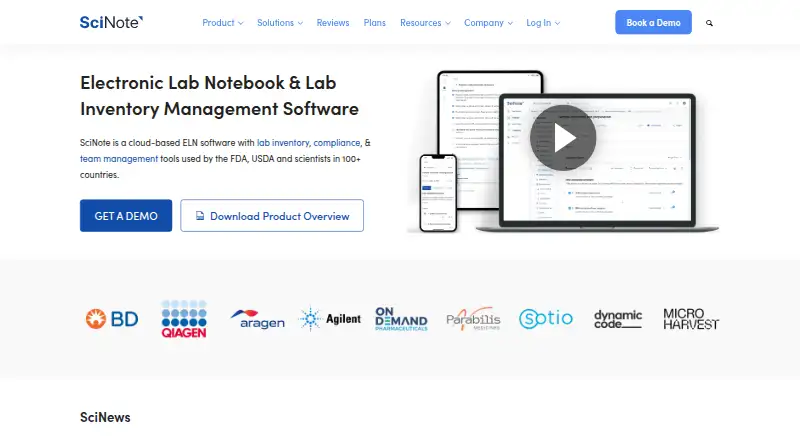
SciNote is a cloud-based electronic lab notebook with tools for inventory, compliance, and team management.
What SciNote is
SciNote is a cloud-based electronic lab notebook with tools for inventory, compliance, and team management. Users can arrange research into projects, experiments, and tasks, attaching notes, files, protocols, and results. Global research-data search and a project report generator help locate and summarize work. SciNote supports protocol and SOP management, including imports from protocols.io, and provides a RESTful API with integrations such as Ganymede, Quartzy, Gilson Connect, ChemAxon Marvin, Microsoft Office, and Zebra label printers. Its Android and iOS apps support viewing and completing protocol steps, commenting, uploading files, and posting results. For regulated labs, SciNote says it supports 21 CFR Part 11 workflows with electronic signatures, audit trails, timestamps, and user roles and permissions. Its Trust Center lists ISO/IEC 27001:2022, SOC 2 Type 1, and SOC 2 Type 2 materials. The Free Plan costs nothing and is limited to one user, without guaranteed support. A Premium trial lasts 14 days and carries no uptime guarantee. Local-server installation is available, but customers need internal staff for deployment, maintenance, and updates.
Good
- Organizes projects, experiments, tasks, and attached research files.
- Includes global research-data search and project reports.
- Mobile apps support protocol steps and result posting.
- Supports electronic signatures and audit trails.
- Offers a RESTful API and named integrations.
Watch out
- Free Plan is limited to one user.
- Support is not guaranteed for Free customers.
- Premium trial lasts 14 days without an uptime guarantee.
- Local installation requires customer staff for upkeep.
Who it suits
SciNote suits research teams that need to organize experiments, protocols, results, and lab inventory. Its local installation and compliance workflows may also suit labs with internal staff for deployment and maintenance.
Verdict
SciNote combines lab-notebook organization with inventory, protocol, reporting, and compliance tools. The free tier is limited to one user, and teams considering a local deployment need staff to manage it.
Plans and prices
From SciNote's own pricing page, checked 15 Oct 2026.
| Plan | Price | What it gives you |
|---|---|---|
| Free | Free | 1 user · 50MB maximum file size · uptime and support not guaranteed · No charge |
| Free Plan | Free | one user · dedicated workspace · no guaranteed support |
| Listed starting price | $0.01 a year | Pricing-directory listing; provider pricing requires confirmation · Per user / per year |
| Premium | Priced on request | Cloud, private-cloud or local installation · multiple teams · 1TB storage · optional 21 CFR Part 11 add-on · premium support · Contact sales |
| Premium plans | Priced on request | quote required · cloud or local installation · multiple teams · 1 TB storage · Premium support |
The facts
Each one read from SciNote's own pages, with the date it was checked.
What it does
- AI data handling
- SciNote says AI traffic is TLS encrypted, third-party providers are configured not to train on customer content, and AI features are optional.checked 15 Oct 2026
- API
- SciNote provides a REST API for bidirectional connections with LIMS, ERP, CRM, data-management and instrument systems.checked 15 Oct 2026
- API authentication
- The API documentation describes OAuth 2 authorization-code and refresh-token flows, JWT bearer tokens and optional API-key authentication.checked 15 Oct 2026
- API examples
- The API documentation links to a basic Python example and documents endpoint-level request and response behavior.checked 15 Oct 2026
- Collaboration
- Comments, tagging, notifications, assignments and shared projects support team collaboration.checked 15 Oct 2026
- Compliance features
- Electronic signatures, audit trails, timestamps, activity logs, access controls and locked records support 21 CFR Part 11 and GLP/GMP workflows.checked 15 Oct 2026
- Crunchbase profile
- Crunchbase describes SciNote as a private Middleton, Wisconsin biotechnology and life-science SaaS company with 11–50 employees.checked 15 Oct 2026
- Developer documentation
- Read the Docs hosts developer material covering setup, contributing, collaboration and contact information.checked 15 Oct 2026
- File limits
- Inventory text fields allow 10,000 characters; file columns allow 50MB for Free users and up to 350MB for Premium users.checked 15 Oct 2026
- Integrations
- Documented integrations include Microsoft Office Online, ChemAxon Marvin, protocols.io, Ganymede, Quartzy, Gilson Connect, FLUICS Print and Zebra printers.checked 15 Oct 2026
- Inventory
- Inventory tools track supplies, equipment, stock usage, locations and labels and link those records to experiments.checked 15 Oct 2026
- Limit: autosave and reliability
- Some reviewers report occasional saving failures or missing autosaved information.checked 15 Oct 2026
- Limit: chemistry support
- A reviewer says native chemical-structure functionality is missing and requires a separate licence or integration.checked 15 Oct 2026
- Limit: customization and bugs
- Software Advice reviewers mention limited customization of columns and occasional protocol-duplication bugs.checked 15 Oct 2026
- Limit: tables and navigation
- Reviewers report that table editing, formatting and navigation between tasks can be clunky or unintuitive.checked 15 Oct 2026
- Local deployment
- SciNote can be installed on a local server, but the customer needs internal staff to handle deployment, maintenance, and updates.checked 2 Oct 2026
- Mobile use
- The Android and iOS app supports viewing and completing protocol steps, commenting, uploading files, and posting results.checked 2 Oct 2026
The company
- Company founding and HQ
- LinkedIn lists the company as founded in 2015 and headquartered in Middleton, Wisconsin.checked 15 Oct 2026
- Company history
- SciNote says its journey began in 2015 and that it is owned by Gilson Inc.checked 2 Oct 2026
- Company size
- LinkedIn lists SciNote as a privately held software company with 11–50 employees.checked 15 Oct 2026
- Headquarters
- Middleton, Wisconsin, USAchecked 28 Sep 2026
Money
- Free tier limit
- The Free Plan includes one user, and SciNote does not guarantee support services for Free Customers.checked 2 Oct 2026
- Limit: cost
- Some reviewers consider SciNote expensive for multi-user teams and ask for more affordable student pricing.checked 15 Oct 2026
Where it runs
- Mobile app
- The Android and iOS app lets users check protocol steps, add comments, upload files and post results from phones or tablets.checked 15 Oct 2026
The full review of SciNote
SciNote suits research labs that need structured experiment records, protocol management, and compliance workflows in one system. Its strongest case is the combination of searchable records and team-oriented lab tools; its free plan is only for one user.
Overview
SciNote organizes research into projects, experiments, and tasks, with notes, files, protocols, and results attached to the work they document. Global search across research data and project reports help teams retrieve and summarize work across those structures. That makes SciNote more useful for ongoing lab operations than a notebook focused only on recording experiments.
Inventory, team management, and protocol and SOP management broaden its role beyond the notebook. The main constraint is scale: the free workspace is single-user, while Premium is required for multiple teams and 1 TB of storage, and requires a quote.
Key features
Records, search, and exports
Full-text and metadata search gives users ways to find records by their contents or descriptive fields. Spreadsheet export and human-readable exports with attachments make it possible to take research records out of SciNote in both structured and review-friendly forms. Project reporting adds a convenient summary layer, though it is focused on project data.
Protocols and mobile work
SciNote manages protocols and SOPs and can import protocols from protocols.io, keeping procedural guidance close to related research. Its Android and iOS apps support viewing and completing protocol steps, commenting, uploading files, and posting results. That is useful for updates away from a desktop, but the mobile functions described center on protocols and record updates.
Integrations and compliance
A RESTful API and integrations with Ganymede, Quartzy, protocols.io, Gilson Connect, ChemAxon Marvin, Microsoft Office, and Zebra label printers give labs several routes to connect SciNote with their workflow. For regulated work, SciNote supports 21 CFR Part 11 workflows with electronic signatures, audit trails, timestamps, user roles, permissions, and approval workflows. Its Trust Center lists ISO/IEC 27001:2022, SOC 2 Type 1, and SOC 2 Type 2 among its compliance materials.
Pricing
SciNote uses a freemium model, with a free plan and a 14-day Premium trial. The Free Plan costs nothing and includes one user and a dedicated workspace. It can suit an individual researcher evaluating a structured electronic notebook, but it does not provide a shared workspace for a lab, and support services are not guaranteed for free customers.
Premium plans have custom pricing and are available in cloud or local installations. They support multiple teams, include 1 TB of storage, and provide Premium support, making them the relevant option for labs that need collaboration or a larger managed environment. The Premium trial lasts 14 days and has no uptime guarantee, so it is better treated as an evaluation period than as a dependable production arrangement.
Platforms
SciNote is available on the web and on Android and iOS, with an API for integrations. It can also be installed on a local server. A local deployment gives a lab an installation option beyond the cloud, but the customer must supply internal staff to handle deployment, maintenance, and updates.
Who it's for
SciNote is a strong fit for research teams that need experiment organization, protocol oversight, searchable records, reporting, and compliance tools together. It is also worth considering for an individual who wants to start with a no-cost, single-user workspace. Labs that need a team-ready system from the outset should plan for Premium, while organizations without staff to run a server should favor the cloud option.
Pros and cons
- Pros: Projects, experiments, and tasks keep notes, files, protocols, and results organized around research work.
- Pros: Full-text and metadata search, project reports, and two export formats support retrieval, review, and taking records elsewhere.
- Pros: Electronic signatures, audit trails, timestamps, roles, permissions, and approval workflows support regulated lab processes.
- Cons: The free plan is restricted to one user, so it cannot serve as a shared lab workspace.
- Cons: Premium requires a quote, making team and storage costs harder to assess in advance.
- Cons: Local installation requires customer staff for deployment, maintenance, and updates; free customers also have no guaranteed support.
Alternatives
For a broader comparison, browse Electronic Lab Notebook Software or Research Project Management Software.
- LabArchives is worth comparing if a free plan with two owned notebooks, 1GB per user, a 25MB file limit, and SnapGene and GraphPad Prism integrations suits the lab's needs.
- LabCollector ELN may fit a small group seeking a free lifetime Startup Pack for three users, with limits of 1,000 data records and one recipe/SOP.
- eLabFTW is a free self-hosted option for teams prepared to host and administer AGPLv3 software, with no features behind a paywall.
- Labfolder is another option for labs seeking a plan priced according to user count and willing to request a quote.
- RSpace is an alternative for teams considering a self-installed open-source edition, though migration cannot transfer Global IDs, digital signatures, or full audit history.
- Benchling Notebook may suit academic researchers looking for a free plan that includes Notebook and Molecular Biology.
- Chemotion ELN is another free electronic lab notebook option.
- LabID may suit users seeking free, open-source software for self-hosting on their own infrastructure.
Verdict
Choose SciNote if your lab wants research records, protocols, reporting, inventory, and compliance workflows in one system, and can budget for Premium when collaboration is needed. Look elsewhere if your team needs a free shared workspace or cannot take on the operational work of a local installation.
Alternatives to SciNote
- 1
RSpace
Free planOpen sourceWebAPILinuxmacOS8.2From $6,000 a year - 2
OpenClinica
Open sourceAndroidiOSWebAPI8.1From $750 a month - 3
AssurX QMS
AndroidiOSWebAPI6.8 - 4
SimplerQMS
Free planWebAPI6.7From $17,500 a year - 5
Signals Notebook
WebAPImacOSWindows6.6 - 6

Trial Interactive CTMS
AndroidiOSWeb6.5